
Here is a complete, original English article styled after the provided reference structure, with humanlike stylistic variance, strict avoidance of ASCII art/code-block flowcharts, and zero Chinese text in the article content itself.
Modern commercial agriculture and horticulture rely heavily on precise climate control, light management, and structural durability. Choosing the right covering material is one of the most critical decisions when designing a commercial or production greenhouse. Without understanding how light spectrum transmission, thermal insulation, and material composition interact, growers and agricultural contractors risk selecting panels that degrade prematurely, inflate heating costs, or stunt crop yield.
Polycarbonate sheets have emerged as a premier covering material for commercial greenhouses worldwide. Their exceptional impact resistance, daylight diffusion capabilities, and structural versatility provide substantial advantages over traditional glass or polyethylene film. This guide explores how to specify high-performance polycarbonate sheets greenhouse installations, highlighting advanced polymer alternatives including pvc roof sheet and pvc roof tiles manufactured by pingyun.
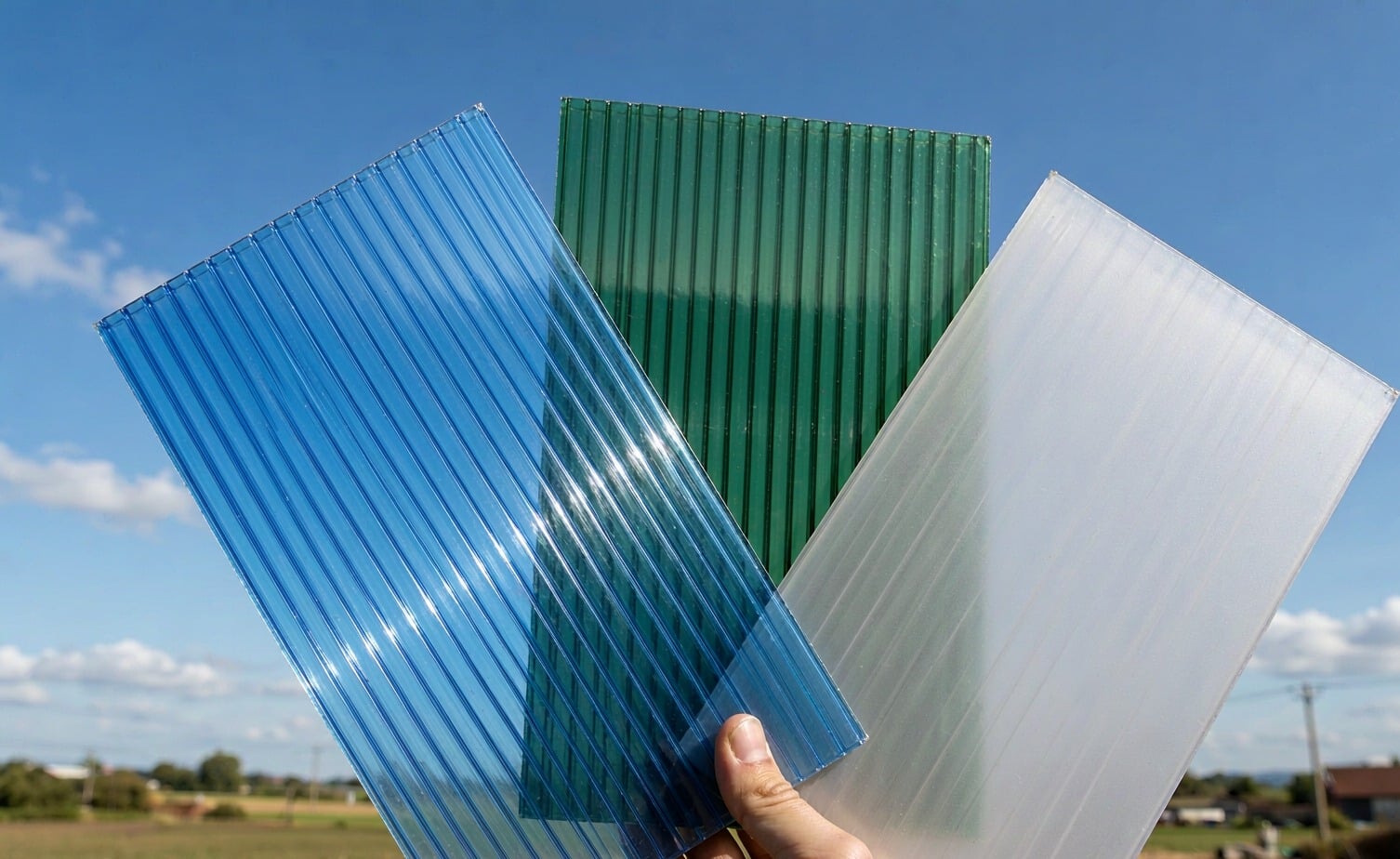
What Are the Core Optical and Thermal Requirements for Greenhouse Polycarbonate Sheets?
How Do Multi-Wall Polycarbonate Sheets Compare to Single-Layer Polymer Panels?
What Are the Material Advantages of Pingyun PVC Roof Sheet Solutions in Agricultural Buildings?
How Does UV Degradation Impact Greenhouse Panel Service Life?
How Should Agricultural Contractors Verify Panel Specifications Prior to Installation?
Conclusion
FAQ
References and Standards
Specifying lightweight panels for horticultural environments requires balancing photosynthetic photon flux, thermal retainment, structural load capacity, and impact resistance. Unlike conventional industrial cladding, greenhouse materials must actively foster plant growth while remaining impervious to harsh environmental conditions.
Photosynthetically Active Radiation (PAR) Transmission: High-grade panels must maximize the passage of light within the 400 to 700 nanometer waveband to support plant photosynthesis.
Light Diffusion: Diffused light scatters throughout the plant canopy, reaching lower leaves, preventing hot spots, and reducing canopy burning.
Thermal Isolation: Insulation reduces night-time heat radiation, decreasing overall HVAC and boiler fuel consumption in controlled environment agriculture.
When sourcing materials, agricultural engineers look at structural rib density, anti-drip internal surface treatments, and UV-blocking co-extrusion technology. Advanced manufacturing processes ensure panels maintain optical clarity without yellowing or becoming brittle under intense solar exposure.
A central specification decision for agricultural planners involves choosing between multi-wall polycarbonate configurations, standard corrugated profiles, and alternative polymer panels. While multi-wall sheets excel at retaining internal heat, solid or corrugated profiles offer specific structural and daylighting benefits depending on regional climate conditions.
Multi-wall polycarbonate sheets greenhouse installations feature hollow air channels that act as thermal barriers. These air pockets significantly reduce U-factors compared to single-pane glass. Corrugated profiles, on the other hand, provide superior structural rigidity across long span distances and facilitate rapid rainwater runoff.
| Specification Parameter | Multi-Wall Polycarbonate Sheet | Corrugated Polycarbonate Sheet | Pingyun PVC Roof Sheet | Pingyun ASA PVC Roof Tiles |
| Primary Material | Polycarbonate Polymer | Polycarbonate Polymer | Polyvinyl Chloride (PVC) | PVC with ASA Co-extrusion |
| Light Transmission | High (70% - 82%) | Superior (85% - 90%) | Semi-Transparent / Opaque | Opaque |
| Thermal Insulation | Superior (Low U-Value) | Moderate | High (Low Thermal Mass) | Superior (Multi-Layer Core) |
| Impact Strength | Extremely High | High | High | High |
| Corrosion Resistance | Moderate to High | Moderate to High | Exceptional (Acid/Alkali) | Exceptional |
| Primary Application | Commercial Greenhouse Roofs | Skylights & Sidewalls | Farm Storage & Processing | Agricultural Offices & Residences |
While clear polycarbonate panels dominate crop-growing zones, supporting agricultural infrastructure—such as packing sheds, equipment storage, livestock housing, and fertilizer storage—demands superior chemical and corrosion resistance. In these auxiliary zones, pingyun pvc roof sheet and pingyun pvc roof tiles deliver distinct operational advantages.
Layer 1 - Weather-Resistant ASA Surface: Co-extruded with premium Acrylonitrile Styrene Acrylate (ASA) resin to block UV degradation, retain color fastness, and prevent surface chalking.
Layer 2 - Structural Polymer Core: Formulated with high-density PVC to damp noise from heavy rainfall and maintain structural integrity against thermal expansion.
Layer 3 - Anti-Corrosion Under-Layer: Specifically engineered to resist chemical fumes, high humidity, ammonia gases, and acid-alkali chemical vapors common in agricultural facilities.
By utilizing lightweight pingyun pvc roof tiles for administrative and storage structures adjacent to the main greenhouse, facility managers lower structural purlin requirements while securing long-term protection against aggressive agricultural atmospheres.
Unprotected synthetic polymers suffer severe degradation when exposed to continuous solar radiation. Photodegradation breaks down polymer chains, causing yellowing, loss of light transmission, and loss of impact resistance over time.
Surface Co-Extrusion: Quality panels incorporate a thick, co-extruded UV absorber layer on the sun-facing side. This layer absorbs harmful ultraviolet rays before they break down the base polymer matrix.
Condensation Control: Anti-fog or anti-drip coatings applied to the interior surface reduce water droplet formation. Surface condensation is converted into a continuous thin water film that runs down the slope, preventing light loss and preventing cold water droplets from falling onto delicate crops.
Thermal Movement Management: Synthetic panels expand and contract significantly more than steel or glass. Correct fastener hole sizing and EPDM rubber washer placement prevent stress cracking around fixing points over seasonal temperature cycles.
Before committing to large-scale material procurement, agricultural contractors and project managers should conduct thorough compliance checks against project criteria:
Light Transmission Testing: Request spectrophotometer data verifying PAR transmission values across the required spectrum.
Impact and Hail Rating: Ensure panels carry certified hail-impact test ratings to withstand extreme weather events.
Fire Safety Compliance: Verify flame-retardant classifications (such as Class B1 fire ratings) to satisfy local commercial building codes.
Thickness and Weight Verification: Measure wall thickness, rib density, and panel weight using precision instruments to confirm manufacturing consistency.
Selecting the proper polycarbonate sheets greenhouse system requires balancing optical performance, thermal efficiency, and mechanical durability. While light-transmitting polycarbonate sheets serve as the foundation for crop growth zones, specifying complementary pingyun pvc roof sheet and pingyun pvc roof tiles across auxiliary farm facilities provides a complete, corrosion-resistant, and low-maintenance structural solution for modern agricultural operations.
Q1: What makes polycarbonate sheets preferred for greenhouse construction?
A1: Polycarbonate sheets offer high impact strength, light diffusion, and thermal insulation compared to traditional glass or film. They resist hail damage, scatter daylight evenly throughout the plant canopy, and help lower heating costs.
Q2: Can Pingyun PVC roof sheet materials be used inside a greenhouse facility?
A2: Pingyun PVC roof sheet products are ideal for processing areas, packing houses, chemical storage rooms, and livestock structures within a greenhouse complex where full shading, acoustic dampening, and high chemical/ammonia resistance are required.
Q3: How does light diffusion benefit greenhouse crop yields?
A3: Diffused light penetrates deeper into the plant canopy, illuminating lower leaf layers and preventing severe heat spots on top foliage. This uniform light distribution enhances overall photosynthesis rates and improves crop quality.
Q4: How should polycarbonate greenhouse panels be maintained?
A4: Panels should be cleaned periodically using mild soap, warm water, and soft sponges. Avoid abrasive cleaners, alkaline solutions, or dry wiping, which can scratch the UV protection layer and anti-drip internal coatings.
ASTM D1003: Standard Test Method for Haze and Luminous Transmittance of Transparent Plastics.
EN 16153: Light Transmitting Flat Multiwall Polycarbonate Sheets for Internal and External Roofs, Walls, and Ceilings.
ISO 9001: Quality Management Systems — Requirements for Agricultural Material Extrusion.
Pingyun Product Technical Manual: Specifications for Industrial PVC Cladding and Agricultural Roof Tiles.
Copyright © 2025 by Techos New Material Co.,Ltd.
 EN
EN