
When a building project requires a practical roof covering, corrugated roofing sheets are often one of the first product categories considered.
But choosing corrugated roofing sheets is not as simple as selecting a color and thickness.
The term corrugated roofing sheets describes a broad group of roofing products with different materials, profiles, structures, thicknesses, widths, surface treatments, and applications. A sheet designed for a warehouse may have a different specification from one intended for greenhouse daylighting. A residential roof may require different considerations from a factory exposed to corrosive substances.
This is why two products can both be called corrugated roofing sheets while having very different specifications and prices.
For buyers, the important question is not simply:
Which corrugated roofing sheet is the best?
A more useful question is:
Which corrugated roofing sheet matches the building, environment, roof structure, and purchasing requirements of the project?
That question leads to a much more practical selection process.
Pingyun's published product information includes PVC and UPVC corrugated roofing sheets, ASA-related roofing products, translucent PVC/UPVC roofing sheets, and multilayer roofing products. Its product listings also identify different models and profiles, including R101, T1070, T1130, and T900.
However, these products do not all have the same specifications.
For example, one product listing identifies R101 with a width of 1070 mm, while another identifies T1130 with a width of 1130 mm. The translucent T900 product is presented with a different width range and application. Thickness options also vary by product.
Therefore, this guide focuses on how to understand the product category, how to compare specifications correctly, and how to use Pingyun's documented product information without confusing one model with another.
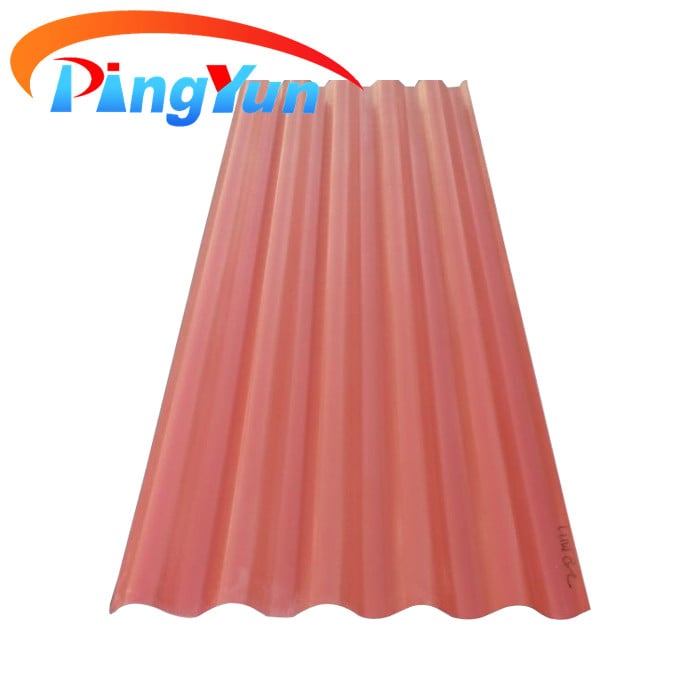
Corrugated roofing sheets are profiled panels used as roof coverings.
Instead of being completely flat, the sheet has a repeated shape such as a wave, rib, arch, or trapezoidal profile.
The profile gives the sheet its characteristic appearance and is an important part of its technical specification.
The word corrugated, however, does not identify the material by itself.
A corrugated roofing sheet can belong to different material categories. Metal, PVC, UPVC, translucent plastic, and other roofing materials may be manufactured in profiled forms.
This article focuses primarily on PVC and UPVC corrugated roofing products documented in Pingyun's product information.
For a buyer, the first important distinction is therefore:
Profile is not the same thing as material.
A product can have a corrugated profile while still having a completely different material structure from another corrugated product.
That is why a quotation request should not simply say:
Corrugated roofing sheets.
It should provide enough information for the supplier to identify the exact product.
At minimum, the buyer should normally specify:
If the project has special requirements, the buyer should also provide them.
For example:
The more complete the specification, the more useful the quotation will be.
Corrugated roofing sheets are used because their profiled construction can provide a practical roof covering for a variety of buildings.
The actual reason for selecting them depends on the project.
For one building, corrosion resistance may be the main consideration.
For another, heat insulation may be more important.
A greenhouse may prioritize light transmission.
A residential building may require a particular appearance.
A warehouse may require long sheets and straightforward installation.
An industrial building may need a roofing material that is suitable for a specific environmental exposure.
This means there is no single reason why corrugated roofing sheets are selected.
Pingyun's product information reflects this variety.
Its roofing listings include products for houses, warehouses, factories, workshops, farm buildings, villas, greenhouses, and daylighting applications.
That range is useful because it shows that the product category is not limited to one type of building.
At the same time, application information should not be interpreted as a guarantee that every model is suitable for every building.
The exact product still needs to be matched to the project.
The profile changes the geometry of the sheet.
A flat panel and a profiled panel made from a similar material do not behave in exactly the same way because the shape of the panel affects its structural characteristics and interaction with supports.
However, profile alone does not determine the allowable roof span.
The actual roof system depends on multiple factors, including:
Therefore, buyers should be careful with statements such as:
This profile can span any distance.
That is not a responsible generalization.
Instead, the supplier should provide the recommended installation information for the exact product.
Pingyun's published information includes model-specific support information for some products.
For example, the T1070 listing identifies a maximum purlin distance of 1200 mm.
The T1130 listing also identifies a maximum purlin distance of 1200 mm.
Those values should remain associated with the relevant product information rather than being treated as a universal rule for all corrugated roofing sheets.
The term corrugated roofing sheets describes shape rather than one material.
Common roofing categories can include metal and plastic-based products.
Pingyun's published roofing products include:
The material structure matters because it affects how the product should be evaluated.
For example, some Pingyun listings describe the material as PVC+UPVC+ASA, while another identifies ASA+PVC and UPVC.
These descriptions belong to individual product listings.
A buyer should therefore avoid creating one universal “Pingyun material specification” by combining information from multiple pages.
The safest approach is always:
Model first, specification second.
PVC corrugated roofing sheets are plastic roofing panels manufactured with a profiled surface.
Pingyun's product information includes PVC corrugated roofing products with different profiles, dimensions, thicknesses, colors, and applications.
One documented R101 listing identifies:
The same product information identifies characteristics including anti-corrosion, heat insulation, sound-proof, lightweight, and fire-proof performance.
These specifications should be treated as R101 product information.
They should not automatically be copied into another model.
That distinction becomes particularly important when a website has a general category page.
A category page can describe the overall product family, but model-specific numbers should remain attached to the relevant model.
UPVC corrugated roofing sheets are another important product category in Pingyun's published information.
Several Pingyun product pages describe UPVC roofing products with different profiles and configurations.
The T1070 product, for example, is listed with:
The product listing identifies features including anti-UV, heat insulation, fire-related performance, sound insulation, anti-corrosion, lightweight construction, impact resistance, and color stability.
Again, these details should be interpreted as information for the specific product listing.
A general statement such as “all Pingyun UPVC sheets have exactly these specifications” would go beyond the documented information.
ASA appears in several Pingyun roofing product descriptions.
In these listings, ASA is associated with the roofing surface or material structure.
The published product information connects ASA-related products with characteristics such as color stability and UV-related protection.
For a buyer, ASA should therefore be treated as one part of the product construction rather than the entire product specification.
When comparing ASA roofing sheets, ask:
This prevents the common mistake of comparing one supplier's complete product against another supplier's material label.
Translucent corrugated roofing sheets allow natural light to enter a building.
They are particularly relevant when the roof itself is expected to contribute to daylighting.
Pingyun's T900 product is documented as a translucent PVC/UPVC roofing product for greenhouse and warehouse daylighting applications.
The product listing identifies:
These figures are specific to the T900 product listing.
They should not be used as universal values for all translucent corrugated roofing sheets.
For a daylighting project, the buyer should also consider the building's ventilation, heat control, roof orientation, and overall daylighting design.
Multilayer roofing sheets use more than one material layer or structural layer.
Pingyun's published information includes a T1130 multilayer UPVC roofing product.
The listing identifies:
The product is described with characteristics including anti-rust, heat insulation, soundproof, fire-proof, and lightweight performance.
The listing also describes color stability and corrosion resistance.
The key purchasing principle remains the same:
Multilayer does not automatically mean every multilayer product has the same specification.
The exact structure and performance need to be confirmed for the selected model.
A corrugated roof sheet may have a wave-shaped profile, while a trapezoidal profile generally has straighter inclined sides and repeated raised ribs.
However, terminology can vary between manufacturers and markets.
Pingyun's product listings use terms such as corrugated, trapezoidal, arched, and other profile descriptions.
Therefore, when ordering, do not rely only on terminology.
Use:
This is particularly important for replacement roofing.
A replacement sheet that looks similar may not fit the existing supporting structure if the profile geometry is different.
The profile affects:
It may also influence the amount of material required for a roof.
This is why profile should be specified before a final quotation.
For example, a buyer who says:
We need PVC corrugated sheets, 2 mm.
has not yet specified the complete product.
A more complete request would identify the profile or model.
That could be:
PVC/UPVC corrugated roofing sheet, T1130 profile, 2.0 mm thickness.
The supplier can then quote a specific product rather than guessing.
Width should be treated carefully because different suppliers may present width differently.
A product page may show:
These terms should not be treated as interchangeable.
Pingyun product listings provide examples of different width specifications.
R101 is listed with a width of 1070 mm.
T1070 is listed with a width of 1070 mm.
T1130 is listed with a width of 1130 mm.
T900 is presented with a wider range in its translucent product description.
The buyer should therefore request the exact width for the quoted product.
This is one of the most important details in roofing procurement.
The overall width is the physical width of the sheet.
The effective width is the usable roof coverage after overlap.
If a sheet is installed with a side overlap, the full physical width does not become roof coverage.
Therefore, the quantity of sheets should not be estimated from overall width alone.
For a large project, even a relatively small difference between overall width and effective width can influence the material quantity.
A good quotation should state:
Overall width
and
Effective coverage width
when applicable.
This makes supplier comparison much easier.
Thickness should be selected according to the product specification and project requirements.
Pingyun's published products show that different models have different thickness ranges.
Examples include:
These differences are important.
There is no single thickness that can be described as the universal Pingyun corrugated roofing specification.
Thickness should be considered together with:
No.
Thickness is important, but it is not the only factor.
A thicker sheet with an unsuitable profile or application may not be the correct product.
A thinner product may be intentionally designed for a different application, such as a translucent daylighting section.
The buyer should therefore ask:
What thickness is appropriate for this exact model and project?
rather than:
What is the thickest sheet available?
A thicker sheet may also increase material cost and weight.
The objective is not maximum thickness.
The objective is the correct specification.
Heat insulation is one of the most frequently mentioned features in Pingyun's corrugated roofing product information.
For example, the R101 listing states that the indoor and outdoor temperature difference could reach 8–10°C and describes the product as providing heat insulation.
That is a product-specific published statement.
It should not be turned into a universal claim that every Pingyun corrugated roofing sheet reduces indoor temperature by 8–10°C.
Actual building temperature depends on many factors, including:
For projects with strict thermal requirements, the buyer should request the technical basis for the product-specific claim.
Anti-corrosion performance is another recurring feature in Pingyun roofing listings.
The R101 product description states that PVC roof sheets are highly resistant to chemical corrosion from acids and alkalis.
Another Pingyun multilayer roofing listing describes resistance to long-term acid, alkali, and salt corrosion.
This characteristic can be relevant to buildings exposed to challenging environments.
However, “anti-corrosion” should not be interpreted as resistance to every chemical under every condition.
Chemical resistance can depend on:
If the roof is installed near a chemical process, provide the supplier with information about the actual environment.
Roofing sheets are exposed directly to sunlight.
UV resistance therefore becomes an important consideration for many outdoor applications.
Pingyun product listings describe UV resistance or UV protection for several corrugated roofing products.
T1070, for example, is described with anti-UV and color-stability characteristics.
T1130 is also described with UV protection and color stability.
The exact UV-related claim should always remain attached to the relevant product.
For a project in a high-solar-exposure environment, buyers should ask for:
Color is not only an aesthetic choice.
For outdoor roofing, long-term color appearance can also be part of the product specification.
Pingyun product information describes color stability for several roofing products.
One multilayer roofing listing describes long-lasting color performance under exposure to UV, high temperature, and freezing conditions.
A buyer should still distinguish between:
These are not necessarily the same thing.
If appearance is important, the quotation should clearly identify the selected color and applicable warranty.
Impact resistance is mentioned in several Pingyun product descriptions.
This characteristic can be relevant to roofing exposed to weather or accidental impact.
One Pingyun product listing states a load-related figure of up to 150 kg.
However, that figure should not be turned into an unsupported engineering claim.
It should not automatically be interpreted as:
The product listing and technical documentation should be checked for the exact meaning of the stated value.
If the roof has specific structural requirements, the project should be evaluated by the appropriate engineering professional.
Fire performance is an important issue for many buildings.
Pingyun product listings describe certain roofing products as fire-proof or fire-resistant and refer to fire-related product characteristics.
However, the word “fire-proof” on a product page is not necessarily the same as a project-specific fire classification.
A project may require a particular standard or classification.
Therefore, if fire compliance is mandatory, request:
Do not assume that a document associated with one product applies automatically to another model.
Some Pingyun corrugated roofing products are described as soundproof or sound insulating.
One product listing states approximately 30 dB sound reduction compared with steel roofs.
That is useful product information, but it should remain attached to the relevant product and test context.
Actual acoustic performance can also depend on:
If acoustic performance is important, request model-specific documentation rather than relying on a general statement.
Lightweight construction is another feature identified in Pingyun product information.
The R101 and T1070 listings describe lightweight characteristics.
A separate Pingyun hollow roofing listing provides a specific weight of 5.6 kg/m² for that particular product configuration.
This demonstrates why weight should always be linked to the exact product.
Lightweight construction can make handling easier, but it does not eliminate the need for proper roof design.
A lightweight roof still requires:
Waterproofing is a system issue as much as a material issue.
Pingyun product descriptions include waterproofing among the advantages of certain roofing products.
But roof performance depends on installation.
Potential leakage points include:
A product described as waterproof does not mean an incorrectly installed roof will never leak.
This is why installation instructions should be considered part of the purchasing process.
Outdoor roofing must face changing environmental conditions.
Pingyun product descriptions include weather-related characteristics for certain roofing products.
For buyers, the relevant question is not simply:
Is this sheet weather resistant?
The better question is:
Is this exact product suitable for the weather conditions at my project location?
The buyer should identify:
The supplier can then confirm the product configuration.
A warehouse roof often covers a large area, so material efficiency and installation become important.
First identify the warehouse environment.
Is it:
If natural light is needed, translucent sections may be considered.
Pingyun's T900 product is specifically described for warehouse daylighting.
If daylighting is not required, opaque corrugated products may be more appropriate.
The buyer should then compare:
Factories can expose roofing materials to more demanding conditions than ordinary buildings.
The first question should be:
What is happening inside and around the factory?
A general workshop may have relatively ordinary exposure.
A chemical-processing facility may have a completely different environment.
A factory in a hot climate may also have stronger thermal requirements.
For factory projects, consider:
Pingyun product listings include factory and workshop applications for several corrugated roofing products.
The exact model should still be confirmed.
Residential projects often place more emphasis on appearance.
The profile and color may be important.
Pingyun's roofing range includes corrugated products as well as Roma-style and Spanish-style roofing products.
A residential buyer should therefore decide whether the project needs:
Heat insulation can also be relevant.
Rain noise may matter when rooms are directly below the roof.
The buyer should therefore compare the exact product characteristics rather than choosing solely from photographs.
Agricultural buildings can experience:
Corrosion resistance can therefore become an important consideration.
Pingyun product information identifies farm-house and agricultural applications for several roofing products.
But different farm buildings have different requirements.
A livestock building and an equipment shed should not automatically receive the same roofing specification.
If daylighting is required, translucent roofing can also be considered.
Greenhouses are special because light is part of the building's function.
An opaque roofing sheet may not be suitable where natural light is required throughout the roof.
Pingyun's T900 translucent product is documented for greenhouse and warehouse daylighting.
The product listing states a transmission rate of 50–70%.
A greenhouse buyer should also consider:
The roof should be considered as part of the greenhouse environment rather than simply as a waterproof cover.
Translucent roofing can be considered when daylighting is part of the building design.
Potential applications include:
The important specification is not simply “transparent.”
The buyer should determine the required light transmission.
Pingyun's T900 product listing states 50–70% transmission.
That figure should remain specific to the T900 product unless another model is separately documented.
Climate can change the priority of the product specification.
In a hot, high-UV environment, heat insulation and UV protection may deserve greater attention.
In a humid environment, corrosion resistance and weather resistance may become more relevant.
In a region with strong wind or snow, structural design becomes particularly important.
In a rainy climate, drainage and installation details deserve attention.
The buyer should provide the project location when requesting a quotation.
This gives the supplier more context for product selection.
Roof area is not always the same as the number of square meters of sheet that must be purchased.
The calculation can be affected by:
For simple roofs, quantity estimation may be relatively straightforward.
For complex roofs, a roof plan or layout drawing is preferable.
The supplier can then help confirm the material quantity.
Sheet length should balance installation and transportation.
Long sheets can reduce the number of transverse joints.
But long sheets also require:
Pingyun product listings for several roofing products refer to customized lengths.
Some listings identify maximum lengths associated with 20-foot and 40-foot containers.
These values should be reconfirmed for the exact product.
Pingyun's product listings show multiple color options.
The T1070 listing, for example, identifies blue, red, green, brick red, white, and customized colors.
T1130 information also identifies multiple colors and customization.
Color should be specified clearly in the quotation.
For a large project, also confirm:
Do not assume that every color is available for every model.
Purlin spacing is a product-specific installation consideration.
Pingyun's T1070 and T1130 listings identify maximum purlin distance information.
This is useful when planning installation.
However, buyers should not take one model's support spacing and apply it to another model.
The exact product documentation should be used.
Local wind and snow conditions may also require project-specific engineering.
Overlap is necessary because corrugated roofing sheets are installed next to one another.
The overlap affects:
The exact overlap should follow the product's installation guidance.
Do not assume that every profile requires the same overlap.
When comparing supplier quotations, ask whether the quoted quantity is based on:
This avoids quantity misunderstandings.
Installation should be considered before ordering.
Confirm:
A product may be technically suitable but still perform poorly if installed incorrectly.
Ask the supplier for installation instructions for the exact model.
A complete quotation should identify the product clearly.
This structure makes quotations easier to compare.
The most important rule is:
Compare equivalent specifications.
For example, these are not necessarily equivalent:
| Supplier A | Supplier B |
|---|---|
| T1130 | T1070 |
| 1130 mm | 1070 mm |
| 2.0 mm | 2.0 mm |
| ASA surface | Different surface |
| Customized color | Standard color |
Both may be called “2 mm PVC corrugated roofing sheets.”
But they are not necessarily the same product.
The comparison should therefore begin with technical equivalence.
Price differences can come from:
Commercial terms also matter.
Pingyun's supplier information lists FOB, CFR, CIF, DDP, FCA, and EXW among available trade terms.
A price quoted under EXW should not be compared directly with a CIF price without adjusting for included costs.
A supplier cannot know the exact product from price alone.
“2 mm” does not identify the product.
This can affect the quantity required.
Do not combine R101 dimensions with T1130 performance data.
“Fireproof” or “impact resistant” may require technical clarification.
The sheet is part of a roof system.
Long sheets require careful logistics planning.
EXW, FOB, and CIF do not represent the same cost basis.
A photograph cannot confirm thickness or material composition.
Published warranty periods vary by product listing.
Before purchasing, ask:
A good RFQ does not need to be long.
It needs to be complete.
A practical RFQ should include:
This format reduces back-and-forth communication.
A product page is useful for initial research.
For an actual order, more detailed documents may be required.
Useful documents can include:
The important point is matching the document to the model.
If the quotation says T1130, the technical document should also identify T1130.
If the product changes, the documentation should be updated.
Every numerical performance claim should be checked against the exact product.
For example:
8–10°C
This appears in a specific Pingyun R101 listing.
30 dB
This appears in specific Pingyun roofing product information.
150 kg
This appears in specific product listings and should be interpreted according to the wording of the listing.
50–70% transmission
This appears in the T900 translucent product listing.
5.6 kg/m²
This appears in a specific hollow roofing product listing.
These numbers should not be moved between models without confirmation.
This is one of the most important rules when creating technical SEO content for building materials.
Pingyun's published catalog includes a broad roofing range.
The catalog includes:
Within the corrugated category, individual product listings provide different model numbers and specifications.
This means Pingyun's product range should be understood as a portfolio rather than one universal corrugated roofing sheet.
That distinction is useful for buyers because it allows product selection to start from the project requirement.
The Pingyun R101 listing identifies:
The listing also describes:
The listing provides a 30-year warranty statement.
These details belong to that published R101 product record.
They should not be generalized to every Pingyun roofing product.
Pingyun's T1070 listing identifies:
The product is described for residential houses, villas, warehouses, and factories.
The listed features include:
Again, these are product-specific published details.
The T1130 product information identifies:
A separate multilayer T1130 listing identifies 1.5 mm, 2.0 mm, 2.5 mm, and 3.0 mm thickness options and describes applications including house, warehouse, workshop, plant, and pavilion.
This demonstrates that even the same model family can appear in different product configurations.
The quotation should therefore identify the exact product configuration.
The T900 listing is different from the general opaque corrugated products.
It is described as a translucent PVC/UPVC roof sheet.
The published information includes:
The listing also describes anti-corrosion performance and weather resistance for humid regions.
This makes T900 particularly relevant when daylighting is part of the project requirement.
A useful model comparison should not ask:
Which one is best?
Instead, ask:
Which product matches the project requirement?
For example:
| Requirement | Product information to check |
|---|---|
| General opaque roofing | Profile, thickness, width, corrosion, UV |
| Warehouse | Length, coverage, heat, installation |
| Factory | Corrosion, fire documentation, heat |
| Residential | Appearance, color, heat, acoustic considerations |
| Greenhouse | Light transmission, UV, heat, installation |
| Daylighting | Translucency and transmission |
| High-exposure environment | Corrosion and UV documentation |
This approach avoids turning product selection into a generic ranking.
The application should define the starting point.
Start with:
Start with:
Start with:
Start with:
Start with:
This is especially important when a supplier has many product pages.
Suppose one product has:
and another has:
It would be incorrect to create a new specification using:
1130 mm width + 30-year warranty
unless the supplier confirms that combination.
The same rule applies to:
Each value must remain connected to its source product.
International purchasing adds another layer of complexity.
The buyer has to consider:
Pingyun's supplier information lists several Incoterms, including:
This means the buyer should specify the preferred commercial basis when requesting a quotation.
A price without an Incoterm is difficult to compare.
Long roofing sheets require special attention during export.
Pingyun product listings provide examples of container-related maximum lengths.
Some product descriptions state:
These values are product-specific references.
Before ordering, confirm:
This helps prevent a quotation from being technically correct but logistically impractical.
International roofing quotations can use different Incoterms.
A buyer should understand whether the quoted price is:
These terms affect which costs are included.
For example, a CIF price includes cost, insurance, and freight to the named destination port under the applicable terms, while an EXW quotation represents a different cost basis.
Therefore:
Do not compare unit prices until the Incoterm is aligned.
Warranty is useful, but it must be read carefully.
Pingyun product listings show different warranty statements.
Examples include:
These statements appear across different product listings.
Therefore, there is no single warranty period that should be presented as applying to every Pingyun corrugated roofing sheet.
Ask for the written warranty applicable to the exact model.
Also check:
Pingyun product listings identify customization options for several roofing products.
Customization can include:
However, the exact options depend on the model.
The buyer should confirm whether customization affects:
Customization should be treated as a commercial and technical requirement, not simply as a checkbox.
Product listings indicate that samples are available for some Pingyun roofing products.
For buyers, a sample can help confirm:
However, a small sample cannot confirm every performance characteristic of the final roof.
For a large order, the sample should be matched to the final model and specification.
Technical documentation becomes more important as the project becomes more complex.
Ask for the applicable:
If the project has a mandatory standard, tell the supplier which standard is required.
This is more useful than simply asking:
Do you have certificates?
The supplier needs to know what documentation the project requires.
Installation information should be model-specific.
The buyer should look for:
The installation guide should match the product being purchased.
Photographs are useful for:
But they cannot reliably confirm:
Therefore, a photograph is a starting point, not a technical specification.
A professional comparison table should use the same fields for every supplier.
| Specification | Supplier A | Supplier B | Supplier C |
|---|---|---|---|
| Model | |||
| Material | |||
| Profile | |||
| Overall width | |||
| Effective width | |||
| Thickness | |||
| Length | |||
| Surface | |||
| Color | |||
| Weight | |||
| UV protection | |||
| Heat insulation | |||
| Corrosion resistance | |||
| Impact performance | |||
| Fire documentation | |||
| Sound performance | |||
| Warranty | |||
| MOQ | |||
| Lead time | |||
| Incoterm | |||
| Packaging |
This makes differences visible.
Before placing the order, confirm:
Model
Material
Profile
Surface
Width
Effective width
Thickness
Length
Color
Finish
UV
Heat
Corrosion
Impact
Fire
Sound
Light transmission if applicable
Purlin spacing
Fasteners
Overlap
Accessories
Quantity
Price
Incoterm
MOQ
Lead time
Packaging
Warranty
Datasheet
Drawing
Installation guide
Test report
Certificate if required
A useful inquiry can look like this:
We are sourcing PVC/UPVC corrugated roofing sheets for a warehouse project. Please recommend a suitable product based on our project conditions and quote the exact model, material, profile, thickness, overall width, effective width, available length, color, packing, warranty, lead time, and Incoterm. Please also provide the technical datasheet, installation information, and relevant test reports or certificates for the quoted model.
This is much more useful than:
Please quote your PVC roof sheet.
The supplier has enough information to understand the buying requirement.
Before placing an order, compare the purchase order with the quotation.
Check:
The product in the purchase order should match the product in the final quotation.
This simple check can prevent many specification disputes.
Technical SEO content should not turn every supplier statement into a universal claim.
For example:
Correct:
Pingyun's R101 product listing states an indoor-outdoor temperature difference of 8–10°C.
Incorrect:
All Pingyun corrugated roofing sheets reduce indoor temperature by 8–10°C.
Similarly:
Correct:
A Pingyun product listing describes approximately 30 dB sound reduction compared with steel roofs.
Incorrect:
Pingyun corrugated roofing sheets reduce rain noise by 30 dB.
The first statements preserve product context.
The second statements generalize the information.
For reliable technical content, product context matters.
They can be used in industrial buildings, but suitability depends on the exact product and building environment.
Pingyun product listings identify warehouses among the applications of several products.
Certain Pingyun products provide customization options, including color and length.
Several Pingyun listings provide customized length options.
Yes. Pingyun's T900 product is documented as a translucent PVC/UPVC roofing product for greenhouse and warehouse daylighting.
The available thickness depends on the exact model.
No. Thickness should be matched with the product profile, structure, application, and project requirements.
Not necessarily. Different buildings can have different requirements.
The selection process can be simplified into seven questions.
House, warehouse, factory, farm building, greenhouse, or another structure?
Humid, hot, corrosive, high-UV, rainy, windy, or cold?
If yes, consider translucent products.
Confirm the profile or model.
Confirm width, effective width, thickness, and length.
Confirm only the characteristics relevant to the project.
Confirm price basis, packaging, delivery, warranty, and documentation.
This framework keeps the selection process focused.
Corrugated roofing sheets are not a single standardized product.
They are a broad category that includes different materials, profiles, structures, thicknesses, widths, surfaces, and applications.
For buyers, the most important step is therefore not choosing a product based on the generic phrase “corrugated roofing sheets.”
The more useful process is to define the project first and then match the product.
The key specifications include:
Pingyun's published information includes several corrugated roofing product categories and model references.
R101 is listed with a 1070 mm width and multiple thickness options.
T1070 is also listed with a 1070 mm width and several thickness options.
T1130 is listed with a 1130 mm width.
T900 is documented as a translucent roofing product with greenhouse and warehouse daylighting applications.
These examples demonstrate why model-specific information matters.
A buyer should not combine specifications from different product pages unless the supplier confirms that the specifications apply to the same product configuration.
The same principle should be used when publishing technical content.
A reliable article should explain what the product can do, but it should also explain the limits of the available information.
For a real project, the final decision should be based on the exact product specification, technical documentation, installation requirements, project conditions, and applicable local construction requirements.
The objective is not simply to find a corrugated roofing sheet.
It is to find a product whose specification matches the building and whose quotation can be clearly verified.
Corrugated roofing sheets are profiled roof panels with repeated waves, ribs, or other shaped sections. The term describes the sheet profile rather than one specific material.
Corrugated roofing sheets can be made from different materials. Pingyun's published product information includes PVC, UPVC, ASA-related roofing products, translucent PVC/UPVC sheets, and multilayer roofing products.
Pingyun's published roofing information includes PVC/UPVC corrugated roofing sheets, translucent roofing sheets, multilayer roofing products, and different roofing styles and profiles.
Pingyun's published R101 listing identifies a PVC+UPVC+ASA roofing product with a 1070 mm width, thickness options from 1.5 to 3.0 mm, customized colors and lengths, and applications including residential buildings, villas, warehouses, and factories.
The Pingyun T1070 listing identifies a 1070 mm wide product with 1.5–3.0 mm thickness options, ASA+PVC and UPVC material description, customized length, and applications including residential buildings, warehouses, and factories.
The T1130 product is listed with a 1130 mm width and is described with PVC/UPVC and ASA-related material configurations. Published information includes multiple thickness options and applications such as residential and industrial buildings.
T900 is listed as a translucent PVC/UPVC roofing product with a trapezoidal profile. The product is described for greenhouse and warehouse daylighting applications.
The published T900 product description states a transmission rate of 50–70%. This value should be confirmed for the final product configuration.
Yes, several Pingyun product listings identify warehouses as applications. The exact model should be selected according to the roof structure, climate, daylighting requirements, and other project conditions.
Several Pingyun products are listed for factories and workshops. The exact model should be evaluated against the factory's environmental and technical requirements.
Certain Pingyun roofing products are listed for houses and villas. Product selection should consider profile, appearance, color, thermal requirements, installation, and local conditions.
Translucent corrugated roofing products can be used for daylighting applications. Pingyun's T900 product is specifically listed for greenhouse and warehouse daylighting.
The appropriate thickness depends on the exact model and project requirements. Pingyun listings show different thickness ranges for different products.
Several Pingyun product listings indicate customized lengths. The available length should be confirmed for the selected model and shipping method.
Yes, customization is indicated for several roofing products. The available colors and minimum order conditions should be confirmed for the exact model.
UV resistance or UV protection is identified as a feature of several Pingyun roofing products. The exact specification should be confirmed for the model being purchased.
Anti-corrosion performance is described in multiple Pingyun product listings. For a specific chemical environment, buyers should confirm compatibility with the exact product.
Lightweight construction is described as a feature of several products. Actual weight varies by model and configuration.
Heat insulation is identified as a feature in several product listings. One R101 listing provides a specific 8–10°C indoor-outdoor temperature difference claim. This figure should not be generalized to all products.
Some Pingyun product listings describe sound insulation or sound-proof performance. One listing states approximately 30 dB reduction compared with steel roofs. The exact model and test basis should be confirmed.
Fire-related performance is described for several products. If a project requires a specific fire classification, the applicable test documentation should be obtained for the exact model.
No. The profile, support spacing, fasteners, roof slope, environmental loads, and installation requirements all need to be considered.
Quantity depends on roof dimensions, effective width, overlap, roof geometry, cutting, and waste. For complex roofs, a roof layout is preferable.
Effective width is the portion of a sheet that provides actual roof coverage after the required overlap.
Because the number of sheets required depends on actual coverage, not simply the physical width of each sheet.
No. Compare equivalent technical specifications and commercial terms first.
They may have different profiles, materials, widths, surface treatments, warranties, packaging, or delivery conditions.
Include the building type, project location, roof area, material, profile or model, thickness, width, length, color, quantity, destination, and commercial requirements.
A sample can help confirm appearance, profile, color, and general product characteristics. For large projects, make sure the sample corresponds to the final product specification.
Depending on the project, request the technical datasheet, product drawing, installation instructions, test reports, certificates, and warranty documents applicable to the exact model.
No. Published Pingyun product listings contain different warranty statements. Warranty should therefore be confirmed for the exact model and quotation.
No. Different product listings have different dimensions, thicknesses, applications, and performance descriptions.
The most important step is to define the exact product configuration and make sure it matches the project requirements.
The article is based primarily on Pingyun's published product information and product listings, with model-specific information kept associated with the relevant product rather than generalized across the entire product range.
The main reference records include:
Pingyun's product listings contain model-specific specifications, and different listings may contain different warranty periods, dimensions, performance descriptions, or commercial information.
Therefore, this article does not treat every published number as a universal Pingyun specification.
For an actual purchase, the latest technical datasheet, quotation, warranty document, and other formal documentation for the exact product should take precedence over a general website article.
This is particularly important for:
A reliable corrugated roofing sheet specification should always identify the exact product or model to which the information applies.
Copyright © 2025 by Techos New Material Co.,Ltd.
 EN
EN