
Choosing greenhouse polycarbonate sheets sounds simple until the purchasing process actually begins.
A project may start with one basic requirement: find a transparent material for a greenhouse roof.
Then the questions begin.
Should the greenhouse use solid polycarbonate sheets or multi-wall sheets? Is a 4 mm sheet enough, or should the project use a thicker panel? Does higher light transmission always mean better performance? What is the difference between a double-wall and triple-wall sheet? Does UV protection matter? What about condensation? Should the roof and side walls use the same material?
And perhaps the most practical question of all:
Why can two suppliers quote very different prices for what appears to be the same greenhouse polycarbonate sheet?
The answer is that a greenhouse covering system is not defined by transparency alone.
The sheet structure, thickness, light transmission, insulation performance, UV protection, color, dimensions, installation method, climate, supporting structure, and expected service conditions all influence the final selection.
Pingyun's building-material product range includes roofing products, polycarbonate sheets, ceilings, wall panels, and flooring products. Within its polycarbonate range, the available product information covers solid sheets, hollow or multi-wall sheets, and corrugated polycarbonate products, with applications including greenhouses, skylights, warehouses, carports, and other daylighting structures.
That range is important because greenhouse projects are not all the same.
A small seasonal greenhouse does not necessarily need the same specification as a commercial agricultural greenhouse. A flower greenhouse may have different light requirements from a nursery greenhouse. A greenhouse in a cold climate may prioritize thermal insulation, while a greenhouse in a hot climate may place greater emphasis on ventilation, shading, and heat management.
This guide looks at greenhouse polycarbonate sheets from a practical purchasing perspective.
Instead of simply saying which product is “best,” it explains how to compare different sheet structures, what specifications matter, what questions to ask suppliers, what installation issues can cause problems later, and how to build a quotation request that allows different suppliers to be compared fairly.
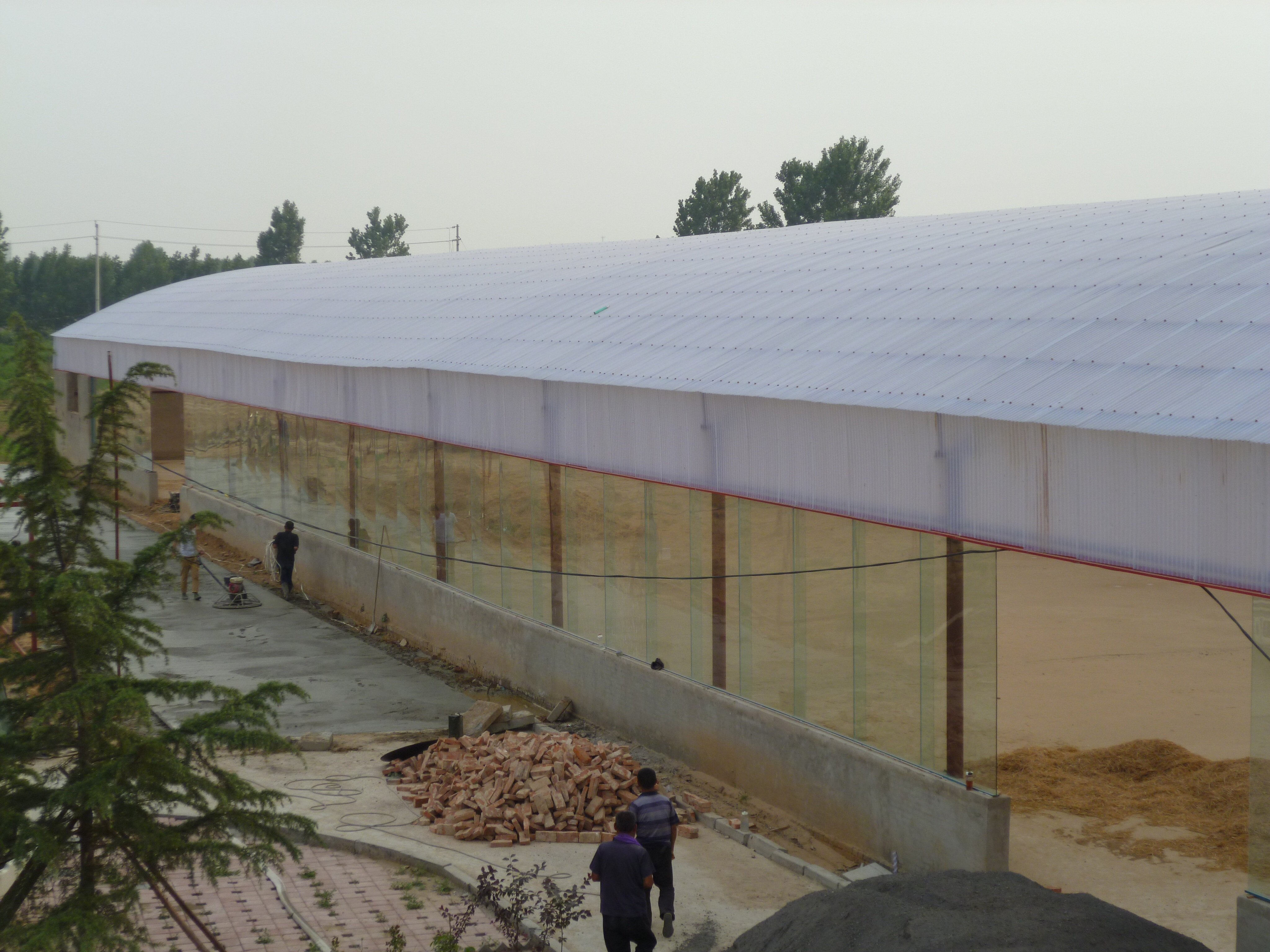
Greenhouse polycarbonate sheets are transparent or translucent building panels made from polycarbonate and designed for applications where daylighting, weather protection, and structural performance need to be considered together.
Unlike a simple plastic film, a rigid polycarbonate sheet can form part of a permanent or semi-permanent building envelope.
The exact construction depends on the product.
A polycarbonate sheet can be manufactured as a solid panel, a hollow multi-wall panel, or a corrugated panel. These different structures can produce different combinations of transparency, weight, thermal performance, impact resistance, rigidity, and installation requirements.
This is why the phrase “polycarbonate sheet” does not describe one single product.
For a greenhouse buyer, the first step should therefore be to identify the structure.
A solid sheet has a continuous panel structure.
A hollow or multi-wall sheet contains internal ribs and air spaces.
A corrugated sheet uses a profiled surface to increase rigidity.
All three can be used for daylighting applications, but they are not interchangeable in every project.
Pingyun's product information includes polycarbonate solid sheets for applications such as greenhouses, skylights, ceiling lighting, warehouses, and carports. Its multi-wall product information includes greenhouse and daylighting applications, while corrugated polycarbonate products are also presented for greenhouse and skylight applications.
This means that a buyer should not begin the quotation process by asking only:
“How much is your polycarbonate sheet per square meter?”
A more useful first question is:
“Which polycarbonate structure is appropriate for my greenhouse design?”
That single change can make the rest of the purchasing process much clearer.
A greenhouse covering has several jobs at the same time.
It needs to allow natural light into the growing area.
It needs to separate the internal environment from outdoor weather.
It needs to remain stable during outdoor exposure.
It needs to work with the greenhouse frame.
It may also need to help control heat loss and condensation.
These requirements create a difficult balance.
If a material is completely opaque, it cannot provide the natural daylight that makes a greenhouse different from an ordinary enclosed building.
If a material provides excellent transparency but performs poorly under outdoor exposure, the greenhouse may face maintenance or replacement issues.
If a material is very strong but unnecessarily heavy, the supporting structure and installation system may become more expensive.
If insulation is improved without considering light transmission, the growing environment may be affected in another way.
Polycarbonate is therefore attractive because it can combine several useful characteristics within one material system.
The exact performance, however, depends on the specific sheet.
This distinction matters.
A buyer should not assume that every polycarbonate sheet has identical light transmission, insulation performance, UV protection, impact resistance, or service conditions.
The product specification still needs to be checked.
For greenhouse procurement, the right question is not:
“Is polycarbonate good?”
It is:
“Which polycarbonate construction matches this greenhouse?”
That is a much more useful question.
Polycarbonate is a technical engineering plastic rather than an ordinary flexible plastic film.
This difference becomes important when the material is used as a building envelope.
Rigid polycarbonate sheets can be manufactured in several structural forms, including solid and multi-wall constructions.
The internal geometry of a multi-wall panel can create air spaces within the sheet.
The result is a product that behaves differently from a simple single-layer plastic covering.
Polycarbonate sheets can also be manufactured in different thicknesses, widths, lengths, colors, and surface treatments.
Pingyun product information shows examples of customized dimensions and colors across several polycarbonate product types.
For example, one Pingyun multi-wall product listing specifies thicknesses from 4 mm to 25 mm and widths from 1,200 mm to 2,100 mm, with customized lengths. Another solid polycarbonate product listing provides a different thickness and width range.
These figures should be treated as product-specific ranges rather than a universal specification for every greenhouse.
That distinction is essential.
A supplier may offer a 10 mm multi-wall sheet, but that does not mean every 10 mm multi-wall sheet from every manufacturer has the same internal structure or performance.
Thickness alone is not a complete product description.
This is one of the first decisions a greenhouse buyer should understand.
Solid sheets have a continuous material structure.
Visually, they can be closer to conventional transparent glazing than a multi-wall panel.
This can be useful when visual transparency is particularly important.
Pingyun product information includes solid polycarbonate sheets in thicknesses such as 0.8–2 mm for certain products, while another listing gives a broader range up to 12 mm.
The exact range depends on the specific product.
Solid sheets can be considered for greenhouses, skylights, ceiling lighting, carports, and other daylighting applications.
However, a buyer should not assume that a solid sheet is automatically the best choice simply because it looks more transparent.
For a large greenhouse, thermal performance and total project cost may be more important than visual clarity.
That is where multi-wall sheets become particularly relevant.
Multi-wall sheets use internal ribs and cavities.
The internal structure creates air spaces inside the panel.
This changes the relationship between weight, insulation, rigidity, and material usage.
Pingyun product information includes double-wall, triple-wall, and other multi-wall polycarbonate products.
A multi-wall panel can therefore be particularly interesting for larger greenhouse projects where thermal performance and lightweight construction need to be considered together.
However, the number of walls should not be treated as a simple ranking system.
More layers do not automatically mean that a product is correct for every greenhouse.
The project climate, structural design, light requirements, and budget still matter.
Corrugated sheets use a profiled geometry.
The profile increases the sheet's structural stiffness while retaining daylighting capability.
Pingyun product information includes corrugated polycarbonate sheets for greenhouse and skylight applications.
Corrugated panels may be particularly practical where the greenhouse or building already uses a profiled roofing system.
The main lesson is simple:
Solid, multi-wall, and corrugated sheets should be compared as different product structures, not just different thicknesses.
The terms describe the internal construction of hollow polycarbonate sheets.
A double-wall sheet generally has two main layers connected by internal ribs.
A triple-wall sheet contains a more complex internal structure.
Multi-wall products can contain additional internal chambers and reinforcement patterns.
The purpose of these internal spaces is not simply to make the panel look more complicated.
They influence how the panel behaves.
An internal air space can contribute to thermal insulation.
The internal geometry can also influence stiffness and weight.
This becomes particularly important when a greenhouse has a large surface area.
Imagine two products with the same external dimensions.
One is a simple solid sheet.
The other is a multi-wall panel.
They may have completely different weights, thermal behavior, and installation requirements.
Therefore, a quotation that says only:
“Polycarbonate, 6 mm”
is incomplete.
The buyer should also know:
Without these details, price comparisons are unreliable.
No.
Thickness is important, but it is only one specification.
This is one of the most common misunderstandings in building-material purchasing.
A thicker sheet can provide different structural and thermal characteristics, but it can also increase:
A greenhouse should therefore not be designed by saying:
“Choose the thickest sheet available.”
Instead, the project should determine the required construction.
Consider a small greenhouse with a lightweight frame.
Installing a very heavy sheet may require changes to the supporting structure.
Now consider a large commercial greenhouse exposed to significant wind or snow.
A very light panel may require a different support arrangement or may not satisfy the project's requirements.
The correct thickness therefore depends on the entire system.
Pingyun's current product information includes multi-wall polycarbonate products with thickness ranges such as 4–25 mm and solid products with other thickness ranges.
These numbers demonstrate product availability, not a universal recommendation.
The final specification should be confirmed against:
A good supplier should ask these questions rather than immediately recommending the thickest product.
Light is one of the central reasons for building a greenhouse.
Plants need light for growth, but the useful question is not simply whether the roof looks transparent.
The quantity and distribution of light entering the greenhouse both matter.
A transparent panel can allow substantial daylight into a greenhouse.
A translucent or diffusion-oriented panel can distribute light differently.
The correct choice depends on the crop, greenhouse design, climate, and environmental-control strategy.
For example, a project focused heavily on natural daylight may prefer a higher-transmission product.
Another project may have reasons to use a more diffused material.
This is why buyers should request actual product data instead of relying on descriptions such as:
These descriptions are useful starting points, but they do not replace a technical specification.
Pingyun product information includes transparent, translucent, opal, blue, green, gray, brown, yellow, and other color options across different polycarbonate products.
The exact optical characteristics vary by product.
Therefore, when requesting a quotation, specify the required light-transmission performance rather than only asking for a color.
Not necessarily.
This sounds counterintuitive, but greenhouse design involves balancing light and temperature.
More incoming sunlight can increase the amount of available natural light.
At the same time, solar radiation can contribute to internal heat gain.
A greenhouse in a cool climate may benefit from solar heat during certain periods.
A greenhouse in a hot climate may have to manage excessive solar heat.
This means the correct optical specification depends on the greenhouse's operating conditions.
The crop also matters.
Different plants can have different requirements for light intensity and distribution.
A flower greenhouse, vegetable greenhouse, and nursery facility may therefore have different priorities.
The practical lesson is:
Do not specify “maximum transparency” unless the project actually requires it.
Instead, define the desired lighting environment.
Ask the supplier for:
This creates a much more useful technical comparison.
A greenhouse does not only need light.
It needs light distributed through the growing environment.
Highly directional light can create areas of stronger exposure.
Diffused light can spread more broadly through the space.
This does not mean that diffusion is automatically better.
It means that diffusion is another variable that should be considered.
For some greenhouse applications, a more uniform lighting environment can be useful.
For others, high direct transmission may be a more important design requirement.
The buyer should therefore avoid making decisions based purely on photographs.
Two sheets can both look “white” or “clear” in a product photograph while having different optical performance.
The more professional approach is to request the technical data for the actual product being quoted.
Thermal performance becomes particularly important when a greenhouse operates across large temperature changes.
During the day, solar radiation enters the greenhouse.
At night, the outside temperature can fall substantially.
The covering material forms part of the barrier between the internal and external environments.
Multi-wall polycarbonate sheets can create internal air spaces that contribute to thermal insulation.
This is one reason hollow panels are widely considered for greenhouse applications.
However, insulation is not the only consideration.
A greenhouse is a system.
Its thermal behavior also depends on:
A polycarbonate sheet cannot solve every temperature-management problem by itself.
This is an important point for buyers because suppliers sometimes focus heavily on the product while the actual greenhouse performance depends on many other components.
The better purchasing question is:
“How does this sheet fit into the greenhouse's overall thermal-control strategy?”
Greenhouse polycarbonate sheets are normally exposed to outdoor sunlight for long periods.
Ultraviolet radiation can affect many plastic materials over time.
For this reason, UV protection deserves specific attention during procurement.
Pingyun product information for several polycarbonate products explicitly identifies UV resistance or UV protection as a feature.
Some product descriptions also refer to UV-protected surfaces.
However, buyers should not stop at the phrase “UV protected.”
They should ask how the protection is provided.
Important questions include:
These questions matter because installation orientation can affect a product that has a designated UV-protected surface.
If the product has a designated UV-protected side, the installation instructions should be followed.
A common purchasing mistake is assuming that both sides of a panel are identical.
They may not be.
If one side has a UV-protective layer or treatment, installing the panel in the wrong orientation may reduce the intended protection.
This is why the packaging and installation documentation matter.
Before installation, confirm:
These details cost almost nothing to confirm before installation.
Correcting them after a large greenhouse has been covered is much more expensive.
Condensation is a practical issue in greenhouse environments.
Greenhouses often have relatively high humidity.
When warm, moist air meets a cooler surface, condensation can form.
If droplets accumulate on the interior surface and fall onto plants, equipment, or growing areas, the result may be undesirable.
For this reason, some greenhouse projects consider anti-fog or anti-drip treatment.
Pingyun's available material includes references to anti-fog surface treatment for certain polycarbonate products.
However, anti-fog treatment should not be treated as a complete solution to every condensation problem.
Condensation also depends on:
If the greenhouse is located in a particularly humid environment, anti-fog requirements should be included in the RFQ.
Do not leave the requirement as an informal question after the supplier has already quoted.
Write it into the technical specification.
That makes supplier comparison much easier.
Clear is a common option for greenhouse applications.
It is not the only option.
Pingyun product information includes several color choices across different polycarbonate products, including clear, white, blue, green, gray, brown, yellow, and other customized colors.
For a greenhouse, however, color should not be selected primarily for appearance.
Color influences light transmission.
A colored sheet may reduce or modify the amount and character of light entering the greenhouse.
An opaque or highly tinted material may therefore have a very different purpose from a clear greenhouse panel.
A buyer should avoid saying only:
“We need green polycarbonate sheets.”
A more useful specification is:
“We need green polycarbonate sheets with a defined light-transmission requirement.”
That is much easier for a supplier to quote correctly.
It can be, but it does not always have to be.
A small greenhouse may use the same material throughout the roof and walls.
A larger or more specialized greenhouse may use different materials.
The roof faces direct solar radiation and precipitation.
It may also experience greater exposure to hail, wind, snow, and accumulated water.
Side walls may have different requirements related to:
For a simple structure, using one sheet type may reduce purchasing and installation complexity.
For a more sophisticated greenhouse, separate specifications can be considered.
The important point is not to assume that the entire greenhouse must use one product.
A project can be designed by zone.
Glass remains an established greenhouse covering material.
Its optical appearance and traditional use make it attractive for some projects.
However, glass and polycarbonate behave differently as building materials.
Glass is relatively heavy.
Transportation, handling, cutting, and installation can therefore require careful planning.
Glass can also break under significant impact.
Polycarbonate is a polymer material and can offer a different combination of weight and impact resistance.
For large greenhouse structures, reduced material weight can influence transportation and installation.
But this does not mean polycarbonate should automatically replace glass.
A useful comparison should include:
| Factor | Glass | Polycarbonate |
|---|---|---|
| Visual transparency | Often very high | Depends on product |
| Weight | Relatively high | Generally lower |
| Impact behavior | Can break | High impact resistance is a common advantage |
| Structure | Rigid | Available in solid, hollow, and profiled forms |
| Thermal behavior | Depends on glazing system | Strongly affected by sheet structure |
| Installation | Requires careful handling | Often easier to handle because of lower weight |
| Customization | Project-dependent | Many sheet dimensions and colors available |
| Maintenance | Depends on glazing system | Depends on surface and installation |
| Greenhouse suitability | Established option | Widely used in daylighting applications |
The correct choice depends on the project.
A buyer should compare total project requirements rather than choosing material based on one characteristic.
Polycarbonate is not the only transparent or translucent roofing material available.
Depending on the project, buyers may also encounter:
Each material system has different characteristics.
The important point is that “transparent” is not a material specification.
Two transparent panels may differ significantly in:
Pingyun's building-material product information itself covers several daylighting and roofing-material categories.
This can be useful for project procurement because it allows the buyer to compare different material approaches rather than assuming that every daylighting requirement has the same solution.
For a greenhouse project, however, the final selection should always be based on the project's actual technical requirements.
Climate is one of the most important variables in greenhouse design.
The same sheet specification may not be equally suitable for every region.
A greenhouse in a cold northern climate may need stronger thermal insulation.
A greenhouse in a hot region may need to control solar heat and provide strong ventilation.
A greenhouse in a coastal or humid region may require careful attention to corrosion, condensation, sealing, and maintenance.
A greenhouse in a snowy region may require a different structural design from a greenhouse in a mild climate.
Therefore, a supplier should know the project location before recommending a final product.
At minimum, provide:
This information can dramatically improve the quality of the quotation.
Cold climates generally increase the importance of thermal insulation.
If a greenhouse operates during winter, the covering system becomes part of the strategy for limiting heat loss.
Multi-wall polycarbonate panels can be particularly relevant because their internal structure creates air spaces.
However, insulation should not be considered separately from daylighting.
Winter often provides fewer hours of useful sunlight.
A greenhouse that chooses an extremely low-transmission covering may reduce one of its most valuable natural energy sources.
The selection should therefore balance:
The supporting structure also matters.
A heavier multi-wall panel may affect the structural design.
Therefore, sheet selection should happen together with greenhouse structural planning rather than afterward.
Hot climates create a different problem.
The greenhouse may receive abundant solar radiation.
The challenge is not simply obtaining enough light.
The challenge may be controlling excessive heat.
In these environments, buyers should consider:
Thermal insulation can help in certain circumstances, but insulation alone cannot solve overheating.
A greenhouse needs a complete environmental-control strategy.
This is especially important because a buyer may incorrectly assume:
“A more insulated sheet will always make the greenhouse better.”
The actual result depends on how the greenhouse is operated.
Rain affects the roof system as a whole.
The sheet itself is only one component.
Buyers should also consider:
A good polycarbonate sheet cannot compensate for a poorly designed drainage system.
For this reason, suppliers should be asked whether installation guidance is available.
A quotation should ideally identify not only the panel but also the compatible installation accessories.
This can reduce the risk of a situation where the panels arrive on site but the required profiles, fasteners, or sealing materials do not match.
Wind and snow loads are project-specific.
A supplier should not simply claim that a sheet is “wind resistant” or “snow resistant” without understanding the installation conditions.
Important variables include:
A sheet that performs well under one support spacing may require a different arrangement under another.
The buyer should therefore provide the supporting-structure information when requesting a quotation.
For major engineering projects, the final structural design should be verified by qualified professionals according to the applicable local requirements.
Different greenhouse applications create different priorities.
Agricultural greenhouses often place strong emphasis on:
The exact balance depends on the crop and production model.
Flowers can be sensitive to their growing environment.
Light quality and distribution may therefore deserve additional attention.
A flower greenhouse should not necessarily use the same optical specification as a vegetable greenhouse.
The buyer may want to ask about:
Nursery production can require tighter control over environmental conditions.
Temperature and humidity management can be especially important.
For year-round operations, thermal performance may become a major procurement consideration.
Again, the sheet is part of the system.
The greenhouse's ventilation, heating, shading, irrigation, and environmental controls all contribute to the final result.
Dimensions affect both installation efficiency and material waste.
Pingyun product information shows that some polycarbonate products are available in customized widths and lengths.
For example, one multi-wall product listing specifies widths from 1,200 mm to 2,100 mm and lengths that can be customized.
Another product listing for corrugated polycarbonate indicates widths around 900–1,130 mm and customized lengths up to 11.8 m.
These are examples from individual product listings.
They should not be treated as universal dimensions for all Pingyun products.
When selecting dimensions, consider:
A panel that looks cheaper per square meter may produce more waste if its dimensions do not match the greenhouse layout.
This is why procurement should consider usable coverage rather than only nominal sheet area.
A polycarbonate panel does not stand alone.
It works with the greenhouse frame.
The frame determines support spacing.
Support spacing influences the structural behavior of the panel.
The panel thickness and internal structure may influence how the frame needs to be designed.
This relationship works both ways.
You cannot always select the sheet first and then expect the existing frame to accommodate it without modification.
Important supporting-structure information includes:
This is particularly important for large projects.
A small difference in support spacing can become significant when multiplied across a large greenhouse roof.
Many greenhouse problems are not caused by the sheet material itself.
They are caused by installation.
Common issues include:
These problems can be frustrating because they often become visible only after the project is completed.
For example, a panel may look perfect when delivered.
If it is fixed too tightly, thermal movement can later create stress.
If the UV-protected side is installed incorrectly, the intended outdoor protection may not work as designed.
If the internal channels of a multi-wall sheet are left improperly exposed, dust or moisture may enter the panel.
Installation therefore deserves the same attention as product selection.
Polycarbonate is a plastic material.
Like many materials, it changes dimension with temperature.
Greenhouses experience temperature changes throughout the day and across seasons.
The roof can become significantly warmer under direct sunlight and cooler at night.
If the panel is installed as though it were a completely rigid material with no dimensional movement, stress can accumulate.
This can contribute to:
The solution is not simply “leave a bigger gap.”
The correct installation allowance depends on the product, dimensions, temperature range, fixing method, and manufacturer instructions.
This is why the supplier's installation guidance is important.
Before purchasing, ask:
What expansion allowance does this product require?
That question is much more useful than simply asking for the panel length.
Sealing is particularly important for hollow or multi-wall panels.
The internal channels need to be protected appropriately.
The edges should be treated according to the manufacturer's installation recommendations.
The roof system also needs to prevent water from entering unwanted areas.
Depending on the product and installation method, the system may involve:
The exact system varies.
A buyer should not automatically mix accessories from different manufacturers without checking compatibility.
This is another reason to request a complete installation guide from the supplier.
Multi-wall sheets contain internal channels.
These channels are part of the panel's construction.
If the edges are left unprotected, dust, insects, and moisture may enter.
This can reduce the appearance and potentially affect the performance of the panel.
Therefore, edge treatment is an important part of installation.
The exact method depends on the panel design.
Some systems use specialized tapes or profiles.
Others use different edge-closing components.
The important point is that the buyer should ask for the manufacturer's recommended method rather than inventing an installation detail on site.
Polycarbonate sheets generally require less maintenance than some traditional glazing systems, but “low maintenance” does not mean “no maintenance.”
A greenhouse should be inspected periodically.
Areas worth checking include:
Cleaning should also follow the product manufacturer's recommendations.
Aggressive cleaning chemicals or inappropriate tools can damage a sheet surface.
For large commercial greenhouses, a maintenance plan should be established before problems occur.
A simple inspection schedule can identify loose fasteners, damaged seals, or blocked drainage before they become larger issues.
There is no single service-life number that applies to every polycarbonate sheet.
Actual durability depends on:
Pingyun product listings contain different warranty information for different products.
For example, one greenhouse polycarbonate listing states a 20-year guarantee, while other product listings specify warranties of more than five years or other product-specific periods.
This variation is exactly why buyers should not use a generic “polycarbonate lasts X years” statement for procurement.
The warranty for the actual product should be checked.
Ask the supplier:
The written warranty is more useful than a general marketing statement.
This is one of the most important parts of the purchasing process.
Suppose three suppliers provide three prices.
Supplier A is cheapest.
Supplier B is in the middle.
Supplier C is most expensive.
It would be easy to conclude that Supplier A offers the best price.
But that conclusion may be wrong.
Supplier A may be offering a solid sheet.
Supplier B may be offering a double-wall sheet.
Supplier C may be offering a thicker multi-wall sheet with a different UV treatment.
The three prices are therefore not directly comparable.
A fair comparison requires a standardized specification.
At minimum, the quotation comparison should include:
| Specification | Supplier A | Supplier B | Supplier C |
|---|---|---|---|
| Material | |||
| Structure | |||
| Thickness | |||
| Width | |||
| Length | |||
| Color | |||
| Light transmission | |||
| UV protection | |||
| Surface treatment | |||
| Warranty | |||
| Accessories | |||
| Packaging | |||
| Delivery | |||
| Payment terms |
Only after these fields are aligned does price comparison become meaningful.
Because thickness is only one part of the product.
Imagine two suppliers both quote a 6 mm polycarbonate sheet.
The first question should be:
Are they actually the same type of 6 mm sheet?
One may be solid.
The other may be hollow.
Even if both are hollow, their internal structures may differ.
Their raw-material specifications may differ.
Their UV protection may differ.
Their surface treatment may differ.
Their dimensions may differ.
Their warranties may differ.
Their packaging may differ.
Their production tolerances may differ.
Therefore:
“6 mm” is not a complete product specification.
A proper purchasing description should include the structure and the key performance requirements.
This is one of the simplest ways to avoid misleading price comparisons.
A professional RFQ should go beyond:
“Please quote your best price.”
A better inquiry asks the supplier to confirm the technical configuration.
The more complete the questions, the more useful the quotation becomes.
A good greenhouse polycarbonate RFQ should contain five categories of information.
Include:
Include:
Include:
Include:
Ask for:
This structure is much more efficient than sending several short messages back and forth.
This is probably the most common mistake.
A lower price may represent a different product configuration.
Always compare the technical specification first.
Thickness matters.
But structure matters too.
A solid 6 mm sheet and a 6 mm multi-wall sheet are not the same product.
Clear does not automatically mean better.
The greenhouse may have specific requirements for light transmission, diffusion, and temperature control.
Outdoor plastic materials need appropriate consideration of UV exposure.
If the supplier cannot clearly explain the UV-protection arrangement, ask for more information before placing a large order.
Some products have a designated outdoor side.
Confirm it before installation.
Rigidly fixing a thermally moving material without following the manufacturer's installation guidance can create problems.
The greenhouse frame, support spacing, roof geometry, and panel structure need to work together.
There is no universal specification that is best for every greenhouse.
The correct product depends on the project.
A supplier cannot provide a meaningful project quotation if the required width, length, thickness, and structure are unknown.
This is where many procurement decisions go wrong.
A standardized RFQ solves much of the problem.
The easiest method is to create a common specification sheet.
For example:
Polycarbonate greenhouse sheet
Structure: Multi-wall
Thickness: [required thickness]
Width: [required width]
Length: [required length]
Color: [required color]
Light transmission: [required range]
UV protection: Required
Anti-fog: Required / Optional
Installation: [system]
Quantity: [quantity]
Destination: [country and port]
Warranty: [requirement]
Then send the same specification to every supplier.
This produces much more reliable quotations.
It also makes negotiation easier.
If one supplier is more expensive, you can identify why.
Maybe the supplier is offering a different structure.
Maybe the warranty is longer.
Maybe the raw material specification is different.
Maybe the dimensions are customized.
Maybe the packaging or accessories are included.
The price difference then becomes something that can actually be analyzed.
Pingyun's building-material product information covers more than a single roofing category.
The available material includes roofing tiles, transparent daylighting products, polycarbonate sheets, ceilings, wall panels, and flooring products.
This broader product range can be relevant to projects where the buyer is sourcing several building-material categories.
For greenhouse and daylighting applications, the polycarbonate range includes:
Product information also identifies applications including:
Some Pingyun product listings specify customized sizes and colors.
One multi-wall product listing identifies 4–25 mm thickness and 1,200–2,100 mm width.
Another listing for a greenhouse-oriented solid polycarbonate product identifies 0.8–2 mm thickness and widths around 900–1,130 mm.
A separate corrugated polycarbonate listing identifies 1.0, 1.2, and 1.5 mm thickness options with widths of approximately 900–1,130 mm and customized lengths.
These figures are product-specific.
They should not be combined into one universal Pingyun specification.
For a project quotation, buyers should provide their required dimensions and application so the supplier can identify the appropriate product.
Instead of starting with price, use the following sequence.
Identify:
Identify:
Identify:
Identify:
Compare:
Confirm:
Confirm:
Confirm:
Confirm:
Only now should the final price comparison be made.
This process may appear slower at the beginning.
In practice, it can save considerable time later because suppliers receive a clearer specification and buyers receive more comparable quotations.
There is no single thickness that fits every greenhouse.
The correct thickness depends on the panel structure and project requirements.
For example, a thin solid panel and a thicker multi-wall panel should not be evaluated using thickness alone.
The buyer should consider:
Pingyun product information demonstrates a broad range of available polycarbonate configurations.
However, a catalog range is not a design recommendation.
For engineering projects, the final thickness should be confirmed against the actual greenhouse design.
Both can be useful.
Clear sheets provide a more transparent appearance.
Translucent or diffusing products can distribute light differently.
The decision should be based on the greenhouse's environmental requirements.
If the project needs strong natural daylight, a high-transmission clear product may be considered.
If the project needs more uniform light distribution, a diffusion-oriented option may be more appropriate.
The key is to specify the required performance rather than simply selecting the panel that looks most transparent in a photograph.
They can be particularly worth considering for large greenhouse projects because the internal structure can provide a useful combination of thermal insulation and relatively lightweight construction.
However, “large greenhouse” does not automatically mean “maximum number of walls.”
The correct configuration still depends on:
A more complex panel may have advantages in one environment and unnecessary cost in another.
The correct question is not:
“How many walls can we buy?”
It is:
“What panel structure provides the required performance for this greenhouse?”
Samples are useful, but they should be evaluated against the project specification.
A buyer should check:
If possible, request a sample that is representative of the final production specification.
A sample of one thickness does not automatically validate another thickness.
A sample of one structure does not validate another structure.
This sounds obvious, but it is an easy point to miss during procurement.
Before a large order, confirm the final approved specification in writing.
The confirmation should include:
If the project is customized, drawings or technical documents should also be approved.
This reduces the possibility of misunderstandings between the sample, quotation, and mass-production product.
Packaging matters because large sheets can be vulnerable during transportation and handling.
The buyer should ask:
Packaging is particularly important for international B2B shipments.
A product can leave the factory in good condition and still be damaged during handling if the packaging and loading method are not appropriate.
For project procurement, packaging should therefore be treated as part of the product specification.
For international projects, shipping efficiency can affect the total landed cost.
The actual loading quantity depends on:
This is another reason why buyers should provide exact dimensions before requesting a freight-inclusive quotation.
A supplier may provide a different loading quantity for different panel structures.
The buyer should therefore ask for:
This information is especially useful when comparing suppliers from different factories.
Warranty terms should be treated as part of the product specification.
Two products with similar prices may have different warranty periods and conditions.
But the length of the warranty is not enough.
The buyer should also understand what the warranty actually covers.
Ask:
A clear warranty is more useful than a large number printed in a sales brochure.
A new supplier should be evaluated on more than price.
Consider:
Can the supplier provide a clear datasheet?
Can the supplier explain the difference between product structures?
Can the supplier respond to project-specific dimensions?
Can the supplier provide installation guidance?
Can the supplier provide warranty and test documents where applicable?
Can the supplier handle the required volume?
Can the supplier explain international shipping and loading arrangements?
Does the supplier ask useful questions before quoting?
That final point is often underestimated.
A supplier that immediately sends a price without asking about thickness, structure, dimensions, climate, and application may not be providing a truly comparable engineering quotation.
A good supplier should be able to discuss the product as part of a system.
The conversation should not stop at:
“This is our polycarbonate sheet.”
A more useful supplier conversation sounds like:
“What is your greenhouse location?”
“What is the support spacing?”
“What crop are you growing?”
“Is the greenhouse used year-round?”
“Do you need thermal insulation?”
“What light transmission do you require?”
“What thickness are you considering?”
“Do you need UV protection?”
“Do you need anti-fog treatment?”
These questions show that the supplier is trying to match a product to an application rather than simply sell a generic panel.
Customization depends on the product.
Pingyun product listings show customized options for certain dimensions and colors.
Some products also provide customized lengths.
However, customization should always be confirmed against:
Do not assume that because one Pingyun product can be customized, every product in the range can be customized in exactly the same way.
The correct approach is to specify the project requirements and ask the supplier to confirm feasibility.
A useful inquiry can be concise if the information is organized.
For example:
Project location:
[Country / Region]
Application:
Agricultural greenhouse / Flower greenhouse / Nursery greenhouse
Greenhouse area:
[Square meters]
Panel application:
Roof / Side wall / Both
Panel structure:
Solid / Double-wall / Triple-wall / Multi-wall / Corrugated
Required thickness:
[Thickness]
Required width:
[Width]
Required length:
[Length]
Color:
Clear / Opal / Other
Light transmission:
[Requirement]
UV protection:
Required / Not required / To be recommended
Anti-fog:
Required / Optional
Quantity:
[Square meters]
Destination:
[Port / Country]
Target delivery date:
[Date]
Required documents:
Datasheet / Warranty / Installation guide / Test documents
This type of inquiry allows the supplier to understand the project before preparing the quotation.
If the buyer has limited time, focus on these questions first:
These questions provide a much better basis for comparison than price alone.
The lowest sheet price does not necessarily produce the lowest project cost.
Total project cost can include:
A cheaper sheet may require more complicated installation.
A different dimension may create more cutting waste.
A lower-quality surface treatment may affect long-term performance.
A poorly selected structure may increase heating or cooling requirements.
This is why professional procurement should focus on total project economics rather than unit price alone.
Because square meters do not describe the complete product.
Consider these two quotations:
Quotation A
6 mm solid polycarbonate
Clear
No specified UV treatment
Quotation B
6 mm multi-wall polycarbonate
Clear
UV protected
Customized width
Longer warranty
The two prices cannot be compared simply because both say “6 mm.”
The buyer must first make the product definitions equivalent.
Only then does the unit price become meaningful.
A useful comparison sheet can include:
| Category | Requirement | Supplier A | Supplier B | Supplier C |
|---|---|---|---|---|
| Material | Polycarbonate | |||
| Structure | Multi-wall | |||
| Thickness | Required | |||
| Width | Required | |||
| Length | Required | |||
| Color | Required | |||
| Light transmission | Required | |||
| UV protection | Required | |||
| Anti-fog | Required | |||
| Surface treatment | Required | |||
| Warranty | Required | |||
| Accessories | Required | |||
| Packaging | Required | |||
| Quantity | Required | |||
| Lead time | Required | |||
| Shipping | Required | |||
| Payment terms | Required |
This table makes it much easier to identify why suppliers are quoting different prices.
This happens frequently.
Supplier A recommends solid sheets.
Supplier B recommends multi-wall sheets.
Supplier C recommends corrugated panels.
Do not immediately assume that one supplier is wrong.
First ask why.
Each supplier may be optimizing for a different priority.
One may focus on transparency.
Another may focus on insulation.
Another may focus on compatibility with the existing roof structure.
The buyer should bring the conversation back to project requirements.
Ask each supplier to explain:
Once the recommendations are expressed in technical terms, comparison becomes easier.
The biggest mistake is treating the sheet as an isolated commodity.
A greenhouse is a system.
It includes:
The covering material interacts with the rest of the system.
Therefore, the correct procurement process starts with the greenhouse requirements and works backward to the panel specification.
If the project has not selected a polycarbonate sheet yet, follow this order.
What is it used for?
Where will it be installed?
What light and temperature conditions are required?
What is the support spacing and roof design?
Solid, hollow, multi-wall, or corrugated.
Thickness, width, length, color, UV protection, and optical requirements.
Check the physical product.
Use the same specification for every supplier.
Include accessories, shipping, installation, and other relevant costs.
Do this before mass production.
This process is slower than asking for a price in one sentence.
It is also much more likely to produce a useful result.
Pingyun's building-material range is not limited to polycarbonate.
Its product information also covers roofing tiles, ceilings, wall panels, and flooring.
For a building-material buyer, this broader range can matter when a project involves several building areas.
A greenhouse project may primarily require polycarbonate roofing or daylighting panels.
A larger agricultural or commercial development may also involve:
The practical value of a broader supplier is not simply that it has more products.
The more important question is whether the supplier can provide accurate product information and help match each product to the intended application.
For every product category, the final specification should still be confirmed through the relevant product documentation.
Buyers should avoid treating one product listing as a specification for the entire product range.
For example, one listing may specify a particular thickness range.
Another may specify a different thickness range.
One product may have a 20-year guarantee.
Another may have a different warranty.
One may be designed for greenhouse applications.
Another may be designed for skylights or carports.
Therefore, the correct method is:
Select the product first, then confirm its exact specification.
Do not combine specifications from different listings into one product.
This is particularly important for international engineering procurement.
Depending on the project, buyers may request:
For projects subject to local building regulations, additional documentation may be required.
The buyer should identify these requirements before ordering.
Before mass production begins, confirm:
For customized products, written confirmation is especially important.
The purpose is simple:
Make sure the product quoted is the product produced.
Before shipment, the buyer should verify:
For large international orders, loading photographs can be particularly useful for confirming how the goods were packed.
Storage should follow the manufacturer's recommendations.
As a general project-management principle, panels should be protected from unnecessary mechanical damage, contamination, and inappropriate environmental exposure before installation.
The buyer should confirm:
These details should come from the product's installation documentation.
The consequences depend on the mistake.
Incorrect orientation may affect UV protection.
Insufficient expansion allowance may create stress.
Poor sealing may contribute to leakage.
Improper support may affect structural performance.
Damaged edges may allow contamination or moisture into hollow channels.
Incorrect fasteners may damage the panel.
These problems can be particularly expensive after installation because the greenhouse may need to be partially dismantled.
Therefore, installation guidance should be treated as part of the purchasing package.
Price is an important commercial factor.
It should not be the only factor.
The useful question is:
“What exactly am I getting for this price?”
A lower quotation may reflect:
Therefore, buyers should compare the complete quotation.
The cheapest number is meaningful only when the technical and commercial conditions are equivalent.
A practical final specification might read like this:
Polycarbonate greenhouse roofing panel
Multi-wall construction
Required thickness: [specified]
Width: [specified]
Length: [specified]
Color: [specified]
Light transmission: [specified]
UV protection: Required
UV-protected surface: Exterior side
Anti-fog treatment: [required / optional]
Installation system: [specified]
Quantity: [specified]
Warranty: [specified]
Packaging: Export suitable
Destination: [specified]
The exact values should come from the project.
The important part is the structure of the specification.
Greenhouse polycarbonate sheets are not a single standardized product.
They include different structures, thicknesses, optical characteristics, surface treatments, dimensions, and installation requirements.
The most important purchasing mistake is to treat all polycarbonate sheets as interchangeable.
They are not.
A greenhouse buyer should first understand the project.
Then understand the climate.
Then define the light and thermal requirements.
Then select the sheet structure.
Then determine thickness and dimensions.
Then confirm UV protection, surface treatment, installation requirements, and warranty.
Only after these factors are aligned should supplier prices be compared.
For Pingyun, the available product information shows a range of polycarbonate solutions, including solid sheets, hollow and multi-wall sheets, and corrugated sheets, with applications covering greenhouses and other daylighting structures.
The exact specification should always be confirmed against the selected product and project requirements.
For buyers, the most useful principle is simple:
Do not ask only how much the sheet costs. Ask what the sheet is, how it is constructed, what it is designed to do, and whether that configuration matches your greenhouse.
That is the difference between buying a sheet and specifying a greenhouse covering system.
Greenhouse polycarbonate sheets are rigid polycarbonate panels used as transparent or translucent coverings for greenhouse and daylighting structures. They can be manufactured as solid, hollow, multi-wall, or corrugated sheets.
Yes. Polycarbonate sheets are used in greenhouse and daylighting applications. The appropriate structure, thickness, light transmission, UV protection, and installation method depend on the project.
Solid sheets have a continuous panel structure, while hollow sheets contain internal ribs and air spaces. Hollow structures can provide a different combination of weight and thermal insulation.
They can be suitable for many larger greenhouse applications, particularly where thermal performance and lightweight construction are important. The correct structure still depends on the project.
No. Thickness is only one factor. Panel structure, support spacing, climate, light transmission, thermal requirements, installation, and budget should also be considered.
There is no universal thickness. The correct thickness depends on the panel structure, greenhouse design, support spacing, climate, and project requirements.
For long-term outdoor applications, UV protection is an important specification to confirm with the supplier. Buyers should ask how the UV protection is provided and which side should face outward.
If the product has a designated UV-protected surface, the manufacturer's installation instructions should be followed. Confirm the correct orientation before installation.
Not necessarily. Clear and colored sheets can serve different purposes. The decision should be based on light transmission, crop requirements, climate, and greenhouse design rather than appearance alone.
Yes. Polycarbonate sheets can be used for side walls as well as roofs. However, the requirements for side walls may differ from those for roof panels.
Polycarbonate can be an alternative to glass in many applications, but the two materials have different characteristics. The comparison should include weight, transparency, impact behavior, thermal performance, installation, cost, and maintenance.
Corrugated polycarbonate sheets can be used for transparent roofing, skylights, greenhouse structures, and other daylighting applications. The profiled shape provides structural stiffness while retaining light-transmission capability.
The complete roofing system is responsible for weather protection. Panel design, overlap, sealing, fasteners, roof slope, flashing, and installation all affect water resistance.
Polycarbonate can change dimensions as temperature changes. Installation should therefore follow the manufacturer's requirements for expansion allowance and fixing.
Support spacing affects how the panel behaves under environmental loads. Panel thickness and structure should be selected together with the greenhouse frame and support arrangement.
Anti-fog treatment is designed to help manage condensation on a surface. Its effectiveness depends on the product, greenhouse humidity, temperature, ventilation, and installation conditions.
Yes. Regular inspection and appropriate cleaning can help maintain the appearance and performance of greenhouse panels. Cleaning methods should follow the manufacturer's recommendations.
There is no universal service-life figure. Durability depends on material quality, UV protection, climate, installation, maintenance, and the specific product warranty.
Because thickness does not fully describe a polycarbonate sheet. Structure, raw material, UV protection, dimensions, surface treatment, warranty, packaging, and accessories can all affect price.
Ask about material, structure, thickness, dimensions, light transmission, UV protection, anti-fog treatment, installation requirements, support spacing, warranty, packaging, lead time, and documentation.
Pingyun product information shows customized dimensions and colors for certain polycarbonate products. Specific customization should be confirmed for the selected product and order quantity.
Based on the available product information, Pingyun's polycarbonate range includes solid sheets, hollow or multi-wall sheets, and corrugated polycarbonate sheets, with applications including greenhouses, skylights, warehouses, carports, and other daylighting structures.
No. Pingyun's building-material information also covers roofing tiles, ceilings, wall panels, flooring products, and other building materials.
The available product information covers multiple building-material categories. Specific availability should be confirmed according to the project requirements and current product range.
Provide the project location, greenhouse type, area, panel application, structure, thickness, width, length, color, light-transmission requirement, UV protection, anti-fog requirement, quantity, destination, delivery schedule, and required documentation.
Copyright © 2025 by Techos New Material Co.,Ltd.
 EN
EN