
When buyers search for a multiwall sheet, they are often looking for a roofing or glazing material that can provide a practical balance between light transmission, thermal insulation, weight, structural performance, and installation cost. However, “multiwall sheet” is not simply another name for every type of roofing sheet. The term usually describes a sheet with multiple layers and internal ribs or cells, most commonly associated with polycarbonate panels.
For a roofing project, the more important question is not whether a sheet looks similar to another panel, but whether its structure, material, profile, thickness, light transmission, weather resistance, and installation requirements match the actual application.
Pingyun supplies PVC roof sheet and PVC roof tiles for roofing applications. These products serve different requirements from typical multiwall polycarbonate panels, so buyers should compare them according to the project rather than treating all plastic roofing materials as interchangeable.
This guide explains what a multiwall sheet is, how it differs from other roofing materials, where it is commonly used, and what buyers should check before choosing a roofing solution.
What Is a Multiwall Sheet?
What Are the Different Types of Multiwall Sheet?
Why Are Multiwall Sheets Used for Roofing and Glazing?
How Does a Multiwall Sheet Compare With PVC Roof Sheet?
When Should Buyers Choose PVC Roof Tiles Instead?
What Factors Should Buyers Compare Before Purchasing?
How Should Buyers Evaluate a Roofing Sheet Manufacturer?
What Should Buyers Request Before Placing an Order?
Conclusion
FAQ
References
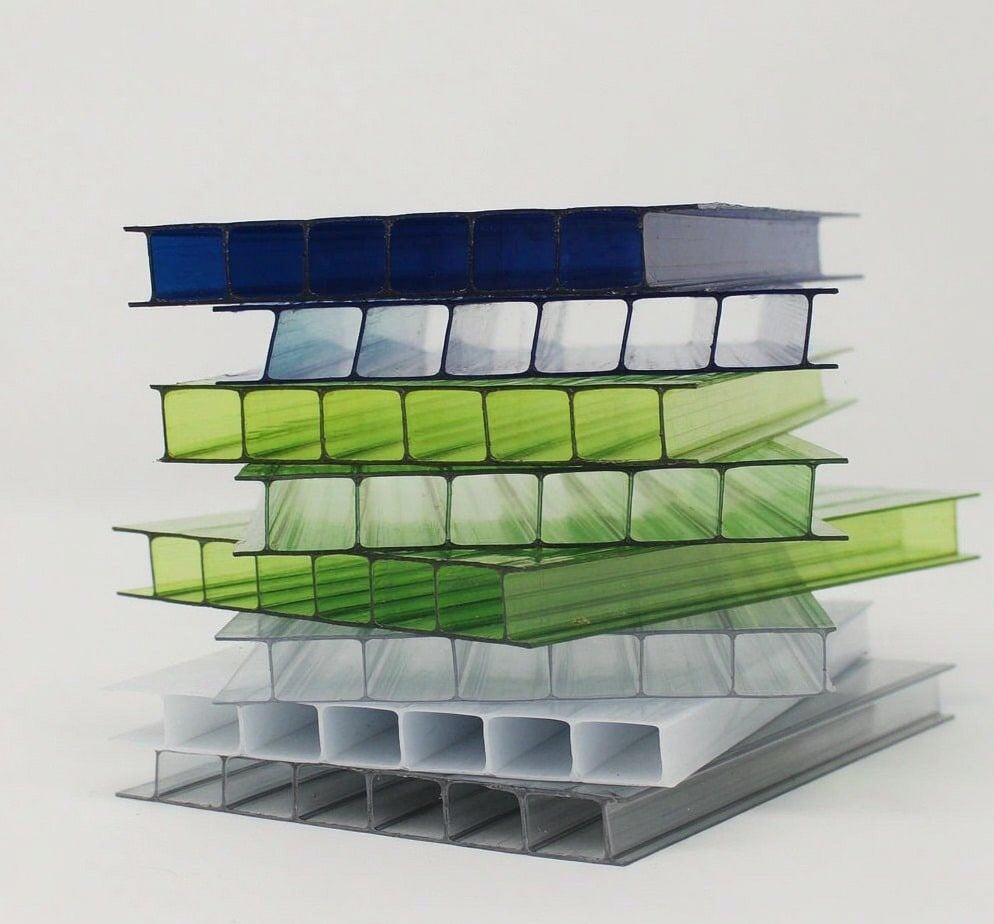
A multiwall sheet is a structured sheet made with more than one layer connected by internal ribs. Instead of being a completely solid panel, the internal structure creates air spaces between the outer surfaces.
This construction can provide a useful combination of low weight, rigidity, thermal insulation, and light transmission. Multiwall polycarbonate sheets, for example, are commonly used for roofing, glazing, wall cladding, skylights, greenhouses, covered walkways, and similar applications.
The exact performance of a multiwall sheet depends on its material, number of walls, thickness, rib configuration, surface treatment, and installation method.
A common mistake is to compare sheets only by thickness.
A 10 mm multiwall sheet and a 10 mm solid sheet do not necessarily behave the same way because their internal structures are different. The same principle applies when comparing a multiwall panel with a corrugated PVC roof sheet.
For buyers, the structure should therefore be considered together with the intended application.
Multiwall sheet performance depends on more than thickness.
| Feature | Multiwall Sheet | Solid Sheet |
|---|---|---|
| Internal structure | Multiple layers and ribs | Solid throughout |
| Weight | Generally lower | Generally higher at similar thickness |
| Thermal insulation | Can be improved by air spaces | Depends mainly on material and thickness |
| Light transmission | Available in different grades | Available in different grades |
| Typical use | Roofing, glazing, cladding | Glazing, roofing, barriers and fabrication |
| Handling | Generally easier for large panels | Can require more handling depending on size |
| Structural behavior | Influenced strongly by internal ribs | Influenced mainly by material and thickness |
The comparison is not about which material is universally better. It is about which construction fits the project.
Multiwall sheet is a structural description rather than one single product specification.
The most common variations are based on the number of walls, thickness, internal geometry, color, light transmission, and surface treatment.
A twinwall sheet has two primary layers connected by internal ribs.
This structure creates an internal air space and can provide a useful combination of rigidity and thermal insulation. Twinwall polycarbonate products are widely used for roofing, glazing, greenhouses, patio covers, and similar applications.
Twinwall construction is often considered when weight and thermal performance are both important.
A triplewall sheet contains an additional internal layer compared with a basic twinwall structure.
The extra structure can change the stiffness and insulation characteristics, although the actual performance still depends on thickness, geometry, material, and installation.
For buyers, the important point is that “triplewall” should not automatically be interpreted as “better.” The correct construction depends on span, loading, climate, light requirements, and budget.
Multiwall polycarbonate sheets are among the most common products associated with the term multiwall sheet.
Manufacturers use different structures and thicknesses for different applications. Some products are designed primarily for natural light, while others place greater emphasis on thermal insulation, solar control, impact resistance, or specialized applications such as greenhouses.
Some multiwall products also include UV protection on one or both sides. When a sheet has single-sided UV protection, the correct installation orientation becomes important.
Not every multiwall sheet is intended to maximize daylight.
Opaque or heavily light-reducing structures may be selected when the project requires less solar transmission, privacy, or controlled lighting conditions.
This is particularly relevant when a buyer assumes that every multiwall sheet should be transparent.
That assumption is false.
Multiwall does not automatically mean clear.
Multiwall sheets are popular because their internal structure can provide several useful properties in one panel.
The combination of light weight, rigidity, thermal insulation, and light transmission makes them suitable for applications where a conventional solid panel or glass solution may be less convenient. Palram, for example, lists roofing, glazing, wall cladding, skylights, covered walkways, greenhouses, and patio structures among common applications for multiwall polycarbonate products.
The internal cavities are one of the most important features.
They create a different thermal path from a solid sheet and can improve insulation performance. The exact result depends on the sheet thickness, wall configuration, air spaces, material, and installation conditions.
For this reason, buyers should not compare insulation performance using material name alone.
A more useful comparison includes:
Sheet thickness
Number of walls
Internal geometry
Thermal performance
Light transmission
UV protection
Installation method
Climate
Roof design
Generally, multiwall structures can reduce material weight compared with solid panels of comparable overall thickness.
This can make handling and installation easier, especially on larger roof areas.
However, lightweight construction does not mean that structural requirements can be ignored.
The roof still needs appropriate purlin spacing, fixing methods, support, expansion allowance, and load consideration.
Yes.
Multiwall polycarbonate sheets are widely used for roofing and glazing applications. Their use includes skylights, patio covers, greenhouses, covered walkways, and architectural roofing systems.
But a buyer should not select a roofing panel simply because it is described as “multiwall.”
The sheet must be suitable for the actual roof design, climate, span, wind exposure, snow or other imposed loads, and installation system.
This is where many buyers need to slow down.
A multiwall polycarbonate sheet and a PVC roof sheet may both be used as lightweight roofing products, but they are not the same product category.
The material, structure, surface characteristics, installation method, and intended applications can be different.
Pingyun's roofing product range includes PVC roof sheet and PVC roof tiles, which are designed around roofing requirements rather than being positioned as multiwall polycarbonate panels.
The better question is therefore:
Which roofing material fits the project's actual requirements?
| Factor | Multiwall Sheet | PVC Roof Sheet |
|---|---|---|
| Typical material | Often polycarbonate | PVC-based roofing material |
| Structure | Multi-layer internal ribs/cells | Often corrugated or profiled |
| Daylight | Often a major application | Depends on product design |
| Thermal insulation | Supported by internal structure | Depends on product construction |
| Roofing use | Common | Common |
| Appearance | Flat structured panel | Available in roofing profiles |
| Main buying concern | Structure, insulation, light transmission | Profile, roofing performance, application |
| Best comparison method | Technical performance and system requirements | Technical performance and roofing requirements |
The important point is that these products should not be compared only by price per square meter.
A lower purchase price can become irrelevant if the product does not match the roof design, expected service conditions, or appearance requirements.
A PVC roof tile can be a more suitable option when the project requires a tile-style appearance rather than a flat multiwall panel.
This matters for residential-style buildings, commercial buildings, renovation projects, and other applications where roof appearance is part of the design requirement.
PVC roof tiles can provide a different visual effect from flat multiwall sheets or corrugated panels.
For a buyer, the decision often comes down to three questions:
Does the project need natural light?
Does the roof require a tile-style appearance?
Is the main priority thermal insulation, roofing durability, appearance, or cost?
If daylight transmission is the main requirement, a multiwall polycarbonate product may deserve closer consideration.
If the project primarily needs a conventional roofing profile or tile appearance, a PVC roof sheet or PVC roof tile may be a more relevant product category.
There is no reason to force one material into an application designed for another.
A practical comparison looks like this:
| Project Requirement | More Relevant Option |
|---|---|
| High daylight transmission | Multiwall sheet |
| Structured insulated glazing | Multiwall sheet |
| Greenhouse application | Multiwall sheet |
| Patio or skylight application | Multiwall sheet |
| Conventional opaque roofing | PVC roof sheet |
| Corrugated roofing appearance | PVC roof sheet |
| Tile-style roof appearance | PVC roof tiles |
| Roof renovation with decorative appearance | PVC roof tiles |
| Need to compare several roofing profiles | PVC roof sheet / PVC roof tiles |
This table is only a starting point.
The actual selection should be based on the project specification rather than the product name.
A professional roofing purchase should begin with the application rather than the supplier's product title.
A buyer asking only for “multiwall sheet” may receive several products that look similar but perform differently.
Thickness is one of the easiest specifications to compare, but it should not be the only one.
For multiwall products, thickness interacts with internal structure, wall configuration, weight, insulation, stiffness, and light transmission.
For PVC roof sheet and PVC roof tiles, thickness also needs to be considered alongside profile geometry and application.
For transparent or translucent roofing, light transmission can be a major buying factor.
Different colors and structures can produce significantly different light levels. Multiwall polycarbonate manufacturers offer different transmission options for different applications.
A greenhouse, warehouse skylight, patio cover, and residential roof may therefore require completely different light characteristics.
UV protection is another specification that should be checked carefully.
Some multiwall polycarbonate products use a co-extruded UV-resistant layer. On products with protection on only one side, the installation direction matters.
Buyers should ask:
Is UV protection included?
Is it one-sided or two-sided?
Which side faces outward?
Is the UV layer part of the sheet construction?
What documentation supports the claim?
For buildings where temperature control matters, thermal performance should be evaluated using actual technical data.
A multiwall structure can provide thermal insulation because the internal cavities reduce heat transfer compared with a simple single-layer construction.
But “better insulation” should never be accepted as a sufficient specification.
Ask for measurable performance data where appropriate.
Roofing materials can be exposed to hail, falling objects, installation impacts, transportation damage, and other mechanical stresses.
Impact performance depends on material, thickness, structure, temperature, and test method.
Therefore, buyers should compare actual test information rather than relying on phrases such as “strong” or “unbreakable.”
A good sheet can still perform poorly if it is installed incorrectly.
Buyers should understand:
Recommended support spacing
Fixing method
Thermal expansion allowance
Overlap requirements
Edge treatment
Sealing requirements
UV-side orientation
Compatible accessories
For example, Palram's technical guidance specifies different end-sealing approaches for some multiwall products to manage moisture and ventilation inside the internal channels.
That is a good example of why the panel and installation system should be considered together.
Price is important, but it should not be the first and only supplier-selection criterion.
For a B2B roofing project, the manufacturer should be able to answer practical technical questions without relying on vague marketing language.
A serious supplier should be able to provide appropriate documentation for the products being offered.
Depending on the product, buyers may request:
Product specification sheet
Material information
Thickness information
Weight information
Performance data
Installation instructions
Test reports
Warranty information
Packaging details
Loading information
The exact documentation depends on the product and destination market.
Buyers should also understand how the manufacturer controls production.
For sheet products, relevant questions can include:
How is thickness controlled?
How is profile geometry controlled?
How is surface quality inspected?
How is color consistency maintained?
How are finished sheets packed?
How are production batches identified?
These questions are especially useful for distributors placing repeat orders.
A product that looks good in one sample but changes noticeably between production batches can create problems for a distributor or contractor.
Before placing a large order, buyers should compare samples under realistic conditions.
Do not inspect only the color.
Check:
Surface appearance
Dimensions
Thickness
Flatness
Profile consistency
Edge quality
Packaging
Installation compatibility
For translucent or transparent materials, inspect the sheet under the actual lighting conditions in which it will be used.
Before approving a roofing material, buyers can use the following checklist.
| Evaluation Area | What Buyers Should Confirm |
|---|---|
| Product type | Multiwall sheet, PVC roof sheet, or PVC roof tile |
| Material | Confirm the actual polymer/material |
| Thickness | Confirm nominal and acceptable tolerance |
| Structure | Confirm wall/profile configuration |
| Dimensions | Confirm width, length, and usable coverage |
| Light transmission | Confirm when daylight is important |
| UV protection | Confirm location and protection method |
| Thermal performance | Request appropriate technical data |
| Mechanical performance | Review relevant test information |
| Installation | Confirm fixing and support requirements |
| Accessories | Confirm compatible components |
| Packaging | Check export and handling requirements |
| Testing | Request available supporting documents |
| Warranty | Confirm coverage and conditions |
| Application | Confirm suitability for the intended project |
This checklist is intentionally practical.
A buyer does not need every possible specification for every project. The goal is to identify the specifications that can actually change the purchasing decision.
One common mistake is selecting a product by keyword instead of application.
For example, a buyer may search for multiwall sheet, see several polycarbonate products, and assume that any lightweight plastic roofing panel can replace them.
That is not necessarily true.
A multiwall polycarbonate panel has a specific internal structure and is commonly selected for applications where light transmission, insulation, and lightweight construction are important.
A PVC roof sheet has a different product structure and may be more appropriate for conventional roofing applications.
A PVC roof tile may be selected when the visual appearance of a traditional tiled roof is important.
The correct buying process is therefore:
Application → Performance requirements → Material → Structure/profile → Supplier → Price
not:
Keyword → Lowest price
This small change in the purchasing process can prevent many unnecessary product comparisons.
Roofing materials are purchased to perform outdoors, often for years.
That means manufacturing consistency matters.
A supplier should be able to maintain consistent dimensions, surface appearance, profile geometry, packaging, and product specifications across repeat orders.
This is particularly important for distributors.
A distributor may purchase one container for a trial order and several containers later. If the material, color, dimensions, or profile changes substantially between batches, the distributor may have difficulty maintaining customer confidence.
For this reason, buyers should evaluate both the product and the supplier.
| Supplier Factor | Buyer Question |
|---|---|
| Product consistency | Can repeat batches maintain the same specification? |
| Documentation | Can the supplier provide relevant technical documents? |
| Samples | Can production samples be evaluated before bulk order? |
| Packaging | Is the product adequately protected during export? |
| Customization | Can required colors, profiles, or dimensions be discussed? |
| Communication | Can technical questions be answered clearly? |
| Production | Is manufacturing capability suitable for the order volume? |
| After-sales support | Can problems be handled after delivery? |
For Pingyun, the important point is not to claim that one roofing material is suitable for every project.
The more useful approach is to match the buyer's application with the appropriate PVC roofing product and provide the information needed for an informed decision.
A multiwall sheet is a structured sheet with multiple layers and internal ribs, commonly used for roofing, glazing, cladding, greenhouses, skylights, and other applications where low weight, rigidity, thermal insulation, and light transmission can be valuable.
However, multiwall sheet should not be treated as a universal replacement for every roofing product.
For projects that prioritize structured daylighting and thermal performance, multiwall polycarbonate may be a relevant option. For conventional roofing requirements, PVC roof sheet can provide a different solution. When roof appearance is particularly important, PVC roof tiles may be more appropriate.
For buyers, the best decision comes from comparing the complete application rather than comparing product names alone.
Before placing an order, confirm the material, structure, dimensions, thickness, performance requirements, installation method, documentation, packaging, and supplier capability.
Pingyun provides PVC roofing products including PVC roof sheet and PVC roof tiles, giving buyers an option to evaluate conventional PVC roofing solutions alongside other sheet materials according to the requirements of the project.
A multiwall sheet is a panel constructed with multiple layers connected by internal ribs or webs. The resulting cavities can reduce weight and contribute to thermal insulation while maintaining useful rigidity. Multiwall polycarbonate is a common example used in roofing and glazing.
No. A multiwall sheet is generally a description of the sheet's layered internal structure, while PVC roof sheet describes a roofing product made from PVC-based material. Multiwall products are commonly associated with polycarbonate, so buyers should confirm the actual material before comparing products.
Yes. Multiwall polycarbonate sheets are widely used for roofing, skylights, patio covers, greenhouses, covered walkways, and architectural applications.
The suitability of a particular sheet depends on its thickness, structure, loading requirements, installation system, climate, and other project conditions.
The main benefit is the combination of a structured internal design with relatively low weight, rigidity, thermal insulation, and available light transmission characteristics. The exact performance varies by product design and thickness.
It depends on the application.
If natural light, structured insulation, and glazing performance are major priorities, a multiwall polycarbonate product may be worth considering.
If the project requires a conventional roofing profile, PVC roof sheet may be more relevant.
The decision should be based on the roof design, climate, appearance, performance requirements, and budget.
PVC roof tiles can be considered when the project requires a tile-style appearance rather than a flat multiwall panel. They can be relevant for buildings where roof appearance is an important part of the overall design.
At minimum, check:
Material
Thickness
Number of walls
Internal structure
Dimensions
Light transmission
UV protection
Thermal performance
Mechanical performance
Installation requirements
Supporting documentation
Warranty conditions
The required specifications depend on the application.
UV exposure can affect polymer materials over time. Some polycarbonate multiwall products use a co-extruded UV-resistant layer to improve weathering performance. For products with single-sided UV protection, the protected side needs to be installed in the correct orientation.
In some applications, yes, but not universally.
A multiwall sheet is particularly relevant when the project benefits from daylight transmission, low weight, thermal insulation, or a modern glazing appearance. Other roofing materials may be more appropriate when opacity, tile appearance, profile design, or other project requirements are more important.
Pingyun supplies PVC roofing products including PVC roof sheet and PVC roof tiles. Buyers should provide the intended application and project requirements so the appropriate roofing product can be evaluated rather than selecting solely by product name.
Palram Americas — SUNLITE Twin & Multiwall Polycarbonate Sheet. Product information covering multiwall construction, thermal insulation, light transmission, roofing, glazing, UV protection, and physical properties.
Palram Americas — Construction Brochure, Roofing & Daylighting. Product and application information for multiwall polycarbonate roofing and glazing.
Palram Americas — SUNPAL Multiwall Polycarbonate Architectural System. Information on multiwall architectural roofing, skylights, facades, insulation, and structural applications.
SABIC — LEXAN THERMOCLEAR Multiwall Polycarbonate Sheet Technical Manual. Technical information on multiwall polycarbonate applications, insulation, impact strength, UV resistance, and light transmission.
Palram Americas — THERMAGLAS Multiwall Polycarbonate. Information on multiwall greenhouse applications, condensation control, insulation, light transmission, and UV protection.
Pingyun — PVC Roofing Product Information. Product scope used in this article is limited to the PVC roof sheet and PVC roof tiles specified for the project; no unsupported technical specifications have been added.
Copyright © 2025 by Techos New Material Co.,Ltd.
 EN
EN