
Choosing a roof material for greenhouse production is a long-life decision that shapes how much light your crop receives, how much heating and cooling the structure needs, how the roof behaves in wind, snow, and hail, and how easily a supplier will stand behind the panels years after delivery. Because a greenhouse roof is both a light-delivery system and a weather envelope, the correct choice depends less on a single material name than on a documented set of properties, a realistic view of how those properties degrade outdoors, and a written commercial agreement that survives the first claim.
This guide is written for buyers who are comparing transparent and translucent roofing options and who want to separate documented facts from marketing language. It uses the product literature published by Pingyun and the archived Pingyun polycarbonate catalog as the reference brand, but it keeps a hard line between three different kinds of statements: what a specific Pingyun source actually says about a specific product, what general greenhouse engineering practice recommends, and what remains unproven until the buyer obtains controlled test data or a contractual commitment. The same method can be applied to any supplier.
A short answer up front: polycarbonate is one relevant greenhouse-roof category, with solid, hollow, and corrugated formats documented in Pingyun materials; the suitability and optical or impact performance of any one format still require product-specific evidence. FRP (fiberglass reinforced plastic) sheet is a separate rigid translucent category that Pingyun also presents for greenhouse daylighting. PVC and UPVC sheet appear as distinct roofing categories and should not be treated as interchangeable with polycarbonate without their own documented specifications. The right answer for a specific project depends on the crop light budget, the local snow and wind loads, the structural span your frame allows, the cleaning regime you can sustain, and the warranty and service terms you can put in writing. No slogan, star rating, or catalog headline replaces those five inputs.
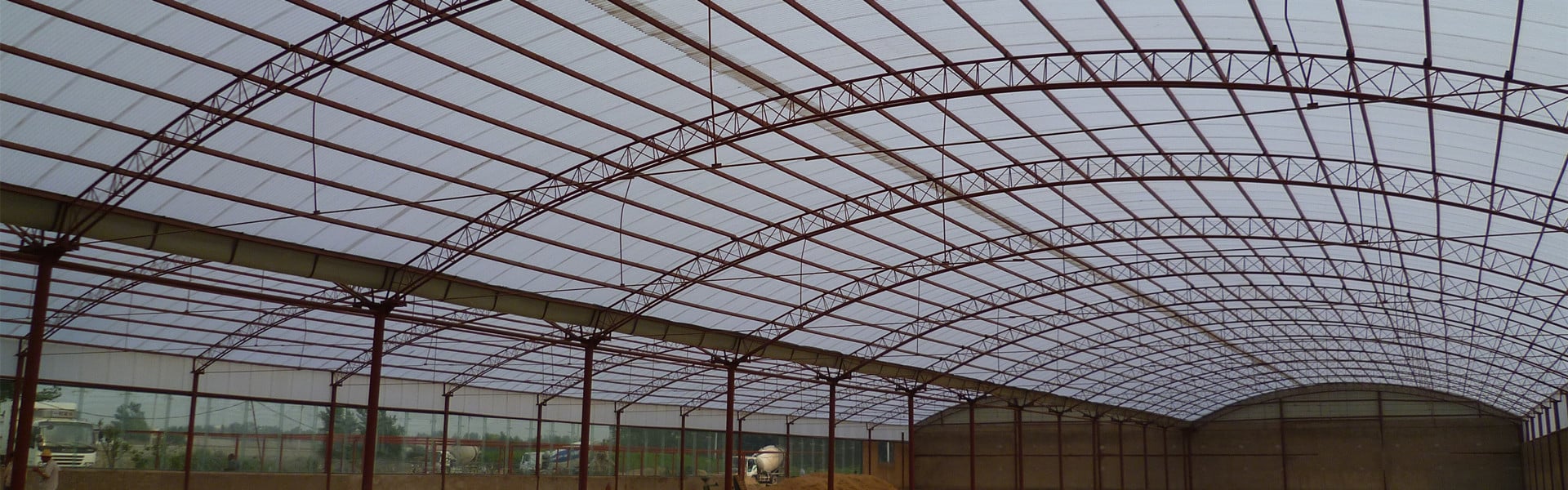
The list below is the fastest way to navigate this guide. The sections move in a deliberate order: first how to frame the material choice, then what the Pingyun sources do and do not document, then the crop and structural properties that matter, then installation, category comparison, warranty, claims, and procurement. Each section ends with the practical question a buyer should carry forward. If you already hold a shortlist, jump straight to the warranty and procurement sections; if you are still choosing, start with the selection and performance sections and read the source-boundary discussion before you rely on any figure.
There is no single best roof material for every greenhouse, because the material is being asked to solve several problems at once, and those problems pull in different directions. A panel that maximizes light transmission may transmit more heat. A panel that insulates best may block some light. A panel proposed for hail exposure must still be checked for its weight, impact evidence, and frame requirements. A low sheet price can be offset by frame changes, cleaning, replacement, or a warranty that does not cover the failure of concern.
The productive way to choose is to define the job before you shop. Ask what the crop needs, what the climate will do to the structure, what the frame can carry, and what evidence the supplier will provide in writing. When those four questions are answered, the comparison between polycarbonate, FRP, and PVC becomes a shortlist exercise rather than a debate about slogans.
For a greenhouse, the word "best" almost always resolves to a weighted combination of the following factors. Each factor should be scored for your own site rather than assumed from a catalog.
The transparent and translucent roof materials most often discussed for greenhouses fall into a small number of documented categories. The categories are not marketing inventions; they describe genuinely different materials with different chemistry and different behavior.
Each of these categories, and each sub-format within a category, carries its own specification set, its own installation rules, and its own warranty wording. The sections that follow show how to read those specifications from the actual source documents rather than from their headlines.
Before comparing materials, it is worth establishing exactly what the available Pingyun sources do and do not say. Buyers routinely over-read a marketing page, assuming that a phrase written about one product applies to the whole catalog, or that a slogan is a legal promise. The three main source types reviewed here are structurally different, and each carries a different level of weight.
The evidence available for this guide comes from a few distinct places, and they should not be treated as equally authoritative.
A useful rule is to grade every claim you collect. A figure that appears in a specification table for a named product is stronger than a phrase in a category introduction, which is in turn stronger than a headline keyword. A performance number that appears only in marketing prose, with no method, no laboratory, and no test standard, stays a claim to be verified, not a specification to be relied upon.
The archived Pingyun polycarbonate catalog is the most concretely specified of the Pingyun sources reviewed. It presents two polycarbonate series on facing pages and then a features panel and a specification table. It is important to keep those parts separate, because they describe different products.
The hollow-sheet page presents a "UV-PC hollow sheet series." Its descriptive paragraph identifies the product as a hollow sheet, also referred to by trade names such as carbulon or sun sheet, and lists intended characteristics including impact resistance, sound insulation, lighting, flame retardancy, and ease of cutting and machining. The listed applications include a range that explicitly names agricultural greenhouse as one of the uses, alongside daylighting, awnings, ceilings, and highway noise barriers. The page displays six color swatches: light green, dark blue, opal, red, brown, and clear. It also shows application photographs including a walkway canopy and a large vaulted roof.
The solid-sheet page presents a "UV-PC solid sheet series." Its introductory paragraph describes the material as a durable, waterproof, light-transmitting engineering material and lists applications including residential, commercial, and public buildings for lighting, highway sound insulation, plant greenhouse, and indoor separation. The displayed colors are green, blue, opal, brown, clear, and a clear embossed variant with a textured surface. Application photographs include a residential patio canopy and a curved public canopy or sound barrier.
Two points deserve emphasis here. First, both series list greenhouse among their applications, but the word "greenhouse" in an application list is a statement of intended use, not proof of measured crop performance. Second, the colors and formats differ between the hollow and solid series, so a specification taken from one page must not be assumed to hold for the other.
The features panel is where most performance claims appear, and it must be read as a claims panel rather than a test report. It states that, depending on color, light transmission can reach a range extending from roughly twelve percent to roughly eighty-two percent. It states that the hollow structure provides sound insulation, that the hollow structure reduces energy consumption for temperature regulation, that the material maintains physical properties across a wide temperature band, that it is classified in a flame-retardant class under a named national standard, that it is easy to install and can be cold bent, that its impact strength is many times that of acrylic, and that its surface contains an anti-ultraviolet layer for outdoor weather resistance. These are the supplier's own claims. They are valuable as a starting point for questions, but a buyer should ask for the test reports behind any figure that matters.
The specification table is the most precise part of the brochure, and it is also the part most often misused. It lists solid-sheet thicknesses across a range from one millimeter up to ten millimeters, rolled lengths, and several widths. It then lists a hollow-sheet table with thickness, panel size, minimum bending radius, weight per square meter, transmittance, and sound insulation values for several thicknesses. The transmittance and sound values decline as the panel gets thicker, which is the physically expected direction. The table carries two footnotes: that colors and specifications can be customized for bulk orders, and that when the bending radius of a sheet is less than the stated minimum, the sheet may burst and the company will not accept liability for the resulting consequences. That second note is effectively a use limitation and a liability exclusion attached to a specific product format, and buyers should treat it as part of the specification, not as fine print.
Critically, this specification table describes the solid and hollow series. It does not describe a corrugated product. Anyone who lifts a thickness, weight, or transmittance figure from this table and applies it to corrugated sheet, or to the whole range of greenhouse roofing, is transferring a number across products that the document never connected.
The official Pingyun website organizes polycarbonate products under a category page and subcategories for solid sheet, hollow sheet, and corrugated sheet. The category introduction describes polycarbonate as flexible and resistant to physical damage, and highlights durability and ease of installation for commercial and residential projects. This is a category-level statement. It is useful context, but it is not tied to a particular thickness, format, or test method, so it cannot be used as a specification.
The corrugated subcategory page lists several products, including a multi-purpose corrugated sheet offered for carports and skylights, a round-wave corrugated roofing panel, a clear corrugated sheet, an anti-corrosion transparent corrugated sheet, and the greenhouse product discussed next. The listing itself shows the supplier's intended positioning of corrugated polycarbonate across canopy, skylight, and greenhouse applications.
The most directly relevant live page is the Pingyun product page titled for a daylighting polycarbonate greenhouse roof sheet with UV protection. This page is worth reading carefully because it shows both how much the supplier advertises and how much remains to be verified.
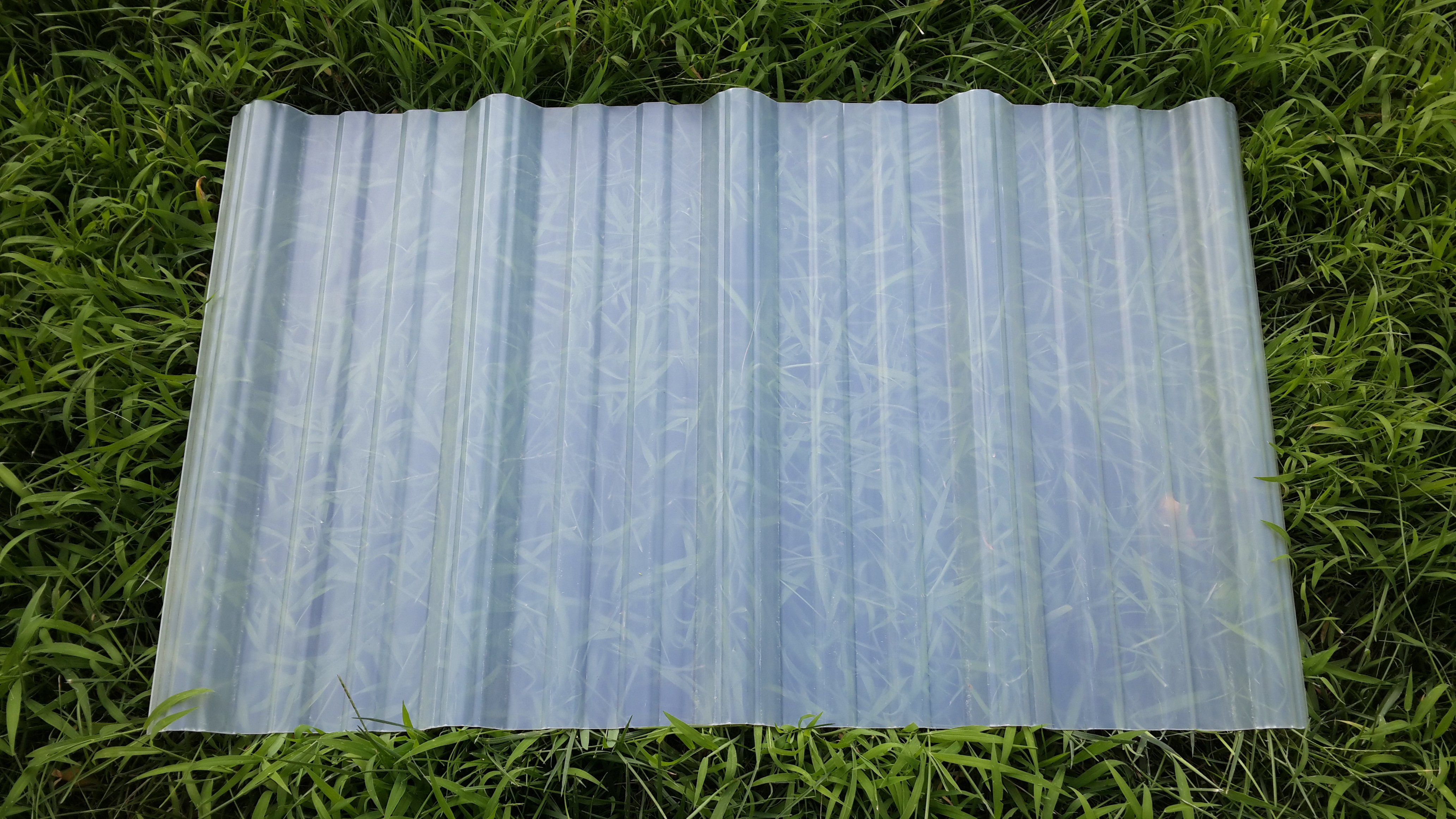
The page lists the product as corrugated polycarbonate sheet. It states a material of polycarbonate, a brand of Pingyun, a type designation, and a customs code. It lists a total width band, a maximum length, a thickness band from under one millimeter to two millimeters, a transmission figure of more than ninety percent, a shape described as round wave or trapezoidal wave, and colors described as customizable. It also lists a warranted period of ten years and a product life of about twenty years under normal conditions, with the phrasing that life can be even longer without man-made destruction.
Three cautionary observations follow directly from the page's own text.
First, the page title emphasizes a transparent greenhouse roof sheet, yet the color field lists red, green, blue, and dark gray, along with "etc." A greenhouse roof that is listed in several strongly tinted colors is not the same as a transparent roof, and a tinted panel will not deliver the same light transmission as a clear panel. The title and the color field are in tension, and a buyer should resolve that tension with the supplier in writing before ordering.
Second, the transmission figure, the warranty period, and the service-life figure all appear as page claims. The page does not present an independent test report, a laboratory name, a test standard, or a method behind the transmission number, and it does not attach conditions to the warranty or the life figure beyond the general phrase about normal conditions. Those numbers therefore remain marketing claims to be confirmed, not specifications already proven.
Third, the page's raw-material line names specific external polycarbonate resin suppliers and the page also presents a series of narrative paragraphs describing daylighting performance, UV protection, thermal insulation, energy efficiency, and suitability for small, medium, and large greenhouses. None of those narrative paragraphs includes measured data for a specific project, a named installation, or a certified test. They describe intended benefits.
The correct way to use this page is to treat it as a map of what the supplier offers and is willing to advertise, and then to convert the claims you care about into RFQ questions and contractual requirements. Asking for the test method behind a transmission figure, or for the warranty terms in a form that can be attached to a purchase contract, is exactly the right response to a page like this.
Pingyun also publishes a category for FRP transparent roof sheet, positioned under translucent roof sheet. The listing includes products marketed for greenhouse daylighting and energy saving, a weatherproof FRP roofing panel described for greenhouse daylighting systems, and an FRP or PVC roof tile offered for greenhouse use. These listings establish that FRP sheet is a real and separately merchandised category in the Pingyun catalog, distinct from polycarbonate and distinct from PVC roofing tiles.
What the category listing does not provide is a single consolidated FRP specification table for greenhouse use. The listings are product headlines and short attribute fragments rather than a controlled datasheet. As with polycarbonate, the practical step is to identify the specific FRP product you want and then request its own documented properties, rather than assuming that a property mentioned anywhere in the category applies to every FRP item.
It is just as important to be clear about what none of these sources proves. None of the sources reviewed here constitutes an independent, third-party certification of greenhouse crop performance. None names a specific commercial greenhouse project with measured outcomes attributable to a Pingyun panel. None provides a controlled accelerated-weathering report or a hail test report. None confirms that a warranty term mentioned on one product page applies across the whole brand. And none of the specification numbers from a solid or hollow table can be transferred to the corrugated or FRP products.
The screening report that covers the archived Pingyun material reinforces this discipline. It explicitly warns that lifetime and warranty values appearing in marketplace listings belong to their specific contexts, that some values attached to wall, ceiling, or floor products must not be reused for roofing, and that the archived screenshots and scanned catalogs are historical rather than current controlled documents. When a claim cannot be traced to a specific product and a specific document, it should be logged as unverified.
The material comparison only becomes meaningful once you know which properties actually drive outcomes in a working greenhouse. This section describes those properties in general engineering terms. The guidance here is general greenhouse practice, not a Pingyun specification, and any figure you intend to rely on must be confirmed against the controlling datasheet for the exact product and thickness you order.
Light is the currency of photosynthesis, and the roof is the first thing that either passes it through or takes it away. Transmission is usually quoted as a percentage, but the number is only comparable when it is quoted for the same color, the same thickness, the same surface finish, and the same measurement basis. A clear thin panel and a dark tinted thick panel will not share a transmission value, and the archived Pingyun hollow-sheet table illustrates the principle: within a single product family, the stated transmittance falls as the panel thickens from the thinnest to the thickest entry. That internal decline is a useful reminder that transmission is not a single brand-level constant.
For crop planning, what matters is the daily light integral the canopy actually receives, which depends on transmission, latitude, season, structure shading from frame and glazing bars, and dust or condensation on the surface. A high nominal transmission that is undermined by a heavy frame, a dirty surface, or persistent internal condensation may underperform a modestly lower nominal transmission on a clean, open structure. Buyers should therefore treat published transmission as an upper bound under clean conditions and plan conservatively.
Colored and tinted panels change more than brightness. A tint reduces overall transmission and can shift the spectrum, which changes how much usable light reaches the crop and how much heat the panel absorbs. When a supplier lists a range of colors for a greenhouse roof, including saturations intended for decorative canopies, the buyer should confirm which colors are recommended for crop production and what transmission each is expected to deliver.
Whether a panel transmits light perfectly directly or spreads it is a separate property from how much it transmits. Diffused light penetrates deeper into a crop canopy and reduces the sharp shadows and hot spots that can scorch leaves and create uneven growth. Some greenhouse glazing products are engineered for diffusion, while a textured surface may change the appearance of transmitted light without establishing a measured diffusion result. Because diffusion is difficult to judge from a marketing page, buyers who care about it should ask for the specific product's measured haze or diffusion data rather than assuming that a textured or patterned surface provides it.
Ultraviolet radiation is a major driver of outdoor performance, and it works in two directions at once. Unprotected polymer products can yellow, become brittle, or lose transmission under outdoor exposure. Radiation also affects crops, but plant responses differ by species, spectrum, and growing conditions. Specify weathering protection and crop-relevant optical properties separately rather than assuming that a UV-resistant sheet delivers an optimal growing spectrum.
The archived Pingyun brochure states that the PC sheet surface contains an anti-ultraviolet layer that provides outdoor weather resistance, and the greenhouse corrugated product page describes a UV-resistant coating that it says protects the sheet from yellowing and brittleness. These are the supplier's statements. They are plausible and common in the industry, but they are not a substitute for a weathering report. A buyer who needs confidence should ask for the UV protection method, the nominal coating thickness if one is specified, and any accelerated-weathering results, and should record the answer in the procurement file.
Greenhouse temperature management involves two opposing risks. In cold conditions, heat escapes through the roof, and an insulating panel reduces that loss and the heating bill. In hot conditions, the roof admits solar heat, and overheating stresses the crop and drives ventilation and cooling costs. Multi-wall and hollow panels improve insulation because the trapped air channels resist heat flow, which is why the archived brochure describes the hollow structure as reducing the energy consumption of temperature regulation.
However, the same trapped air that insulates also influences how heat builds up, and a tinted panel that reduces incoming radiation can help or hurt depending on the climate and season. The greenhouse product page describes polycarbonate as helping to keep a greenhouse warm in cold weather and to provide some shade in hot weather. That is a reasonable general description of how a translucent panel behaves, but the balance point for a specific site depends on climate data and on the crop's temperature tolerance, and it should be evaluated with a local greenhouse engineer rather than from a catalog sentence.
Humidity is unavoidable in a working greenhouse, and condensation on the inner face of the roof is normal whenever the surface temperature drops below the dew point. The problem is not condensation itself but where the water goes. If condensate sheets across the panel and drips onto the crop at specific points, it can cause leaf spotting, disease spread, and uneven watering. If the panel or its coating manages condensate so that it runs to the edges, the same water is removed by the drainage system instead of falling on the plants.
Anti-drip or anti-condensation coatings are common on greenhouse glazing, and the orientation of hollow channels matters because water behaves differently in vertical and horizontal channels. Buyers should confirm whether the specific product carries an anti-drip treatment, how the channels or ribs must be oriented, and how condensate is expected to reach the gutter. None of the Pingyun sources reviewed here states a specific anti-drip specification, so this is a question to raise explicitly rather than assume.
The roof must carry its own weight, the weight of snow, the pressure of wind, and occasional loads such as maintenance access, without deflecting so far that it leaks or cracks. Span capability depends on the material, the profile, the thickness, the number and depth of ribs, the purlin spacing, and the fastening method. It is a systems property, not a panel-alone property.
A thin panel and a thick panel of the same material can have very different span limits, and a corrugated profile behaves differently from a flat solid sheet or a multi-wall panel. For this reason, no single span figure can be applied across a product family. The archived brochure's hollow-sheet table does list a minimum bending radius per thickness, which is a curvature limit rather than a span limit, and it carries the explicit warning that bending a sheet tighter than the minimum can cause it to burst. That warning is a good example of a documented structural limit that should feed directly into the design.
Impact resistance is one of polycarbonate's best-known advantages, and the archived brochure states that the impact strength of its PC sheet is many times that of acrylic. Strong impact resistance matters for hail, for accidental contact during installation and maintenance, and for wind-borne debris. FRP and PVC have their own impact behavior, which differs by formulation and thickness. Snow is a sustained load rather than a sudden impact, and it is governed more by stiffness and span than by toughness. Buyers in hail or heavy-snow regions should ask for the applicable load and impact data rather than relying on the general reputation of a material.
Fire performance matters for insurance, for building code compliance, and for life safety. The archived Pingyun brochure states that its PC sheet is classified in a flame-retardant class under a named national combustibility standard. That is a useful documented claim for that product line, and it is the kind of statement a buyer can ask to see certified. Buyers should confirm the exact fire classification for the specific product and thickness they intend to install, because fire class can vary by formulation and by thickness, and local codes may impose additional requirements such as limiting the proportion of combustible glazing or requiring sprinklers.
Sound insulation is relevant when a greenhouse sits near a road, an industrial area, or a residential boundary, and it can also matter for worker comfort in large halls. The archived brochure claims good sound insulation for its hollow structure and publishes sound insulation values per thickness in its hollow-sheet table. Solid, hollow, and corrugated panels behave differently because the trapped air and the panel mass differ. As with every other property, the value belongs to the product and thickness it was measured on.
Greenhouse surfaces collect dust, pollen, algae, and mineral deposits, and they are exposed to fertilizers, pesticides, and cleaning agents. Some of these substances attack polymer surfaces. The archived brochure's installation and maintenance page lists a set of substances to avoid, including alkaline materials and a long list of aggressive organic solvents, and it names specific examples such as certain alcohols, asphalt, and putty. This is a genuine compatibility limitation: a cleaner that removes stubborn deposits may also dull or craze the panel, and a solvent-based sealant or adhesive may damage it. Buyers should obtain a written list of compatible and incompatible substances for the exact product and should brief the cleaning crew before the first wash.
Even a correctly specified panel can underperform if it is installed without regard for thermal movement, water management, and mechanical protection. The following points combine general greenhouse practice with the specific cautions that the archived Pingyun brochure states for its polycarbonate sheet. Where a point comes from the brochure, it applies to the product described there; where it reflects general practice, it should be confirmed against the controlling datasheet.
Polycarbonate and PVC expand and contract with temperature far more than metal or masonry. If a panel is fastened so rigidly that it cannot move, the movement converts into stress that can buckle the panel, elongate the holes, or crack the sheet over time. Both general practice and the archived brochure point in the same direction. The brochure describes drilling holes sized larger than the fastener and placing holes a minimum distance from the sheet edge, and it describes a reserved expansion allowance within the joining profile. The lesson is that the roof must be detailed to let each panel move, with fasteners and profiles that capture the panel without locking it.
The direction of ribs and channels is a design decision with practical consequences. The archived brochure notes that cold bending must run parallel to the ribs, which tells you that the ribs define the panel's strong direction and its bending behavior. Channel orientation also affects condensate drainage and how water travels to the gutter. The brochure describes installing the printed side of the sheet facing the sun and sealing the embedded edges with rubber strips. These details are specific to that product, and they illustrate why the installation drawing matters as much as the panel order: the same sheet installed with channels running the wrong way can behave quite differently.
Many polymer sheets ship with a protective film that must be handled correctly. The archived brochure states that the film edge should be peeled back a short distance before installation, that the film should be removed after installation, and that sharp tools must not be used when removing it. The general principle is that the film protects the surface during transport and handling, but if it is left in place under strong sun it can bond to the surface or leave residue, and if it is torn off carelessly it can scratch the panel. Storage should keep panels flat and protected from heat, direct sun, and heavy stacking that could deform them.
Workers may need to reach the roof during construction or maintenance, but the panels must not be assumed walkable. The archived brochure warns against standing directly on the sheet and describes a padded board fixed over the frame for access. That illustration is not a universal access design: have the project designer and contractor provide a safe method suitable for the actual roof system, with no direct foot traffic on unverified panels.
Seals and adhesives must be compatible with the panel, and the two failure modes to avoid are a seal that does not adhere and a sealant that attacks the plastic. The archived brochure's caution against contact with aggressive organic solvents and certain alkaline materials applies here as well, because many sealants and cleaners are solvent-based. Buyers should obtain the supplier's recommended sealant and fastener system and should not substitute a hardware-store product without confirming compatibility.
The comparison below is organized by category rather than by brand, and it reflects the documented distinctions that appear in the Pingyun sources and in general material knowledge. It is a framework for asking better questions, not a substitute for the datasheets of the specific products you are considering. Where a category is described as offering a property, that means the category can offer it in some products; it does not mean every product in the category provides every property, and it does not mean any Pingyun product provides it at a particular value.
Polycarbonate is a thermoplastic. It can be extruded as a thin solid sheet, as a hollow or multi-wall sheet with internal channels, or as a corrugated profile. It is prized for toughness, and it can be manufactured with a UV-protective surface. The Pingyun literature reviewed here documents polycarbonate most fully, with separate solid, hollow, and corrugated product lines and a scanned catalog that includes color swatches, a features panel, and a specification table for the solid and hollow series.
FRP is a glass-fiber-reinforced resin composite, and its particular resin and profile must be identified. Pingyun markets FRP sheet as a distinct translucent category with greenhouse-oriented listings. Its stiffness, impact response, weathering and forming behavior should be assessed from the offered product's evidence rather than ranked against polycarbonate at nominally similar thickness.
PVC and UPVC are rigid vinyl-based materials. Pingyun presents them primarily as a roofing and cladding family, including corrugated, trapezoidal, wave, and hollow roof sheets, and as translucent roof sheets. The company also presents PVC as an anti-corrosion, heat-insulating roofing option in marketplace listings, though those listings belong to specific products and must not be generalized into a brand-wide guarantee.
The table below summarizes the practical distinctions. Treat every cell as a question you should confirm for your chosen product, thickness, and color.
This table deliberately uses cautious wording such as "can be" and "confirm per product" because a category-level table cannot bind a supplier. Its purpose is to keep you from comparing a clear polycarbonate panel against a tinted PVC panel, or a hollow polycarbonate panel against a single-skin FRP panel, as though they were the same product.
The most frequent mistake in greenhouse roof procurement is transferring a property from one category to another. A buyer reads that polycarbonate has high impact strength and then assumes an FRP panel will behave the same way. A buyer sees a competitor's polycarbonate product page quote more than ninety percent transmission and then applies that number to a tinted corrugated sheet. A buyer reads a warranty term on a PVC roofing listing and applies it to a polycarbonate greenhouse order.
The archival screening report that accompanies the Pingyun material was explicit about this risk. It warned that lifetime and warranty values found in marketplace listings belong to their specific product contexts, that values attached to wall, ceiling, or floor products must not be reused for roofing, and that figures from one product page must not be generalized to a whole series. That warning is not legal boilerplate. It is the single most useful discipline a buyer can adopt, because almost every dispute later in the project traces back to a value that was borrowed from the wrong source.
Warranty questions in greenhouse roof sourcing go wrong because three different ideas get blended together: a marketing slogan, a service-life estimate, and a legal warranty term. They are not the same thing, they are measured differently, and only one of them is enforceable.
The archived Pingyun brochure includes a project case page that carries a circular emblem reading "PINGYUN PC SHEET" together with the phrase "10 YEARS QUALITY," surrounded by stars, along with a stylized slogan text. That page is a promotional composition. The "10 YEARS QUALITY" phrase is a marketing slogan, not a warranty clause. It does not state what is covered, from what date coverage begins, what exclusions apply, or how a claim is made. Treating it as a warranty would be a mistake, and no buyer should sign a purchase order believing that a slogan on a catalog page constitutes a guarantee.
Separately, the live greenhouse corrugated product page lists a warranted period of ten years and a product life of about twenty years. A product-page line like that is more specific than a slogan but is still not, by itself, an enforceable contract. It becomes meaningful only when it is restated in a quotation, a specification, or a purchase contract with defined coverage, conditions, and remedies.
It helps to think of a greenhouse roof as running on three separate clocks, each with its own meaning.
Keeping these three clocks separate prevents the most common misunderstanding: assuming that a long advertised service life implies a long enforceable warranty, or that a warranty period measures how long the roof will last.
A claim's weight depends on where it appears. A term written into a signed purchase contract and referencing a defined product is enforceable. A term written on a quotation or proforma invoice is strong evidence of what the supplier agreed to sell. A term on a current product page shows what the supplier advertises today. A term in an archived scan or a third-party listing shows what was advertised at some point in the past.
The archived Pingyun material sits in the last two categories, and the screening report is careful to label it accordingly. Buyers should record, for every claim they intend to rely on, which category it came from, and should escalate the claims they care about up the chain until they are in a contract.
A useful warranty does more than state a duration. It defines what a defect is, what the supplier will do about it, and under what conditions the obligation applies. This section describes the elements a buyer should expect to see. It is general commercial guidance, not a description of any specific Pingyun warranty, because no brand-wide Pingyun warranty for greenhouse roof material is established by the sources reviewed here.
A greenhouse roof material warranty should address defects that originate with the supplier rather than with the site. The categories that buyers should expect to see defined are the following.
Each of these categories should be tied to a measurable definition. A warranty that says the supplier will replace panels that "fail prematurely" is far weaker than one that specifies the property, the threshold, and the method of evaluation.
The start date of coverage is one of the most under-negotiated terms in a roofing contract. Coverage might begin on the invoice date, the delivery date, the installation date, or the date the greenhouse is first put into production. Those dates can be months apart, and the choice materially changes how much protection the buyer actually receives. The start point should be stated explicitly in the contract, and buyers should ensure that any storage or construction delay does not silently consume the warranty period.
A warranty is only as good as its remedy. Buyers should confirm what the supplier will actually provide when a covered defect is confirmed: replacement panels, a credit, a refund, or a repair. They should also confirm who bears the associated costs, because the panel price is often the smallest part of a claim. Freight for replacement panels, removal labor, re-installation, sealant, and any consequential loss of production can dwarf the material cost, and suppliers frequently limit or exclude these.
The following items should be captured in the quotation or contract rather than left in email threads or inferred from a catalog. This is a general checklist for greenhouse roof procurement.
Nearly every roofing warranty, in any material, excludes causes that are not the supplier's responsibility. Exclusions are normal and reasonable in principle, but they must be read carefully, because a warranty whose exclusions swallow its coverage is not worth much. This section describes the exclusions and conditions that are common in the industry. It is general guidance; the actual exclusions that apply to any Pingyun product must be taken from that product's own terms.
The following causes are commonly excluded from roofing material warranties because they reflect site conditions, handling, or events outside the supplier's control.
The underlying logic is consistent: the supplier is responsible for defects that originate in its product and its promised properties, and the buyer is responsible for everything that the product experiences after it leaves the factory. Buyers who understand this division can protect their coverage by installing carefully, documenting the work, and using compatible accessories.
To retain coverage, buyers must generally satisfy a set of conditions. These are also common across the industry.
Read from a different angle, the exclusion list is a design and site-preparation checklist. Every excluded cause is something the buyer can reduce in advance. Over-tightened fasteners can be prevented with the right installation detail. Chemical attack can be prevented by confirming compatible cleaners and sealants before the first wash. Load failures can be prevented by specifying the panel and frame for the actual local snow and wind loads. Improper storage can be prevented with a simple receiving and storage procedure. Treating the exclusions as a to-do list on the buyer side is far more productive than arguing about them after a problem occurs.
When a defect appears, what matters is whether the claim process is clear and documented. A supplier that handles claims well will have a defined path from notification to resolution. This section describes a sound claim process in general terms and shows where the buyer should push for clarity during procurement. It does not describe a specific Pingyun claim procedure, because no such procedure for greenhouse roof material is set out in the sources reviewed here.
A well-run claim process typically moves through a predictable sequence.
Because the buyer's leverage is greatest before the purchase, the claim process should be agreed during procurement, not discovered later. Buyers should confirm the following.
A supplier that is willing to put these points in writing is demonstrating exactly the confidence that a slogan cannot.
More claims fail on documentation than on merit. A buyer who keeps a simple, disciplined record dramatically improves the odds of a fair outcome.
These habits cost very little and convert a vague dispute into a documented claim.
Beyond a standard defect warranty, suppliers in the roofing and greenhouse materials market often offer additional commercial arrangements. These can be valuable, but they should be evaluated on their own terms, and they should never be assumed to be included unless they are written down.
Common additional options in this market include the following. This is a general description of what is available in the industry, not a list of Pingyun services.
An additional arrangement is worth its cost only if it changes the outcome in a realistic failure scenario. Buyers should ask what specific problem the option solves, what it costs, what it obligates the supplier to do, and what conditions attach. A longer warranty period with narrow coverage and heavy exclusions may be worth less than a shorter period with clear coverage and a workable remedy. The right comparison is not the number of years but the value of the protection in the situations you actually expect.
Greenhouse roofs have a few features that make some service terms more important than others. Because a greenhouse is a controlled growing environment, a roof leak or a fallen panel can affect the crop and not just the structure, so response speed and the availability of matching replacement material matter. Because the roof is part of a light-delivery system, a gradual loss of transmission is a performance issue as well as an appearance issue, and a service program that inspects transmission over time can help. And because greenhouses are often located in agricultural areas, the practical availability of local installation and repair labor should be confirmed along with the material supply.
This section turns the discussion into a decision process. The goal is to move from a broad material category to a specific, documented product backed by a workable set of terms. The steps below are a general framework for any supplier.
Start with the crop, not the panel. Record the crop or crop mix, the target light level, the acceptable temperature range, and the sensitivity to dripping and to spectral changes. Then record the site conditions: latitude, typical and extreme temperatures, snow load, wind exposure, hail frequency, pollution or salt exposure, and the distance to any noise-sensitive boundary. These inputs decide which properties are non-negotiable and which are nice to have.
Determine the frame geometry, the purlin spacing, and the maximum allowable deflection for your project. These parameters determine which panel thicknesses and profiles are feasible, and they prevent the common error of choosing a panel the frame cannot support. If the design is not yet fixed, get the panel's span and load data first and design the frame around it.
Shortlist the polycarbonate, FRP, and PVC options that can meet the crop and site requirements as documented. For each candidate, collect the properties that matter for your project from the specific product's documentation, not from category pages or headlines. The core properties to capture are light transmission for the chosen color and thickness, UV and weathering basis, thermal behavior, condensation handling, impact and hail performance, fire classification, and any span or bending limits. Record the source of each figure and mark whether it is a specification, a page claim, or marketing prose.
For every figure you intend to rely on, escalate it from whatever promotional source you found it in to a document that binds the supplier. The archived Pingyun brochure, its "10 YEARS QUALITY" emblem, and its features panel are useful for identifying what the supplier offers, but the numbers that go into your design should come from a datasheet or, where necessary, from test reports or a written commitment in the order. If a supplier cannot or will not substantiate a figure, treat that figure as unverified and design without relying on it.
Compare candidates on the full picture: material cost, frame cost implied by the panel's span and weight, installation labor, expected cleaning and maintenance, expected replacement interval, and the value of the warranty actually offered. A lower-priced panel could cost more overall if its approved frame, cleaning requirements, or replacement needs add substantial expense; compare documented installed and maintenance costs instead of assuming that either bid wins.
Before issuing a purchase order, confirm the product identity, the performance properties you rely on, the warranty terms, the exclusions, and the claim process in writing. Attach the agreed terms to the order so there is no gap between what was advertised and what was sold.
The following checklist is designed to be pasted into a request for quotation. It forces the supplier to answer the questions that decide whether a claim will be honored later. It is a general procurement tool.
Every supplier answer to this checklist should be recorded alongside the source, so the buyer can later distinguish a promised specification from an advertised claim.
Most greenhouse roof problems that end in a dispute can be traced to a small set of avoidable mistakes. Recognizing them before the order is placed is far cheaper than correcting them after installation, and every one of them is a question the buyer controls.
The most expensive mistake is signing an order while believing that a promotional phrase is a guarantee. The archived Pingyun brochure's "10 YEARS QUALITY" emblem, and the product-page line about a ten-year warranted period, are not the same thing as a warranty clause with defined coverage. Before relying on any duration, ask for the written warranty text and confirm what is covered, when coverage starts, what the remedy is, and how a claim is made. A number of years without a definition is not a protection; it is a headline.
A figure that belongs to one product is easily borrowed by another. The solid and hollow specification table in the archived brochure does not describe corrugated sheet. A transmission value measured on a clear panel does not apply to a tinted one. A warranty term seen on a PVC roofing listing does not travel to a polycarbonate greenhouse order. The archive screening report warns about exactly this kind of mixing, and the discipline that prevents it is simple: keep every number attached to the product, thickness, and color it was measured on.
Buyers who focus only on transmission and price often overlook the two properties that generate the most day-to-day complaints: where condensate goes and how the surface behaves when it is cleaned. A panel that drips onto the canopy and a panel that dulls the first time it meets an aggressive cleaner both create problems that no material warranty is designed to cover, because they are installation and maintenance outcomes rather than manufacturing defects. Confirm the anti-drip treatment, the required channel orientation, and the compatible cleaning products before ordering, and brief the maintenance team accordingly.
A greenhouse roof is a system, not a panel. Choosing a panel first and then discovering that the purlin spacing or the local snow load demands a different thickness or rib profile forces an expensive redesign and delays the build. The archived brochure's warning that a sheet bent tighter than its minimum radius may burst is a reminder that structural limits are real and specific to each product. Fix the span, load, and deflection envelope first, then choose the panel that fits it, rather than the other way around.
Color is a crop decision, not merely an aesthetic one. A strongly tinted panel reduces light and can shift the spectrum, which may be acceptable for a decorative awning and unacceptable for a seedling house. The Pingyun greenhouse page presents a transparent title alongside a color field that lists red, green, blue, and dark gray, so the buyer must confirm which of those colors the supplier recommends for production and what transmission each is expected to give. Buying on the strength of the title alone risks a roof that under-lights the crop.
Even when a supplier's claims are honest, they become enforceable only when they are written into the commercial documents. The difference between a product page and a purchase contract is the difference between an advertisement and an obligation. Attach the agreed specification, warranty terms, exclusions, and claim procedure to the order, and keep a signed copy, so that any future disagreement has a single agreed reference point rather than a collection of contradictory screenshots.
Many otherwise valid claims fail not on merit but on evidence, because the buyer cannot show the condition of the material at delivery or the details of the installation. A few simple habits prevent this: inspect each delivery, photograph the bundles before unloading, record the dates and quantities, and keep the ordering, specification, and warranty documents in one project file. When a defect appears, document it in place before any repair or removal. Documentation is the cheapest form of warranty protection a buyer can obtain.
Selecting a roof material for greenhouse production is a decision that combines crop science, structural engineering, and commercial risk management. The material family matters, but the specific product, its documented properties, and the terms attached to it matter more. Polycarbonate offers the widest documented range of greenhouse-relevant formats, including solid, hollow, and corrugated panels, and the Pingyun catalog reviewed here presents polycarbonate as its most thoroughly specified transparent and translucent product line. FRP and PVC are real, separately merchandised categories with their own behavior, and they should be evaluated on their own documents rather than on borrowed numbers.
The discipline that separates a good purchase from a costly one is the same in every case. Define the crop and the site first. Fix the structure envelope. Shortlist materials on documented properties. Separate a specification from a slogan and a service-life estimate from a warranty. Escalate every figure you rely on until it is in writing. Compare candidates on total cost and risk. And agree the warranty terms, exclusions, and claim process before ordering, not after a problem appears.
Applied to the Pingyun sources specifically, this means reading the archived PC brochure for what it actually states about its solid and hollow series, treating its "10 YEARS QUALITY" emblem as a promotional slogan rather than a warranty, keeping the solid and hollow specification table within the products it describes, treating the installation page as product-specific cautions rather than universal rules, and treating the live greenhouse product page and category pages as advertised claims that must be confirmed contractually. Used that way, the available material is a genuinely useful map of what the supplier offers. It is not, by itself, proof of performance, and it should never be stretched to cover products it does not describe.
Polycarbonate is the material category most often shortlisted for greenhouses because it can combine high light transmission with strong impact resistance and is available in solid, hollow or multi-wall, and corrugated formats. That does not make it automatically best. FRP and PVC can be appropriate in specific situations, and the correct choice depends on the crop light budget, the local snow and wind loads, the structural span your frame permits, the cleaning regime you can sustain, and the warranty terms you can obtain in writing.
The live Pingyun greenhouse product page describes a corrugated polycarbonate sheet, with a thickness band from under one millimeter to two millimeters, a width band, a maximum length, a stated transmission of more than ninety percent, and colors listed as customizable. The same page lists a range of colors including red, green, blue, and dark gray, which is in tension with the transparent wording in the page title. A buyer should resolve that inconsistency in writing and confirm which colors are intended for crop production.
No. The phrase appears on a project-case page inside a circular emblem, together with stars and a stylized slogan. It is a promotional composition, not a warranty clause. It does not state what is covered, when coverage starts, what exclusions apply, or how a claim is made. A warranty claim should rest on written terms attached to the purchase, not on a slogan printed on a catalog page.
No. The specification table in the archived brochure describes the solid series and the hollow series. It does not describe a corrugated product, and its transmittance and sound values are tied to specific hollow thicknesses. Transferring those figures to a corrugated sheet or to the whole range of greenhouse roofing would apply numbers to products the document never connected, which is exactly the category-confusion error that the archival screening report warns against.
The page lists a warranted period of ten years and a product life of about twenty years under normal conditions. Those are page claims. The page does not present an independent test report, a laboratory, a method, or specific conditions behind the numbers, and it does not establish a brand-wide warranty. A buyer should treat the figures as claims to be confirmed and should move the specific terms they need into the purchase contract.
FRP is a fiberglass reinforced plastic composite, typically supplied as a rigid corrugated sheet, while polycarbonate is a thermoplastic available in solid, hollow, and corrugated formats. Polycarbonate is generally recognized for higher impact resistance and can be thermally formed, while FRP is stiffer and more brittle. The two are marketed as separate categories by Pingyun, and neither category's properties should be assumed for the other. Each should be evaluated on its own datasheet.
Pingyun presents PVC and UPVC primarily as a roofing and cladding family, including corrugated, trapezoidal, wave, and hollow roof sheets, and it presents marketplace listings that claim anti-corrosion and heat-insulating properties. Those claims belong to specific products and listings, and the archival screening report explicitly warns against reusing lifetime and warranty values across categories. If you consider PVC for a greenhouse, obtain that product's own specification, transmission data, and warranty terms rather than assuming properties from another category.
Ask for the properties that drive crop and structural outcomes: light transmission for the exact color and thickness with its measurement basis, the UV protection method and any weathering evidence, thermal behavior, condensation handling and required channel orientation, span and bending limits, wind and snow load design values, impact and hail data, fire classification for the exact product and thickness, and the list of compatible and incompatible cleaners and sealants. Ask which of these figures can be supported by a test report or a written guarantee, and which remain typical values.
A useful warranty defines the covered defect types, states the coverage period and the exact event that starts it, identifies the remedy the supplier will provide, sets out the exclusions, lists the buyer obligations that keep coverage valid, and describes the claim procedure including contacts and timelines. It should also address who bears freight, removal, and re-installation costs, because those often exceed the panel price. A warranty that only states a number of years, without defining these elements, provides limited protection.
Common exclusions include improper installation, improper handling and storage, physical and mechanical damage after delivery such as hail or foot traffic, chemical attack from incompatible cleaners or solvents, loads beyond the design values, unauthorized modifications, and normal weathering beyond the covered terms. These exclusions are also a design and maintenance checklist, because every excluded cause is something the buyer can reduce in advance by installing carefully and using compatible products.
Compare what each supplier will put in writing. Ask both to commit to the specific properties you rely on, the warranty terms, the exclusions, and the claim process, and compare those commitments rather than the headlines. A supplier that documents its claims and offers a clear remedy is worth more than one that competes on a numeric slogan. If a supplier will not substantiate a figure, design without relying on it.
Not necessarily. A service-life estimate is an engineering projection, while a warranty is an enforceable obligation, and the two are different. A product with a long advertised life but a narrow, exclusion-heavy warranty may offer less real protection than a product with a shorter advertised life and a clear, well-covered warranty. Judge the warranty by what it actually covers and how a claim is handled, not by the length of the number in the headline.
The archived brochure is a scanned historical catalog, so individual characters can be misread and the document is not a live, controlled specification. It is valuable for showing what the supplier has published about specific product series, and it is a good starting point for questions. It should not be treated as the current authoritative datasheet, and the figures that matter for a project should be confirmed against current controlled documentation and the purchase contract.
Condensation forms whenever the inner surface drops below the dew point, which is normal in a greenhouse. The practical goal is to manage where the water goes: an anti-drip treatment and the correct channel or rib orientation help condensate run to the edges and into the gutter rather than dripping onto the crop. Buyers should confirm whether the specific product carries an anti-drip treatment and how the panels must be oriented for drainage, rather than assuming this from the material category.
Copyright © 2025 by Techos New Material Co.,Ltd.
 EN
EN