
A greenhouse covering is not chosen by brand name or by a single headline number; it is chosen by matching the sheet, its profile, its UV-facing surface, its fixings and the surrounding structure to a specific crop, a specific climate and a specific maintenance regime. Polycarbonate sheets for greenhouse use are a light-transmitting glazing product supplied in solid, hollow and corrugated forms, and they only deliver the daylight, shelter and serviceability a grower expects when the whole covering assembly is designed and documented as one system rather than assembled from a catalogue page.
A greenhouse is built to hold an environment steady enough for a crop to be grown profitably, and the covering is the single largest interface between that controlled environment and the weather outside. It decides how much light enters, how much heat escapes at night, how much solar heat has to be removed at midday, where condensation forms and where it drips, how the structure resists wind and snow, and how often someone has to climb up and clean it. Get the covering wrong and every other system in the house — heating, ventilation, irrigation, shading, disease control — spends its life fighting a boundary it cannot fix.
This guide is written for the people who have to get the covering decision right: the grower who knows the crop, the specifier who must describe the requirement, the fabricator or contractor who must erect it, the person who will clean and inspect it for years, and the buyer who has to turn all of that into an order that will not be regretted. It is organised as a continuous set of practical questions and answers, moving from what the product is, through how climate and environment drive specification, to how structure, procurement and maintenance close the loop.
Scope and Source Note. This guide was written under a hard material boundary. When the knowledge base was searched for this product category and its common synonyms, no matching record was returned, and nothing here is claimed to be supported by a hit knowledge-base document. Every Pingyun-specific statement is drawn only from the publicly accessible Pingyun pages listed in the References section, and those statements are limited to what the public catalogue lists and how a page is titled. Industry-general selection, horticultural, daylighting, thermal, ventilation, condensation, structural, maintenance and purchasing guidance used in this guide is not a Pingyun product commitment; it is neutral background that must always yield to your project design, your local regulations, the current controlled product literature and the current controlled drawings.
A note on numbers. This subject is full of figures that swing widely with crop, climate, profile, resin grade, region, fixing method and the assumptions behind them: light transmission percentages, insulation values, thermal expansion coefficients, load capacities, service lives and warranty lengths. Quoting one generic figure for any of these would be more misleading than saying nothing, because the correct figure is always the one in the current controlled documentation for the exact product, in the exact market, for the exact project. Where a number would normally appear, you will instead find a pointer to the document that governs the decision.
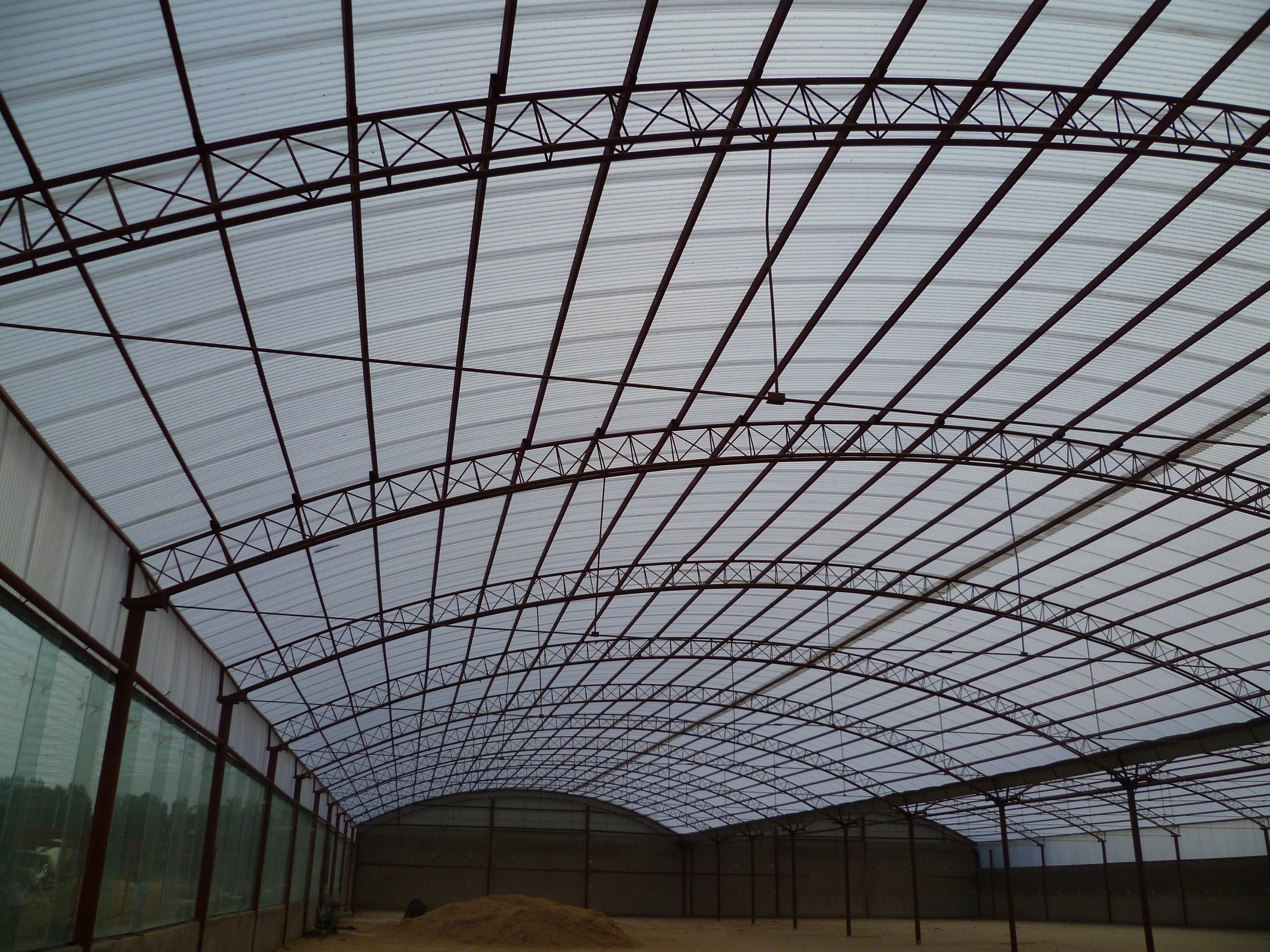
Table of Contents
Polycarbonate is a thermoplastic glazing material considered in horticulture where light transmission, structural detailing and impact behavior all matter. Glass, flexible film and rigid sheets present different combinations of optical behavior, weight, replacement needs, framing and maintenance; no material ranks best without a defined construction and site. Polycarbonate can be supplied in flat or profiled forms, while some multi-wall constructions create air spaces that may improve thermal performance in a suitable assembly. Whether any of these advantages applies depends on the exact products and the greenhouse design.
For greenhouse purposes the category is usually divided into three physical forms, and the first thing a buyer should understand is that these three forms are not interchangeable variants of one product. They behave differently, they are fixed differently, they span differently and they insulate differently. Confusing them is the single most common source of a poor covering decision.
Solid (compact) sheet is a continuous polycarbonate panel without internal cells. It can offer a transparent covering, but clarity and light transmission depend on thickness, color, surface finish and the exact product. It has no cellular air spaces, so its thermal performance must be evaluated as part of the complete covering assembly rather than inferred from its name. A framed greenhouse application may consider a solid sheet where its optical characteristics and installation details meet the growing and structural brief.
Hollow (multi-wall or cellular) sheet has parallel skins joined by internal ribs or webs, creating channels that influence stiffness, heat transfer and light distribution. Different cell geometries and panel constructions should not be assumed to share a single insulation or transmission value. Cut edges require the closure and drainage treatment specified for the actual product and assembly; otherwise moisture or debris may become a maintenance concern. Whether this form is preferable depends on the project's optical, thermal and detailing requirements.
Corrugated sheet is a profiled sheet, sinusoidal or trapezoidal in section, that gains stiffness from its corrugation and that is designed to nest with profiled construction. It is used where a translucent strip must sit inside or alongside a profiled roof, or where a simple profiled covering is wanted over a wide span. Its corrugations also channel water and influence how the covering drains and how it laps.
It is worth being precise about what a public vendor catalogue does and does not tell you. The Pingyun public catalogue presents a Polycarbonate Sheets category and, beneath it, three sub-categories that mirror the division above: a Polycarbonate Solid Sheet sub-category, a Polycarnobate Hollow Sheet sub-category (the catalogue's own spelling) and a Polycarbonate Corrugated Sheet sub-category [1]. Two public product pages sit under those sub-categories: a daylighting sheet that is filed under the corrugated sub-category and whose title names greenhouse use and UV protection [4], and a clear sheet that is filed under the solid sub-category and whose title names agriculture and a long service term [5].
That is a statement about catalogue structure and page titles, and nothing more. A category page tells you that a form exists in the catalogue; it does not tell you the dimensions, the transmission, the load capacity, the fire behaviour, the warranty or the service life of the form. A product page title tells you how a page is named; it does not convert one page's promotional figures into a property of the whole line. The disciplined reading — and the one this guide uses — is to treat the catalogue as evidence that the forms and pages exist, and to treat everything else as something to be confirmed in the current controlled documents for the exact product being bought.
Two coverings can both honestly be called polycarbonate and still be entirely different purchases. A single-skin solid sheet and a multi-wall cellular sheet share a polymer but differ in insulation, weight, light loss and structural behaviour. A corrugated sheet nests into a profiled roof; a flat sheet is bedded into a flat or glazed frame. If a specification says only "polycarbonate" without saying which form, which profile, which construction and which fixing system, it has not actually specified anything that can be quoted or inspected.
The practical consequence is that the covering decision should always be made at the level of the assembly, not the level of the material. The assembly is the sheet plus its profile plus its edge treatment plus its fixings plus the frame it lands on plus the flashing and gutters that finish it. This guide returns to that idea repeatedly, because the same sheet that performs well in one assembly can disappoint in another, and the failure is usually attributed to the material when the real cause is the assembly.
A greenhouse covering is one of the few purchases a grower makes that is judged continuously, in public, in all weathers, for as long as the house stands. It is also a purchase that interacts with almost everything else: light transmission affects yield potential, insulation affects heating cost, condensation affects disease, and cleanliness affects all three. That is why the covering decision deserves to be treated as an engineering and horticultural decision rather than a commodity purchase. The sections that follow work through the environmental and operational factors one at a time, in the same order a careful specifier would raise them.
Light is the reason a greenhouse exists. The covering's first job is to let the right amount of the right kind of light reach the canopy, and the second job is to do so without the covering itself becoming the limiting factor. The mistake that causes the most trouble is treating "light" as a single quantity. It is not. There is the total amount of light over a day, the distribution of that light through the day and across the house, the spectral quality of the light, and the portion of the spectrum beyond what plants use — and each of these is affected differently by the covering.
Plants use a specific band of the spectrum for photosynthesis, commonly described as photosynthetically active radiation, and horticultural planning usually thinks in terms of that band rather than in terms of human brightness. Ultraviolet radiation is a different part of the spectrum from the photosynthetic band; it is largely outside what photosynthesis uses directly, and it is also the part of sunlight that most aggressively degrades materials. These two things must not be confused. A covering that is said to have "UV protection" is making a statement about how the covering manages ultraviolet radiation — usually to protect its own material from degradation — and that statement is not, by itself, a claim about how much photosynthetic light the covering transmits or how a crop will grow.
Keeping the two separate matters for two practical reasons. First, a buyer who reads "UV protection" and hears "better growing light" has misread the label, because the two are different physical quantities. Second, a buyer who reads "high light transmission" and assumes it also means the sheet will not degrade has made the mirror-image mistake. The controlled technical documents for the actual product are the only place where the specific, product-level statements about light transmission and ultraviolet management belong, and those numbers must not be borrowed from a general description or from a different page.
Different crops and different production goals have genuinely different relationships with light. Leafy crops grown for vegetative mass often tolerate and can even benefit from relatively diffuse, moderate light, whereas fruiting crops generally want more total light to drive the energy balances behind flowering and fruit development. Ornamental and flowering crops may be more sensitive to day length and to the balance of light through the season than to the absolute peak. Seedling and propagation stages are frequently the most light-critical and the most light-sensitive at the same time, because young plants are easily stretched or scorched depending on how evenly and how intensely light arrives.
A covering decision that ignores this spread will tend to over-serve some crops and under-serve others. The useful discipline is to name the crop or crop mix, name the production stage or stages the house will run, and state whether the house will be used year-round or seasonally. Those three facts, more than any catalogue figure, tell a designer which form of covering and which shading strategy make sense.
Even a single crop does not want the same light at every stage. A propagation house, a vegetative house and a finishing house can have quite different light requirements, and a single structure that must serve all three at different times may need the covering to be modifiable rather than fixed. That is one reason shading in greenhouses is so often handled by removable or movable means rather than by permanently selecting a darker covering: a permanently tinted roof solves the summer problem and creates a winter problem.
This is also where the difference between solid, hollow and corrugated forms becomes a horticultural question rather than merely a structural one. A form that transmits light very cleanly may suit a stage that needs maximum light; a form with internal cells may lose a little light at every internal surface but gain insulation that helps a stage that runs in cold nights. Neither is right in the abstract. The right answer depends on which stage the house is really for.
The total amount of light is only one part of the story; how evenly it arrives is the other. A covering that concentrates light into bright bands and deep shadows produces uneven growth, uneven ripening and uneven demand on irrigation and climate control. Uniformity depends on the geometry of the frame as much as on the sheet, because every structural member casts a shadow, and a heavy frame with close members throws more shadow than a light frame with wide spacing. When the covering is selected, the frame that carries it should be reviewed at the same time, because the two together determine the light field the crop actually experiences.
Some covering products are designed to diffuse light as it passes, spreading it more evenly across the canopy instead of delivering hard beams. Whether diffusion is helpful depends on the crop and the climate, and the specific behaviour of any product must be taken from that product's controlled literature rather than assumed from a general description of the category. What a specifier can do without any product-specific number is to state the requirement plainly: the house must deliver light evenly enough to avoid troublesome shadowing and bright spots, and the frame and covering together must be reviewed against that requirement.
Before any covering is selected, it is worth writing down, in plain language, what is actually required. Which crop or crops? Which production stages? Year-round or seasonal? Is maximum light the priority, or is a degree of light management and heat reduction equally important? Is the local climate light-limited in winter or light-abundant — even excessive — in summer? These answers do not produce a number, but they produce the brief against which a designer can test a covering, a shading system and a frame. Without that brief, a covering choice is just a preference, and preferences are expensive to correct after the house is built.
A greenhouse works by holding a temperature difference between inside and outside. In winter it must slow the escape of heat that the sun or the heating system put into it; in summer it must resist the accumulation of heat that the sun is pouring in. The covering sits at the centre of both problems, and the single most important physical feature it brings is trapped air. Still air is a poor conductor of heat, so any covering that contains pockets of still air between layers will slow heat transfer better than a single layer of the same material. That is the entire principle behind multi-wall, cellular and twin-wall constructions.
In a solid single-skin sheet, heat crosses the material directly, and the only resistance is the material's own conductivity plus the thin boundary layers of air clinging to each face. In a hollow multi-wall sheet, heat has to cross several solid skins and several channels of still air in series, and each interface adds resistance. This is the same reason a double-glazed window insulates better than a single pane. The practical result is that a hollow sheet can provide a meaningfully higher level of insulation than a solid sheet of comparable overall thickness, which is exactly why hollow forms are so often chosen where night-time heat retention and winter fuel cost are major concerns.
The insulation question, however, is not the same as the light question, and the two pull in opposite directions. Every extra internal layer that helps trap heat also introduces additional surfaces where light is reflected or absorbed, and it can also trap condensation that reduces transmission further over time. The knobs are not independent. A designer choosing between forms is really balancing a light budget against a heat budget, and the correct balance is set by the crop, the climate and the cost of heat, not by a general preference for "more insulation" or "more light".
It is important to separate two different things that both get called "temperature". One is the difference between inside air and outside air, which drives heat loss and heat gain through the covering. The other is the temperature the crop itself experiences — leaf temperature, root-zone temperature and the temperature of the air immediately around the plants — which is what actually governs growth, flowering and stress. These are related but not identical, because the covering also modifies the radiation reaching the canopy and the movement of air around it.
A covering with strong insulation reduces the rate at which the house loses heat, but it does not by itself guarantee that the crop stays warm, because heat distribution, air movement and the behaviour of the heating system all matter too. Conversely, a covering that lets more heat escape may be entirely adequate in a mild climate where the night-time difference is small and the crop is tolerant. The point is that "how much insulation" is a question that must be answered against the actual expected temperature difference at the site and the actual tolerance of the crop, both of which are project-specific facts.
The same covering has to solve two opposite problems at two different times of day. At night, in a cold season, the house is trying to retain heat, and insulation through the covering is an ally. During the day, in a sunny season, the house is trying to avoid overheating, and every bit of trapped heat in the covering becomes a liability, because the structure must then be ventilated or shaded to remove it. A covering chosen only for its night insulation can make the daytime heat problem harder, and a covering chosen only for its summer cooling can make the winter heat bill higher.
This is why greenhouse climate design so rarely lives on the covering alone. It lives on the combination of covering, ventilation, shading and, where the climate demands it, active cooling. The covering sets the baseline rate of heat exchange; the other systems trim around that baseline. Selecting a covering without considering the ventilation and shading it will be paired with is like choosing a coat without knowing the climate you will wear it in.
There is a subtle interaction between insulation and condensation that is easy to miss. Any surface inside the house that is colder than the dew point of the air will collect condensation, and in a multi-wall sheet the internal surfaces are among the coldest, because they sit between the warm interior and the cold exterior. Condensation inside the cells is a known behaviour of cellular coverings, and it is why the disposition of the channels, the sealing of cut edges and the orientation of the sheet all matter. The insulation that makes the covering valuable is also the reason moisture management has to be thought through rather than assumed.
This does not mean hollow forms are a problem; it means they demand design attention. The condensation that forms has to be given somewhere harmless to go, and the sheet has to be oriented and sealed so that water does not accumulate where it degrades the covering or drips onto the crop. The correct orientation and edge treatment come from the controlled installation guidance for the exact product.
Insulation value ultimately shows up in an economic question: how much heat has to be supplied at night, and how much cooling has to be supplied during the day, to hold the crop where it needs to be. Reducing heat loss lowers the fuel or power required, which is the main reason insulated coverings command a premium. But that premium only pays back if the climate actually imposes a meaningful temperature difference and if the house actually runs when the difference is large. In a climate where the night-time difference is modest and the crop tolerates it, the extra insulation may be buying less than it costs.
The honest position is that insulation choices should be justified against a project-specific energy picture, and that the specific insulation performance of any covering must be taken from that product's controlled documentation rather than estimated from a category description. What can be stated in general, and safely, is the principle: trapped air slows heat loss, more layers trap more air, and more trapped air means less heat loss — at the cost of a little light and a little more design care around condensation.
Before the form is chosen, the specifier should be able to state the expected winter night-time temperature difference at the site, the crop's minimum tolerable temperature, whether the house will be heated and to what level, and how the daytime heat will be removed in summer. With those four things stated, the insulation choice becomes a reasoned trade rather than a guess. Without them, "insulated polycarbonate" is just a phrase, and a phrase cannot be quoted, checked or defended after installation.
In most climates the same covering that helps in winter becomes the difficulty in summer. A greenhouse is a solar collector by design: sunlight enters through the covering, is absorbed by the plants, the soil and the structure, and is re-radiated as heat that cannot all escape back through the glazing. The result, on a bright day, is that the interior warms well above the outside air unless the heat is removed or prevented from entering. Managing that is a three-part problem — reduce the heat that enters, remove the heat that gets in, and keep the air moving evenly while both are happening — and the covering choice interacts with all three.
The covering determines how much solar energy is admitted in the first place. A clear covering admits the most, which is usually wanted in a light-limited winter and can be a liability in a heat-limited summer. Tinted or coloured coverings, and coverings that diffuse or reflect a portion of the incoming radiation, reduce the admitted load but also reduce the light available to the crop, which loops straight back to the light discussion in the previous section. There is no covering that maximises both light in winter and heat rejection in summer, because those two goals trade against each other through the same surface.
That is why the covering is best chosen together with the shading strategy rather than before it. If summer heat rejection is going to be handled by removable shading, the covering can stay as clear as the winter crop needs. If shading is fixed, then the covering itself may need to be more heat-managing, and the winter light penalty has to be accepted or offset.
Shading is the deliberate reduction of incoming solar radiation, and it can be fixed or movable, internal or external, applied as a coating or provided as a physical screen. The general principle that has held for greenhouse design for decades is that shading placed outside the glazing reduces the heat load on the house more effectively than shading placed inside, because external shading stops the radiation before it enters and becomes trapped heat, whereas internal shading stops the light but leaves much of the heat already inside the structure. That is a durable principle, and it is worth stating carefully because it is often overlooked.
Shading has a cost, though, and the cost is light. Every gram of shade is light the crop does not receive, so shading must be applied with the crop's real needs in mind, and it must be adjustable if the crop's needs change through the season. This is exactly the argument for movable or removable shading over fixed and permanent shading: it lets the house be light-rich when light is scarce and heat is not a problem, and heat-managing when light is abundant and heat is the threat.
However well a covering and its shading are chosen, some heat will enter, and the house must be able to remove it. Ventilation does that by exchanging interior air with cooler exterior air, and greenhouse design has long relied on two mechanisms: natural ventilation, driven by wind and by the buoyancy of warm air, and forced ventilation, driven by fans. Natural ventilation through ridge and side openings is the traditional and often sufficient approach in temperate conditions, while forced ventilation is called on when natural air exchange cannot keep up with the load.
The performance of natural ventilation depends on the total area of the openings, the wind speed, and the temperature difference between inside and outside — three things that are all site-specific. The historical design rule of thumb that a vent area of a certain fraction of floor area is needed is exactly the kind of generic figure that should not be transplanted to a new project, because it was developed for particular conditions and particular crops. The durable principle, rather than the number, is that ventilation must be sized against the actual peak heat load and the actual climate, and that air must be able to move through the house rather than merely in at one end.
The crucial insight is that covering, shading and ventilation are one system. A clear covering raises the demand on shading and ventilation; heavy fixed shading lowers the light and may reduce the ventilation demand; good ventilation can rescue a house that would otherwise overheat under a clear covering. Change one and the other two must be re-checked. A specification that fixes the covering without revisiting the shading and ventilation it implies has fixed only a third of the problem.
There is also a spatial dimension: heat and humidity do not distribute evenly, and the movement of air inside the house determines whether the crop experiences a uniform environment or pockets of stagnation and hot spots. This is why ventilation design is not only about total air exchange but about where the air enters, where it travels and where it leaves. The general principle is to arrange openings and, where used, circulation, so that the whole canopy is served, not just the parts nearest the inlets.
Where ventilation alone cannot hold the temperature down, evaporative cooling is the conventional next step, using the evaporation of water to cool the incoming air. It cools effectively but it raises humidity in the process, which connects directly to the condensation and disease discussion later in this guide. The choice to use evaporative cooling therefore changes the moisture balance of the house, and the covering must be able to cope with the higher humidity that results. Again, the covering is not a standalone decision; it is a participant in a climate system.
Before the covering is finalised, the specifier should be able to say how much light the crop needs in its light-limited season, how much heat the house must reject in its heat-abundant season, how that heat will be removed, and how shading will be applied and adjusted. Those four answers determine which covering, which shading and which ventilation make sense together. Any of them changed later forces the covering back onto the table, which is why deciding them before the order is placed saves far more than it costs.
Water is present in every greenhouse. It is transpired by the crop, released by irrigation and misting, drawn in with ventilation and produced by any evaporative cooling. All of that vapour has to go somewhere, and a covering that handles moisture badly turns an invisible atmospheric condition into a visible daily problem: fog on the glass, water pooling in cells, and drips falling onto leaves and fruit. Condensation and dripping are among the most common and most misunderstood greenhouse covering complaints, and they are worth understanding properly because they are often a design issue rather than a product defect.
Air can hold only a limited amount of water vapour, and that limit falls as the air cools. When warm, moist greenhouse air meets a surface that is cooler than its dew point, the excess vapour condenses onto that surface as liquid water. In a greenhouse, the coldest surfaces are usually the covering itself on a cold night, which is why the underside of the roof is where condensation appears first. This is normal physics, not a fault, and it happens to glass, to film and to polycarbonate alike. The design question is not how to prevent condensation entirely — that is generally not possible — but how to manage it so that it does harm neither to the crop nor to the covering.
Multi-wall and cellular coverings behave in a specific way here. Because they have internal surfaces, some condensation can form inside the cells as well as on the exposed underside. That internal condensation is a recognised behaviour of the form, and it is one of the reasons the cut edges of cellular sheets are sealed and the sheets are oriented in a particular way: the intent is to keep water where it can drain and to prevent it from accumulating and degrading the product or leaching into the house.
Water that condenses on a roof must eventually return to the ground, and the trouble is the path it takes. If condensation coalesces into droplets large enough to fall, those droplets land on the crop below, and continuous dripping onto foliage is a recognised route for the spread of foliar disease and for marking of fruit and ornamentals. This is why anti-drip and anti-condensation approaches exist: surfaces are engineered so that condensed water spreads into a thin film that runs down to the gutters instead of gathering into falling drops.
Whether a particular covering manages condensation by film drainage or by another mechanism is a product-specific matter that must be taken from that product's controlled documentation, and it should never be assumed from a general description of the category. What the specifier can state as a requirement, without any product-specific number, is that the covering and its fixings must be designed so that condensate is guided to the gutters rather than allowed to drip freely onto the canopy, and that the need for this must be confirmed for the actual product and the actual roof geometry.
Condensate becomes controllable only when it has somewhere to go, and where it goes is decided by the roof geometry. Gutters must be sized and positioned to collect both rainfall and the run-off from condensation, and they must be able to carry that water away without ponding. Where a translucent covering meets an opaque one, the interface must be detailed so that water from one does not run onto or under the other. And the cut edges of cellular sheets — where the internal channels are exposed — must be closed or sealed in the manner the product's controlled guidance requires, because those edges are simultaneously the place where water can enter the cells and the place where it can drain out.
This is one of the clearest examples of the covering being an assembly rather than a sheet. The same sheet can shed condensation cleanly or drip persistently depending on how the roof drains, how the edges are treated and how the fixings sit. A buyer who specifies the sheet but not the drainage path has specified half a roof.
Condensation is ultimately a function of humidity, temperature and air movement, so it is not solved by the covering alone. Higher humidity raises the dew point and makes condensation more likely; better air movement reduces cold spots and carries vapour away; and a higher night temperature reduces the temperature difference that drives condensation in the first place. This is why condensation control and climate control are the same conversation. Evaporative cooling, for instance, deliberately raises humidity, which will increase condensation unless the house is managed for it.
The practical consequence is that the covering's condensation behaviour must be judged against how the house will actually be run. A house operated at high humidity for a humidity-loving crop will put more demand on condensation management than a house run dry. The right covering and the right drainage detail depend on the operating regime, and that regime is a project-specific fact.
Before ordering, the specifier should know the expected internal humidity range and how it will be controlled, the roof geometry and how it drains, how the cut edges of any cellular sheet will be treated, and whether the product being bought is documented to manage condensation in the way the project needs. None of these can be answered by a general category description; all of them should be answerable from the controlled documents and drawings for the actual product and the actual roof.
The local environment does not stop at temperature and light. Salt, dust, industrial emissions, agricultural chemicals, sand and biological growth all attack a greenhouse covering in ways that a mild inland site never will, and they determine both how the covering should be specified and how often it must be cleaned. The general rule is that the harsher the environment, the more the covering's long-term appearance and transmission depend on deliberate selection and deliberate maintenance rather than on the material alone.
A greenhouse near the coast is bathed in airborne salt, which deposits on the covering and, in the presence of moisture, becomes a corrosive agent. Salt films reduce light transmission by scattering and absorbing light, and they can attack unprotected metal components such as fixings, flashings and frames. The practical implications are two-fold: the covering will need cleaning more often than an inland equivalent because salt haze accumulates quickly, and every metallic part of the assembly should be specified for a corrosive atmosphere rather than assumed adequate.
Salt does not usually damage the polycarbonate sheet's bulk material the way it corrodes steel, but it degrades the system around the sheet and it degrades performance by fouling the surface. A coastal project should therefore treat cleaning frequency and the corrosion protection of fixings and frames as first-order design decisions, not afterthoughts.
In dry, dusty or sandy regions, wind-borne particles settle on the covering and are periodically driven against it. Settled dust reduces transmission and, because it is abrasive, it can dull a surface over years of being wiped across by wind and by cleaning. Sites close to unpaved roads, quarries, construction activity or bare farmland can experience these effects far more than their general climate suggests. The response is again two-fold: a covering whose exterior surface is engineered and documented for abrasion resistance will fare better, and a cleaning regime that removes abrasive grit gently rather than grinding it into the surface will preserve transmission longer.
Industrial and urban locations add airborne chemicals to the mix. Depending on the local industry, these can include acidic and alkaline particulates and gases that deposit on the covering and, in combination with moisture and sunlight, can attack surfaces and accelerate soiling. Greenhouses near such sources may also be exposed, in some locations, to fallout that is simply unavoidable and that must be washed off regularly to keep the covering functioning. As with salt, the covering material is only part of the story; the fixings, seals and frames are often the more vulnerable components and should be specified accordingly.
The environment inside a greenhouse is not neutral either. Growers use cleaning agents, sanitisers, pesticides and fertilisers, and some of these can be aggressive to certain plastics, to sealants or to coatings if they are applied to the covering or drift onto it. This is a frequently overlooked risk: a chemical that is entirely appropriate for the crop can be harmful to the covering or to the seals around it. The safe practice is to check the compatibility of any chemical that may contact the covering against the product's controlled guidance before routine use, and to avoid contact where compatibility is unknown.
Warm, humid environments grow things. Algae, mould, lichen and moss can establish on persistently damp surfaces, particularly near gutters, in shaded areas and on north-facing slopes that stay wet longer. Biological growth reduces transmission, holds moisture against the surface and can stain the covering. It is managed by keeping the covering clean and dry as far as possible, by ensuring that shaded and low-lying areas drain, and by following the manufacturer's guidance on cleaning agents rather than using whatever is to hand.
The environment should change at least four things in the specification. First, the frequency of cleaning, which rises with salt, dust and biological load. Second, the corrosion specification of every metallic component in the assembly. Third, the choice of seals, gaskets and any exposed coatings, which must be compatible with the local chemistry and the chemicals used inside. Fourth, the maintenance budget and access provision, because a covering that needs frequent cleaning needs a safe, practical way to be cleaned. None of these depends on a single number; all of them depend on the actual site, which is why a site assessment belongs in every serious greenhouse covering project.
Every covering is a surface exposed to weather, and weather pushes and pulls on it. Wind creates pressure and suction; snow and ice add weight; hail and wind-borne debris add impact. These loads do not act on the sheet in isolation — they act on the sheet as it is carried by the frame — so the structural question is always about the covering-and-frame assembly, not the sheet alone. This is the part of the decision where the cost of getting it wrong is highest, because a structural failure is not an inconvenience; it is a hazard and a total loss.
Wind does two things to a roof: it pushes on the windward face and, just as importantly, it sucks on the leeward face and across the surface. Suction is frequently the dominant effect on lightweight roofs, because it tries to lift the covering off its fixings, and a covering that is well enough fixed for gravity may still fail under suction. The loads depend on the local wind climate, the exposure of the site and the height and geometry of the house, so they must be calculated for the project rather than assumed. The durable principle is that the covering must be fixed to resist uplift, not merely to hold the material in place under its own weight.
Snow load is a weight that sits on the roof until it is removed or melts, and it can be compounded by ice and by freezing rain. The magnitude depends on the local snow climate, the roof slope and how snow is expected to accumulate or shed, and again it must be calculated for the project. Two design features matter repeatedly. The first is the roof slope, because a steeper roof sheds snow more readily than a shallow one. The second is the frame spacing, because the covering spans between supports and the load it carries depends on how close those supports are. Snow that slides off a warm covering can also fall unexpectedly, so the area beneath an eave is a place to keep clear.
Hail is an impact load rather than a steady one, and its severity depends on hail size, frequency and direction, which vary strongly by region. Polycarbonate is generally chosen in hail-prone areas for its impact tolerance relative to glass, but impact tolerance is a product property that must be taken from the product's controlled data, not assumed from the material family. A covering that resists an impact is not necessarily undamaged by it, and the accumulation of small impacts over years can affect appearance and transmission even when no single strike is catastrophic. Where hail is a known risk, the project should ask specifically about the documented impact behaviour of the exact product, and should plan inspection after significant hail events.
Ice adds weight and can also load fixings and gutters unevenly. Severe cold can change the behaviour of sealants and gaskets and can make some materials more brittle, so a cold-climate project should confirm that every component in the assembly — sheet, seal, gasket, fixing — is documented for the expected low temperatures. The principle is that the coldest expected condition must be part of the specification, not an afterthought discovered in the first hard winter.
Loads are carried by the frame through the fixings, so the chain is only as strong as its weakest link. A strong sheet on a weak frame, or a strong frame with inadequate or badly spaced fixings, will fail. The spacing of supports, the size and type of fixings, the number of fixings per sheet and the details at edges and corners all determine the real capacity of the assembly, and all of them are design decisions that must be made together for the specific loads.
This is also where the fixings' role in thermal movement appears, because a fixing must hold the sheet down without immobilising it so completely that thermal movement tears it or the frame. The two functions — restraint and allowance for movement — must be satisfied by the same fixing detail, which is why fixings are so often the focus of failures. A general guide cannot give the spacing or the type; only the controlled structural design for the project can.
Different forms tolerate loads differently. A corrugated sheet gains stiffness from its profile and may span further between supports than a flat sheet of the same material. A hollow multi-wall sheet has depth and internal structure that contribute to stiffness but may also be more sensitive to local point loads. A solid sheet is uniform and predictable but relies entirely on its thickness and its supports. The correct choice among these depends on the loads, the spans and the support arrangement, and it must come from the structural data for the exact product applied to the project's own load case.
Before committing, the project should obtain the site's wind and snow design information, the geometry and slope of the roof, the intended support spacing, and the structural data for the exact covering product that will be used. With those in hand, the responsible engineer can confirm that the covering-and-frame assembly is adequate for the site. Without them, any claim that a covering "will take the weather" is unsupported. Loads are the clearest example in this whole subject of why generic figures cannot be transplanted between projects.
Polycarbonate, like most materials, changes size with temperature. A covering that is fixed rigidly at every point has nowhere to go when it expands, so the movement turns into force against the fixings, the frame and the sheet itself. Over enough hot-and-cold cycles that force finds the weakest point, which is often a fixing hole, an edge or a joint. Designing for thermal movement is therefore not an optional refinement; it is a basic requirement of a durable covering, and it is bound up with how the frame is built and how the fixings are arranged.
A greenhouse covering experiences large temperature swings. It is hot in the sun and cold at night; it can be heated from inside on a cold day and chilled by wind on a warm one. The material expands and contracts with each swing, and on a long sheet the cumulative movement can be substantial. If the sheet is over-constrained, the movement appears as stress, which can bow the sheet, enlarge fixing holes, loosen fastenings, open joints or crack edges. If the sheet is correctly detailed, the same movement is accommodated harmlessly by allowing the material to slide and by leaving the right allowances at edges and in the fixing detail.
Frames move too, and different frame materials move by different amounts. A metal frame and a polycarbonate covering do not expand at identical rates, so the interface between them is where mismatched movement has to be absorbed. This is why the frame material, the fixing method and the movement allowances must be designed as one detail. A frame chosen for strength alone, without regard to how it will behave with the covering through temperature cycles, is an incomplete design.
The essence of a good fixing detail is that it holds the sheet against wind and load while allowing it to move. In practice this is achieved with fixings that are positioned and sized so that the sheet can shift slightly, and with edge details that leave room for expansion rather than pinning the sheet at its perimeter. The amount and the way of providing this allowance depend on the product and the design, and the specific values belong in the controlled installation documentation.
Two things are worth stating generally. First, fixing holes and fixings must be detailed to suit a moving sheet, not a rigid one. Second, the edges of the covering must be free enough to move, which often means the edge detail is a designed component rather than a simple trim. Where these two are done well, thermal movement is invisible; where they are not, it is a recurring source of leaks and failures.
Where a translucent covering meets an opaque one, or one form meets another, the interface has to accommodate both movement and water. The joint must be flexible enough to move with the materials and sealed enough to keep water out, and it must be detailed so that the two materials do not damage each other as they move. Interfaces that are left unspecified are typically improvised on site, and an improvised detail cannot be inspected against a drawing. The disciplined approach is to draw and approve the important interfaces before fabrication.
The perimeter of any covering is where movement concentrates and where weather most easily gets in. For cellular sheets, the cut edges expose the internal channels and must be treated as the product's guidance requires, both to manage movement and to manage moisture. For all forms, the edge fixing must allow movement while sealing against wind-driven rain. This is a detail that is easy to neglect and expensive to get wrong, and it should be explicitly designed rather than left to the erector's habit.
The specifier should require that the covering be detailed to accommodate thermal movement, that the fixings be specified for the actual product and the actual frame, that the perimeter and interfaces be drawn and approved, and that the controlled installation guidance for the product be followed. None of these requires a number in this guide, because the numbers are product- and project-specific; all of them require that movement be treated as a design input rather than an inconvenience discovered later.
Ultraviolet radiation is the part of sunlight that does the most damage to polymers. Left unmanaged, it breaks down the surface of many plastics over time, causing yellowing, hazing and embrittlement, and it is one of the main reasons a glazing product can look fine for years and then deteriorate comparatively quickly. Because of this, polycarbonate glazing products for outdoor use are commonly made with an ultraviolet-management system, and a buyer will often see the phrase "UV protection" on a product page. Understanding what that phrase can and cannot mean is important, because it is one of the most loosely used terms in the category.
The face of a covering that points at the sky receives the sun directly and takes the bulk of the ultraviolet dose. It is therefore the face that is engineered for ultraviolet management in products that use a surface treatment or a co-extruded layer. This is why the phrase "outer face" matters: if a covering has a protected face, that face has to be installed facing out. Installing such a sheet the wrong way round can leave the unprotected face exposed, which defeats the purpose of the product. Confirming which face goes outward, and how it is marked or identified, is a basic installation discipline.
The phrase is best understood as a statement about the product's own durability under ultraviolet exposure — an intent to slow the degradation of the material itself. It is not, by itself, a statement about how much light the product transmits, what the spectrum of the transmitted light is, or how a crop will grow beneath it. Confusing ultraviolet management with photosynthetic light quality is a common and consequential error, because the two are different physical properties and neither can be inferred from the other. A product page that names ultraviolet protection is telling you something about how the sheet is built to survive the sun; it is not telling you a transmission figure or a growth result, and neither should be read into it.
The Pingyun daylighting product page that is filed under the corrugated sub-category names greenhouse use and uses the wording "UV Protection" in its title [4]. That is a fact about what the page is called and what applications it names. It is not a quantified statement about transmission, spectral behaviour or service life, and it must not be expanded into one. The same discipline applies to any other public page: a phrase in a page title or a bullet in a feature list describes the page, and its promotional numbers stay with that page and that product rather than becoming properties of a whole category. Translating page wording into a performance guarantee is exactly the step that this guide refuses to take.
The quantified ultraviolet and light-transmission behaviour of a product is a measurable property, and like all such properties it must be taken from the controlled technical data for the exact product. Different products in the same family manage ultraviolet radiation differently and transmit light differently, and the only reliable statement is the one attached to the specific product being purchased, under stated test conditions. Borrowing a figure from one product page and applying it to another is unsound, and this guide does not do it.
Where ultraviolet management is effective, the covering resists the yellowing and hazing that would otherwise reduce its transmission and change its appearance. That is the reason the property is specified: to preserve the covering's function and appearance over its service life. But how well any particular product preserves its transmission, and for how long, depends on the product, the climate, the exposure and the maintenance, and the honest statement is that the meaningful figure is the documented one for the specific product under the specific conditions. A general guide can explain the principle — manage the ultraviolet so the material does not degrade — but it must not manufacture a service life or a warranty out of that principle.
The specifier should confirm which face of the product is the protected face and how it is identified, that the product is documented for the exposure conditions of the site, and that the product's controlled literature, not a general description, supports the ultraviolet and transmission statements the project is relying on. These confirmations turn "UV protection" from a marketing phrase into a checked requirement, and they cost nothing but attention at the specification stage.
A covering is one of the few parts of a greenhouse that can be improved, or ruined, by routine housekeeping. Transmission declines as the surface soils; biological growth holds moisture against it; abrasive grit and careless cleaning can dull it; and a small fixing or sealing fault can grow into a leak. Maintenance is also where the covering's life is actually decided, because a covering that is cleaned and inspected properly will generally outlast the same covering that is neglected. The subject splits naturally into cleaning, inspection and the documentation that keeps both honest.
The goal of cleaning is to restore transmission by removing what has settled on the surface — dust, salt, pollen, biological growth, and airborne fallout — without damaging the surface in the process. The hazards are equally clear. Abrasive cleaning, aggressive solvents, hard water left to dry, and hot or high-pressure water can all harm the covering or leave it worse off. The safe principle is to use a mild method appropriate to the product, to remove abrasive grit gently rather than grinding it, and to follow the product's own cleaning guidance rather than improvising with whatever is available.
Because different products tolerate different agents, the cleaning regime must be based on the product's controlled guidance, not on folklore. A chemical that is harmless to one covering can attack another, and some agents can harm seals, gaskets or fixings even when they are gentle on the sheet. Compatibility should be confirmed before any agent is used at scale.
Inspection is the process of catching small faults before they become large ones, and it should be scheduled rather than reactive. The things worth looking at repeatedly are the fixings and their integrity, the seals and edge treatments, the condition of gutters and their outlets, the appearance of the surface for hazing or staining, and any sign of movement, cracking or distortion in the sheet or the frame. After significant weather — a storm, a heavy snow, a hail event — a targeted inspection is worthwhile, because the covering may have been loaded or impacted beyond its normal duty.
A simple inspection schedule with a written record is far more valuable than an occasional informal look, because it turns the history of the covering into evidence. If a fixing starts backing out or a seal starts to fail, catching it early is the difference between a five-minute correction and a leaking roof.
A covering that needs cleaning needs a safe way to be cleaned, and this is best designed in rather than improvised. Safe access to a greenhouse roof is a genuine constraint, particularly on large houses, and it affects both the feasibility and the cost of any cleaning regime. The roof structure must not be walked on carelessly, because point loads on a covering or a light frame can cause damage. Where access is difficult, the covering's design and the layout of the house should reflect that reality, because a maintenance regime that is unsafe will not be performed.
Maintenance is broader than cleaning. It includes checking and, where necessary, re-tightening or replacing fixings; maintaining gutters and downpipes so water is carried away; repairing or renewing seals and edge treatments; and correcting any local damage before it spreads. It also includes keeping an eye on the interaction between the covering and the systems around it — shading, ventilators, gutters — because faults in those systems can load or damage the covering. The covering does not exist in isolation, so its maintenance does not either.
The most underrated maintenance tool is documentation. A record of what was cleaned, when, and with what; what was inspected and what was found; and what was repaired, creates the history that supports any later claim and informs any decision about replacement. It also makes it possible to detect trends — increasingly frequent cleaning, slowly worsening appearance — before they become acute. Documentation costs almost nothing and is the difference between managing a covering and merely reacting to it.
Before construction, it is worth establishing who will clean the covering, how they will reach it safely, what agents are approved, how often cleaning is expected, and what will be inspected and recorded. These are not glamorous decisions, but they determine whether the covering performs for its intended life. A covering specified without a maintenance plan is a covering that will be judged by its first failure rather than by its working life.
A greenhouse covering purchase goes wrong most often not because the product was bad but because the order described the product inadequately. The cure is to define the purchase with documents rather than adjectives. Before ordering, the buyer should assemble a small set of controlled documents and a physical reference, and should make the order point to those documents as the definition of what is being bought. What follows is a checklist of the items that most commonly matter; the exact list depends on the project and the market, but the categories are stable.
Ask for a current technical data sheet that identifies the exact product — not the family, not the category, but the product that will be delivered — and that states its construction and its documented properties under stated conditions. The data sheet should identify the form (solid, hollow or corrugated), the profile where relevant, and the properties the project is relying on for light, insulation, impact and any other performance. Where a page or a catalogue lists several variants, the data sheet must be specific to the one being ordered.
Ask for a dimensional drawing showing the profile and the key dimensions, so that the geometry can be checked against the frame and against any adjacent material it must nest with. Where the covering meets other materials, ask for the interface details. Geometry that is only described in words tends to be interpreted differently by different parties, and interpretations cannot be inspected.
Ask for the installation guidance for the exact product, covering orientation (which face is the protected face, and which way the sheet is laid), fixing method and accessory requirements, edge treatment and sealing, and the movement allowances that must be respected. This document is what converts a sheet into a correctly built assembly, and it should be the current controlled version rather than a superseded one.
Ask for the order confirmation in a form that states the agreed product, quantity, dimensions, colour or finish, accessories and delivery basis, and for a packing list that identifies what was shipped. Where accessories such as fixings, seals, flashings or edge profiles are part of the assembly, they should be named in the order rather than assumed to be available later.
Where the project or the market requires compliance with a standard — fire performance, structural behaviour, food-contact safety for certain applications, or anything else — ask for the relevant declaration and confirm precisely what it covers. A declaration is only meaningful if its scope matches the product being bought and the requirement being relied upon; a document that covers a different product or a different property does not serve. The buyer should read the scope, not just the title.
A sample is valuable for three specific purposes: approving appearance and finish, confirming profile geometry where a fit is critical, and trying a fixing or edge detail on a mock-up. A sample is not proof of performance, and it is not proof that delivered goods will match it. If a sample is approved, it should be named in the order as the reference standard, a signed retained copy should be kept, and the order should state which properties the delivered goods must match. That converts the sample from a souvenir into a contractual reference.
Do not rely on a category page, a family name or a marketing phrase as the definition of the product. Do not rely on a figure that appears on a different product's page. Do not rely on an assumption that an accessory exists because the sheet exists. Each of these substitutions is a step away from a defined purchase, and each is a step toward a dispute. The discipline is to make the order point to specific, current, controlled documents and to a specific physical reference.
A quotation is only comparable to another quotation when both describe the same thing. The frequent mistake is to compare prices on a headline number and treat the cheapest as best value, when the offers behind those numbers differ in construction, accessories, documentation, quantity basis or delivery terms. Reading a quotation properly means reading the scope, the exclusions and the assumptions, not only the total. What follows is a structured way to do that.
Identify exactly what product the quotation covers: the form, the construction, the profile, the dimensions, the colour or finish, and the grade. Two offers for "polycarbonate greenhouse sheet" can be offers for two different products, and until the scope is the same, the prices are not comparable. Write the scope down and check that every offer covers the same scope before looking at the total.
A covering needs its fixings, seals, edge profiles and flashings. If an offer includes them and another does not, the "cheaper" offer may be incomplete rather than better. Check whether accessories are included, whether their type and quantity are specified, and whether they are compatible with the sheet and the frame. An offering that supplies a sheet without the accessories it needs is not a complete offer for a covering.
Confirm the unit of measure and how quantity is calculated: by area, by sheet, by linear measure, by pack. Check whether the price is per unit or for a stated total, whether it is based on the delivered dimensions or on nominal dimensions, and how waste and cutting are treated. A price that looks lower may simply be quoted on a different basis. Only once the basis is the same can the numbers be compared.
Confirm which documents are included: data sheet, drawings, installation guidance, declarations, warranty statement, and any test or approval documentation the project requires. An offer that omits the documentation the project needs is not equivalent to one that includes it, because the buyer will have to obtain it separately or do without it — and doing without it is rarely acceptable.
Confirm the delivery basis, who carries the risk of loss or damage in transit, how the goods will be packed, how they will be unloaded and who is responsible at each stage. Confirm the delivery period and the basis on which it is stated, and confirm what happens if it changes. Delivery terms are part of the purchase, and two prices on different delivery terms are not the same price.
Every quotation rests on assumptions, and the exclusions are where the real cost hides. Look for what the offer expressly does not include: unloading, installation, accessories, compliance documents, taxes, or the consequences of site conditions. A quotation whose exclusions remove half the scope is not a low price; it is a partial price. The honest comparison is between fully scoped offers.
Where anything in a quotation is ambiguous, ask for clarification in writing and keep it with the quote. A clarification that is not recorded does not exist when the dispute arrives. Written clarifications also force the scope to converge, which makes the offers genuinely comparable rather than superficially so.
Compare offers on scope, accessories, quantity basis, documentation, delivery and exclusions first, and compare prices only between offers that are genuinely equivalent on all of those. A price is a number in a context, and a number without its context tells you almost nothing about value.
A covering decision carries a handful of recurring risks, and the value of a simple risk matrix is that it forces those risks to be named, ranked and given an owner before the order is placed rather than after the first failure. The matrix below is qualitative on purpose: it ranks risk by how much it would hurt and how likely it is, and it points to the control that addresses it. It does not assign numeric probabilities or costs, because those depend on the project, and it does not replace the project's own risk process. It is a thinking tool, not a certificate.
The matrix is meant to be read left to right as a chain: a risk, why it matters, what makes it more likely, and what controls it. In practice, a project team should take each row, decide whether the risk applies to the project at all, decide how it will be controlled, and name the person responsible. Rows that apply strongly should be given explicit controls before the order is placed; rows that do not apply should be noted as considered and dismissed, so that the decision to dismiss them is on record.
The most valuable rows are usually the ones that are easy to skip. "Protected face installed inward" is almost never discussed and is easy to get wrong on site. "Condensation and dripping" is often treated as unavoidable rather than designed. "Inadequate cleaning access" is nearly always ignored until cleaning is impossible. These are the rows that separate a covering that works from a covering that is regretted, and they cost almost nothing to control if they are controlled early.
It is worth saying plainly that a risk matrix does not design anything. It identifies what needs designing. The controls named in the right-hand column — structural design, drainage design, cleaning access, documentation — are the actual work, and they belong to the project's designers and its supply chain, not to the matrix. The matrix simply makes sure the work gets done and that someone owns it. Used that way, it is one of the cheapest quality tools available to a greenhouse project.
The final discipline before an order is placed is to verify that every decision that matters is genuinely specific to the project rather than borrowed from a general description. This is the step that catches the errors that would otherwise surface only in service: a number that came from the wrong product, an assumption that a feature exists because a nearby page mentioned it, a load case that was never checked. The verification is a short, structured review, and it is worth doing explicitly rather than assuming it has been done.
Confirm that the exact product being ordered is identified unambiguously — form, construction, profile, dimensions, colour or finish, and grade — and that the controlled data sheet describes that exact product. Where the specification was written from a category page or a family name, close the gap by obtaining the specific product's data. A covering is not defined until the specific product is defined.
Confirm that every performance statement the project relies on — light, insulation, impact, fire, and so on — is supported by the controlled documentation for the exact product under stated conditions, and that no figure has been carried over from a different product or a different page. Where the project needs a property and the documentation does not provide it, that is a reason to ask, not a reason to assume.
Confirm that the site's environment has been assessed and reflected in the specification: the light climate, the temperature range, the humidity regime, the wind and snow loads, the hail risk, the salt or dust or chemical exposure, and the exposure of the site. Each of these should map to something in the specification rather than being left to the material to absorb by default.
Confirm that the covering-and-frame assembly has been designed for the actual wind, snow and impact loads of the site, that the support spacing and the fixings are specified for those loads and for the product, and that the movement allowances are detailed. This is the responsibility of the project's design professionals, and the buyer's job is to confirm that it has been done and to obtain the design basis in writing.
Confirm that the interfaces between the covering and adjacent materials are drawn and approved, that the perimeter and the cut edges are detailed, and that condensate and rainwater have a designed path to the gutters and away. Interfaces and drainage are where assemblies most often fail, so they deserve explicit verification rather than a general assurance that "it will be detailed".
Confirm that the controlled data sheet, drawings, installation guidance, declarations and warranty statement are in hand and match the product being ordered, and that the order itself points to those documents as the definition of what is being bought. Then check the order against the project's requirements one last time. A covering that is verified in this way is far more likely to arrive, be installed and perform as intended.
Finally, write down what was verified and what remains open. A verification that is not recorded cannot be demonstrated later, and open items that are not tracked tend to close themselves optimistically. A short written record of the verification, with owners and dates for anything outstanding, is the last thing to do before committing — and one of the most valuable.
The following points condense the guide into what a buyer should carry into a supplier conversation. They are deliberately written as actions rather than as slogans, because the covering decision is made in actions.
Choosing polycarbonate sheets for a greenhouse is not a single decision with a single right answer. It is a chain of decisions that starts with the crop and the climate and ends with a documented, inspected, maintained assembly. The material offers a genuinely useful combination of light transmission, stiffness and impact tolerance, and in its hollow forms it can add insulation that single-layer coverings cannot match. But those advantages are only realised when the form is matched to the light and heat budget, when the covering is detailed to shed water and to move with temperature, when the site's salt, dust, chemical and load realities are designed for, and when the purchase is defined by controlled documents rather than by adjectives.
The recurring theme of this guide is that the environment decides the specification. A house in a light-limited cold climate, a house in a heat-limited sunny climate, a house on a coast, a house near industry, a house in a snow region and a house in a hail region are not the same project, and they should not receive the same covering by default. The right approach is to start from the site and the crop, to state the requirements in plain language, to let the design professionals convert those requirements into a structural and thermal design, and then to buy against that design with the documents and the sample that make the purchase checkable.
It is worth repeating the boundary that this guide has held throughout. The Pingyun public catalogue divides its polycarbonate offering into solid, hollow and corrugated sub-categories, and two public product pages name a corrugated greenhouse sheet and a solid agriculture sheet respectively [1][4][5]. Those are catalogue and page facts. They are not performance guarantees, and no dimension, transmission figure, service life, warranty or application result should be inferred from them. Every specific value that a real project needs — thickness, span, load capacity, transmission, insulation, service life — belongs in the controlled documentation for the exact product and the exact project, and it must be confirmed there before anything is ordered.
A greenhouse covering is judged every day, in all weathers, for as long as the house stands. Approached as an engineering and horticultural decision rather than a commodity purchase, it can be the part of the house that quietly does its job for years. Approached as a price comparison on a catalogue page, it becomes the part of the house that everyone remembers for the wrong reasons.
They are light-transmitting glazing sheets made from polycarbonate, supplied in solid, hollow and corrugated forms, used to cover a greenhouse so that daylight reaches the crop while the structure is sheltered from wind, rain and, in cold seasons, some heat loss. What makes them useful is the combination of light transmission, stiffness and impact tolerance, with the hollow forms adding insulation by trapping air in internal channels. The form chosen should always be matched to the crop's light needs and the site's climate rather than picked by habit.
No form is universally better. Solid sheet transmits light cleanly with minimal internal interference but insulates only as a single layer. Hollow multi-wall sheet insulates better because of the air trapped in its cells, at the cost of a little light loss and more care needed around condensation and edge treatment. Corrugated sheet gains stiffness from its profile and nests into profiled construction. The right choice depends on the light budget, the heat budget, the structure and the climate, and it should be made as part of a design rather than as a preference.
No. Ultraviolet management is about how the covering itself survives exposure to the sun, and it is a different property from the amount or spectrum of light that reaches the crop. A phrase such as "UV protection" in a page title is a statement about the product's construction, not a transmission figure and not a growth result. Quantified light-transmission and ultraviolet behaviour for any product must be taken from that product's controlled technical data, under stated conditions.
Accept that condensation will form on cold surfaces, then design for it. The goal is to keep condensed water where it can drain to the gutters rather than allowing it to gather into drops that fall onto the canopy, since continuous dripping onto foliage is a route for disease. That means designing the roof geometry and the edge treatment so water has a path, sealing the cut edges of cellular sheets as the product's guidance requires, and managing the house's humidity and air movement. Confirm the condensation behaviour of the actual product from its controlled documentation.
Insulating forms can reduce the rate of heat loss, because trapped air slows heat transfer, and this is the main reason hollow multi-wall forms are chosen. How much a specific product helps depends on its construction and must come from its controlled data. Insulation also interacts with the daytime heat problem, because a covering that retains heat at night also resists heat loss during the day, which is why the covering must be designed together with ventilation and shading rather than on its own.
They drive the structural design of the covering-and-frame assembly. Wind exerts both pressure and suction, and suction often dominates on lightweight roofs, so the covering must be fixed to resist uplift. Snow and ice add sustained weight, which depends on the local snow climate and the roof slope, and hail adds impact, which polycarbonate generally tolerates better than glass though the documented impact behaviour of the exact product still has to be checked. None of these loads can be assumed from a general description; they must be calculated for the project.
Yes, like most materials, and the movement must be accommodated rather than resisted. If a covering is fixed rigidly at every point, thermal movement turns into force against the fixings and the frame, which can enlarge fixing holes, open joints, crack edges or loosen fastenings over time. The remedy is a fixing and edge detail that restrains the sheet against loads while allowing it to move, designed for the specific product and frame. The specific movement allowances belong in the controlled installation documentation.
There is no single correct interval. Cleaning frequency depends on the site's environment — salt near a coast, dust in dry regions, fallout near industry, and biological growth in warm humid conditions all increase it — and on the covering's condition and the crop's tolerance for reduced light. The useful approach is to assess the site, set a cleaning regime based on the product's guidance, provide safe access, and record what is done so that the frequency can be adjusted as actual conditions reveal themselves.
Ask for a current technical data sheet for the exact product, a dimensional or profile drawing, the installation guidance, the order confirmation and packing list, any compliance or declaration documents the project or market requires, and a warranty statement if one is offered. Confirm the scope of each document so that it covers the product and the property being relied on. Also approve a physical sample if appearance or fit matters, and name it in the order as the reference the delivered goods must match.
Compare scope first. Two offers are comparable only when the product, accessories, quantity basis, documentation and delivery terms are equivalent. Check whether fixings, seals and edge profiles are included, whether the units are the same, which documents come with the offer, who carries transit risk, and what the offer excludes. Only after the scopes match does the price mean anything. Where anything is ambiguous, ask for written clarification and keep it with the quote.
Sometimes, but it depends on whether the existing frame can carry the covering's weight and the site's loads, whether the support spacing suits the covering, and whether the interface details can be made to work. None of these can be answered from a general description. The existing frame should be reviewed by a competent person against the new covering's requirements and the site's wind and snow loads before any purchase, and the fixings and edge details must be designed for the combination.
Not automatically, and a higher price is not automatically safe. A price is only meaningful when the offers behind it cover the same scope. Two genuinely equivalent offers should be decided on price and on the confidence you have in the supplier; two offers that differ in construction, accessories, documentation or delivery terms are not the same purchase, and the headline number says very little about which is better value.
The honest answer is that service life depends on the product, the climate, the exposure, the installation and the maintenance, and that the meaningful figure is the documented one for the specific product under the specific conditions. This guide does not state a service life, because a general figure would be misleading and because public page wording is not a performance commitment. Ask the supplier for the current documented position and the conditions it assumes, and plan inspection and maintenance around the documented guidance.
The public catalogue shows a polycarbonate product category with solid, hollow and corrugated sub-categories and two product pages naming greenhouse and agriculture use [1][4][5]. It does not, on the evidence used in this guide, establish that every accessory, system or service is offered. Buyers should confirm exactly what a supplier can provide — sheets, accessories, documents, support — against their project's needs rather than assuming that a sheet in a catalogue implies a complete system.
The Pingyun-specific statements in this guide are drawn only from the publicly accessible pages listed below, and they are cited strictly as public catalogue and page facts. They support statements about what Pingyun lists or how a page is titled. They are not presented here as verified performance, certification, warranty, capacity, service-life or test results, and no dimension, specification or application suitability should be inferred from them. Titles and marketing wording on those pages are used only to describe what the catalogue lists or identifies.
The following source is not a Pingyun document. It is a publicly available, brand-neutral horticultural engineering reference, used here only for general background on how greenhouse structure, glazing, ventilation, shading and environment relate to crop production. Nothing quoted or paraphrased from it is a Pingyun requirement, specification or commitment, and none of its specific figures, thresholds or region-specific recommendations are applied to any Pingyun product in this guide.
Readers should treat the current controlled technical documents for their own project as the governing source for every specification decision, and should confirm all technical, regulatory and horticultural positions with their own design professionals and their supplier before ordering. The general selection, structural, thermal, ventilation, condensation, maintenance and procurement guidance elsewhere in this article is brand-neutral background information and is not a statement of any Pingyun product specification.
Copyright © 2025 by Techos New Material Co.,Ltd.
 EN
EN