
Buying corrugated sheets for roofing is not the same as buying a commodity that can be swapped between suppliers. A wave-profile sheet in one material, a trapezoidal sheet in another material, and a corrugated polycarbonate panel can look similar in a catalogue photograph, but they have different structural behaviour, different fixing requirements, different expansion characteristics, different service environments, and different failure modes. When a buyer treats them as interchangeable, the contract usually inherits defects that only appear on site: sheets that do not nest correctly at the lap, side laps that stand open, purlin spacing that does not match the span capacity of the delivered profile, or a translucent sheet that behaves differently from the opaque sheets next to it.
Because of that, the contractual risks around corrugated sheets for roofing are not only commercial. They are also technical, logistical, and documentary. A price that looks competitive at the quotation stage can become expensive if the contract leaves coverage, overlap, accessory supply, drawing approval, delivery timing, inspection rights, warranty scope, payment milestones, and dispute evidence undefined. This guide sets out the risks that a buyer should consciously allocate before signing a purchase contract, and it explains how each risk can be reduced through clear drafting. It uses a question-and-answer structure so that each section can be read on its own and applied to a live negotiation.
The main contractual risks when purchasing corrugated sheets for roofing include unclear material and profile definition, mismatched geometry and effective coverage, undefined overlap and fixing responsibility, an ambiguous supply boundary between buyer and supplier, unallocated design and installation responsibility, uncontrolled drawing and sample versions, delivery schedules that ignore shipping constraints, weak or one-sided delay provisions, warranty terms that exclude the real failure modes, unbalanced payment milestones, unclear price adjustment and quotation validity, poorly defined inspection and acceptance windows, missing rules for transport damage, and no agreed mechanism for disputes and evidence. A buyer reduces these risks by defining each item in the contract before production starts, rather than resolving it after the sheets have arrived.
Direct answer: the risks are real, but they are manageable. They are managed by writing a contract that names the material, the profile, the geometry, the coverage, the accessories, the responsibilities, the schedule, the inspection rights, the warranty, and the payment logic in specific terms, and by keeping records that would allow either party to prove what was agreed if a dispute later arises. The purpose of this guide is to help a buyer reach that level of specificity for corrugated sheets for roofing, without copying assumptions from unrelated product categories.
A purchase contract for corrugated sheets for roofing is a technical document as much as a commercial one. It should connect the commercial terms to a controlled specification. If the specification is loose, the commercial terms cannot protect the buyer, because there is no objective baseline against which to measure conformity. If the specification is precise but the commercial terms are vague, the buyer may have a good claim in theory but no practical route to enforce it. The two halves have to be written together.
This guide is written for buyers, importers, distributors, contractors, and project engineers who are sourcing corrugated sheets for roofing and who want to reduce the chance of a dispute. It is deliberately cautious about legal conclusions. Contract law, product liability, and enforceability vary by jurisdiction, and nothing in this guide is legal advice. Where a section touches on liability, penalties, or dispute resolution, the correct next step is a review by a qualified lawyer familiar with the governing law chosen for the transaction.
The discussion is organised around seven practical questions, followed by a short section on change and document control, a conclusion, a frequently asked questions section, and a list of the sources used for the brand-specific statements. Each question corresponds to a cluster of risks that commonly appear in sheet-metal and plastic-sheet roofing procurement, and each is broken into sub-topics that a buyer can convert into contract clauses.
The sections below follow the order in which the risks usually become material during a purchase. A buyer can read the guide from start to finish, or can use the list as a checklist and work through the topics that are most relevant to the current negotiation. Each question is answered directly in its opening paragraph, and the sub-sections that follow break the answer into the specific items that a contract should address. Readers who only have time for one section should read the technical specification discussion first, because almost every other obligation is measured against the product definition.
Technical specification risk is the single largest source of downstream disputes in corrugated sheet procurement, because almost every other obligation is measured against the specification. If the sheet is not defined, the supplier cannot be shown to have delivered the wrong product, the installer cannot be shown to have installed it incorrectly, and the buyer cannot show what was promised. Preventing specification risk therefore means converting a product name into a set of measurable requirements that both parties accept before the order is released.
"Corrugated" describes a family of shapes, not a product. In the roofing trade it is used for wave profiles, for trapezoidal profiles, and for a range of sinusoidal and semi-circular forms, in metal, in PVC and UPVC, and in polycarbonate. Two sheets can both be sold as corrugated and still differ in material, thickness, pitch, depth, cover width, length, colour, coating, and fixing method. A contract that specifies only "corrugated sheets for roofing" has specified almost nothing, and a buyer who later complains about the delivered sheets may find that the supplier has met the literal words of the order while missing the buyer's actual requirement.
The practical remedy is to treat "corrugated" as the starting category and then define the product inside it. The contract should name the material family, the profile family, the nominal geometry, the coverage, the length, the colour, and the accessory system, and it should reference a controlled document such as a specification sheet or an approved drawing. The buyer should also state the intended application, because the same profile can be suitable for a carport canopy and unsuitable for a large industrial roof with long runs and heavy wind uplift.
A second reason "corrugated" is not a specification is that the term is often used loosely in marketing. Product listings, catalogue pages, and marketplace titles frequently describe plastic roof sheets with metal-roofing vocabulary, or describe one material with the name of another. A buyer who copies that vocabulary into a contract can accidentally import a requirement that the supplier never intended to meet, or can accidentally exclude the product that the buyer actually wanted. The contract should always be built from the buyer's own technical requirement, not from advertising copy.
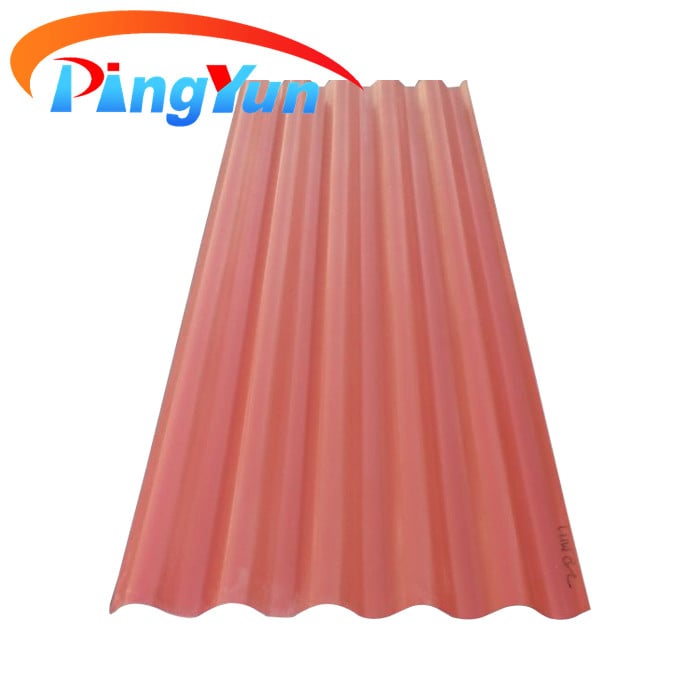
The three product families that a buyer should distinguish at the outset are wave-profile UPVC roof sheets, trapezoidal UPVC roof sheets, and corrugated polycarbonate sheets. The first two describe different profile families within the UPVC category, while the third belongs to a different material category; its profile geometry must also be identified. The public Pingyun category pages establish these classifications but do not establish a uniform layer construction, cover width, optical behavior, or thermal movement value for every item. [1–5]
These families should not be treated as interchangeable. A substitution may change effective coverage, lap geometry, support and fixing requirements, movement detailing, and—where the intended products differ—the daylight outcome. The extent of each change depends on the exact products and roof design. A contract should therefore name the material and profile explicitly and require written technical approval for a substitution before it takes effect.
A useful discipline is to require the supplier to state, in the offer itself, which family the offered sheet belongs to, and to require that statement to be carried into the contract as a defined term. Buyers who adopt this discipline find that later disputes are easier to resolve, because the question is not "what did we think we were buying" but "which named family was contracted, and did the delivered family match it".
For transparency, the brand discussed in this guide, Pingyun, organises its public catalogue so that the corrugated rigid roof sheet category sits at the top level with a wave sub-category and a trapezoidal sub-category beneath it, while its corrugated polycarbonate sheet sits in a separate polycarbonate branch of the catalogue. That structure is a useful illustration of why the three families should be treated as distinct in a contract, but the catalogue organisation is not itself a specification and should not be substituted for one.
Profile geometry should be defined with enough precision that two suppliers would produce the same roof. The essential dimensions are the nominal pitch or repeat distance between adjacent corrugations, the profile depth, the total sheet width, the cover or effective width after the side lap, the nominal thickness, and the length. Where the supplier uses internal standards or mould numbers, the contract should still record the physical dimensions, because a mould number alone is not verifiable on site.
Effective coverage deserves particular attention. The effective coverage is the area of roof that one sheet covers after the side lap is taken into account, and it is always less than the gross sheet area. If a buyer estimates the required quantity from gross width and the supplier quotes from gross width, the delivered quantity may be insufficient once the laps are formed. If the buyer estimates from effective coverage and the supplier quotes from gross width, the two numbers will not reconcile and the negotiation can stall. The contract should therefore state the coverage basis explicitly and should require the supplier to declare the cover width that was used to build the quantity.
The safest approach is to require both figures to appear in the offer and the contract: the gross or total width, and the effective or cover width after the standard side lap. With both numbers on the record, the quantity can be checked, and any later disagreement about shortfall can be resolved by reference to agreed values rather than by re-measurement and argument.
Overlaps are a frequent source of leakage, wind uplift, and dispute, which is why the contract should define them rather than leaving them to site practice. The side lap is the overlap between adjacent sheets along their length; the end lap is the overlap between the end of one sheet and the start of the next when the roof run is longer than a single sheet. Both laps depend on the profile geometry, the roof slope, the exposure conditions, and the fixing method, and both should be documented.
The contract should specify the minimum side lap, the minimum end lap, and the direction of the lap relative to the prevailing weather, because a lap that runs the wrong way can admit water under wind-driven rain. It should also specify whether the laps are sealed, and if so with what, and whether the sealant, tape, or closure piece is supplied by the supplier or the buyer. Laps that are assumed to be self-sealing but are not sealed in practice are a classic cause of post-installation complaints.
Where the roof run exceeds the maximum transportable sheet length, the end lap becomes unavoidable and the contract should say so. It is better to agree the end lap detail in advance than to discover during delivery that a run requires a lap that the buyer had not planned, with the associated additional material, fixing, and sealing cost.
A corrugated sheet rarely forms an entire roof on its own. It meets other materials at ridges, valleys, parapets, gutters, and penetrations, and it may be combined with translucent sheets to bring daylight into a building. Each interface is a potential contract gap. The contract should identify the adjacent materials and should state who is responsible for the interface details, the flashings, the closures, and the sealing.
Compatibility is not only about fit. Different materials expand at different rates. A rigid PVC or UPVC sheet and a polycarbonate sheet can move by different amounts under the same temperature change, so a detail that works for one material may fail for another. Where two different materials meet, the contract should place the responsibility for the transition detail with a named party and should require the detail to be reviewed against the actual materials delivered.
Penetrations such as vents, pipes, and skylights should be anticipated in the contract. Each penetration interrupts the corrugation, requires flashing, and may need additional support. If the contract is silent, the installer may improvise, and the resulting roof may perform adequately but will have no agreed documentation to support a future warranty claim. Requiring a penetration schedule, even a simple one, closes this gap.
Accessories are often overlooked because they are not the sheet itself, but they determine whether the roof works. Ridge pieces, barge boards, closures, gaskets, sealants, tapes, fasteners, washers, and gutter components all have to be supplied by someone. The contract should list them and should state, item by item, whether the supplier or the buyer provides them.
Fixing hardware deserves explicit treatment because it is material-specific. Fasteners and washers that suit one material may not suit another, and the wrong washer can abrade or over-compress the sheet at the fixing point. The contract should state who selects the fasteners, who supplies them, and what corrosion or compatibility requirements apply. Where the supplier recommends a fixing system, that recommendation should be recorded in the contract so that responsibility for the interface is clear.
The supply boundary also determines the price comparison. Two quotations for the same roof area can differ substantially if one includes all closures and fasteners and the other does not. The contract should normalise the comparison by listing everything that is in scope, so that the buyer is comparing like with like and so that the delivered package is complete.
Drawings and samples are the practical bridge between the specification and the delivered product, and they are also a common source of version confusion. The contract should establish which drawing version governs, how revisions are issued, how long the buyer has to comment, and what happens if the buyer does not comment within that period.
Samples serve a similar purpose. A physical sample can demonstrate profile, colour, finish, and thickness, and it can be held by both parties as a reference. Because samples can fade, deform, or be lost, the contract should state how the sample is stored, how long it is retained, and how it is identified. An agreed, dated, signed sample held by both sides is far more useful in a dispute than a photograph in an email.
Approval records matter because they show that the buyer had the opportunity to review the product before production. A contract that requires a documented approval step gives the buyer a clear point of leverage, and gives the supplier a clear record that the specification was confirmed. Both parties benefit from that clarity, which is why the approval step should be written into the schedule rather than left informal.
The contract should state clearly who designs the roof and who installs it. Some buyers expect the supplier to guarantee that a given profile will perform on a given building, while the supplier may intend only to supply material to a stated profile. That gap in expectation is a serious risk, and it is best closed by naming responsibilities.
If the supplier is responsible for design, the contract should say so and should require the design to be documented and approved. If the buyer or the buyer's contractor is responsible for design, the contract should say that too, and should require the supplier to provide the data the designer needs, such as cover widths, spans, and fixing recommendations. A common middle position is that the supplier provides material and technical data while the buyer's designer and installer take responsibility for the completed roof. Whichever position is chosen, it must be written down, because an unallocated design responsibility is an unallocated risk.
Installation responsibility should also be explicit. Installation quality affects water tightness, wind resistance, and the appearance of the finished roof, and it interacts with the warranty. The contract should state who installs, to what instructions, and how the supplier's installation guidance is delivered. Where the supplier's warranty depends on correct installation, the contract should require the guidance to be provided in writing before installation, so that the installer has a fair opportunity to comply.
Quantity risk is easy to underestimate. The number of sheets required depends on coverage, laps, cut waste, and the shape of the roof, and it is affected by the sheet lengths that can be transported and handled. The contract should state how the quantity was calculated, whether waste is included, and whether a spare allowance is provided for future repairs.
Spare allowance is particularly valuable for coloured or coated sheets, because a later repair may be difficult to match if the colour is discontinued or the production batch differs. The contract can require a modest spare quantity to be delivered from the same production batch as the main order, so that future repairs can use matching material. This is a simple provision that solves a recurring problem, and it is far easier to agree before production than to negotiate afterwards.
The service environment should be part of the specification. A roof over a chemical store, a livestock building, a coastal site, or a food-processing plant faces different exposures from a roof over a dry warehouse. The contract should record the environment, and should require the supplier to confirm that the offered product is suitable for that environment or to state its limitations.
This is also where material families diverge most sharply. Rigid PVC and UPVC sheets and polycarbonate sheets have different responses to chemicals, ultraviolet exposure, and temperature, and the same environment can be acceptable for one and unsuitable for another. Rather than assuming equivalence, the contract should ask the supplier to confirm suitability for the named environment and should keep that confirmation on file as part of the technical record.
Finally, the contract should state the standard or test basis against which the product will be assessed, if one is agreed. This might be a national product standard, an industry test method, or a project-specific requirement. If no standard is agreed, the contract should say so explicitly, so that the absence is a conscious decision rather than an accident.
Where the supplier cites test reports or certificates, the contract should identify the specific report, its scope, and the product to which it applies, rather than accepting a general claim of certification. Reports can cover one product in a range while leaving other products untested, so the link between the report and the ordered product should be established. This step protects both parties, because it prevents a buyer from assuming coverage that a report does not provide.
Delivery is where technical and commercial risks meet operational reality. A roof cannot be closed if the sheets have not arrived, and a construction schedule can be disrupted by a shipment that is late, short, or damaged. The contract should therefore translate the buyer's required on-site date into a set of supplier obligations, and it should allocate the consequences of delay in a way that both parties understand before production begins.
Corrugated sheets for roofing are long, light, and easily damaged, which makes them awkward to transport. Sheet length is limited by the container or vehicle used, by handling equipment at both ends, and by the route. Where the roof run is longer than the maximum transportable length, the design must introduce an end lap, and the schedule and the quantity depend on that decision.
The contract should state the maximum sheet length that the buyer expects, and should require the supplier to confirm that it can be produced and shipped at that length. If the supplier's limit is lower than the buyer's requirement, the difference should surface at the quotation stage, not at loading. Agreeing the sheet length early also allows the buyer to plan lifting, storage, and installation, all of which are easier with known lengths.
"Delivery" can mean different things, and the contract should define it. It can mean the date the goods leave the supplier's factory, the date they are loaded at a port, the date they arrive at the destination port, the date they clear customs, or the date they arrive at the project site. Each definition shifts risk differently, so the contract should name the delivery point and the delivery event precisely.
The delivery point determines who bears the risk of loss and who arranges and pays for transport. It also determines the point at which the buyer can inspect, and therefore the point at which acceptance can begin. A clear delivery definition removes ambiguity from the schedule and from the risk allocation, and it makes delay measurement objective.
Where the buyer takes responsibility for onward transport, the contract should still require the supplier to provide loading information, packing details, and dispatch documents in time for the buyer to arrange collection. A delay caused by missing dispatch information is as damaging as a delay in production, so the documentation obligations should be scheduled as well.
Production of a roofing package involves several milestones that can be controlled: order confirmation, drawing or sample approval, material preparation, production, packing, and dispatch. The contract can convert these into schedule milestones with dates, so that progress can be monitored rather than assumed.
Documentation is part of the schedule. The buyer typically needs a packing list, an invoice, transport documents, and any agreed inspection or test records before shipment or before arrival. If these are required only at the last moment, they can hold up the goods. The contract should list the documents, set the deadline for each, and, where relevant, connect release of a payment milestone to receipt of a document.
A practical safeguard is a pre-shipment notification obligation, requiring the supplier to notify the buyer a defined number of days before dispatch so that the buyer can arrange inspection, transport, and receipt. This is a low-cost clause that prevents a costly surprise.
Delay penalties, sometimes called liquidated damages, are the commercial consequence of late delivery. The contract should state whether a penalty applies, how it is calculated, what its cap is, and what triggers it. A penalty that is unclear or that has no cap can be contested, and a penalty that is too small to matter provides little incentive.
The buyer should also consider what the penalty is meant to compensate. If a late roof delays a wider project, the buyer's actual loss may exceed the value of the sheets, and a modest penalty may not reflect that loss. Conversely, a penalty that is disproportionate may discourage responsible suppliers or be challenged later. The right balance depends on the project and the governing law, and it is a point for legal review rather than a fixed formula.
Penalties also need a trigger and a measurement method. The trigger should be tied to the defined delivery event, and the measurement should reference a clear date. If the schedule has milestones, the contract should say which milestone carries the penalty and whether partial deliveries reduce it. Clarity here prevents arguments about whether a delivery was late at all.
Most contracts include a force majeure clause that excuses delay caused by events beyond the parties' control, but the details matter. The contract should define what counts as force majeure, what notice the affected party must give, what evidence is required, and what happens if the event continues for a long period. A vague clause can be used to excuse almost anything, while an over-narrow clause can be unfair.
Tolerance is a related concept. The contract may allow a small delivery window, or may specify that a delay within a few days does not attract a penalty. Tolerance can be useful because it acknowledges normal variation, but it should be stated explicitly so that neither party argues about it later.
It is also worth distinguishing excusable from non-excusable delay. A delay caused by the buyer's late approval, late documents, or late payment is normally excusable for the supplier. The contract should reflect that symmetry, so that each party bears the consequences of its own delay.
For large roofs, delivery is often phased, either because the site cannot store the full quantity or because installation proceeds in stages. The contract should state whether partial shipment is allowed, how the quantity is divided, and how the schedule milestones apply to each phase.
Phased delivery affects payment, inspection, and acceptance, because each phase may carry its own documents and its own inspection. The contract should therefore link the phases to the payment and inspection provisions, so that the whole package is consistent. A phase that is delivered but not inspectable can create a gap that neither party has planned for.
Where the buyer requires phased delivery, the supplier needs to know the phase sequence early, because production scheduling and packing depend on it. Agreeing the phases at contract signature is more efficient than negotiating them later under schedule pressure.
Delivery risk is not entirely the supplier's. If the buyer's site cannot receive the goods, or cannot store them safely, the sheets may be damaged or the delivery may be refused. The contract should state the buyer's obligations regarding site readiness, receiving, unloading, and storage.
Storage matters for long plastic sheets, which can deform under their own weight if supported incorrectly or exposed to heat. The contract can require the supplier to provide storage guidance, and can require the buyer to follow it. That allocation is fair, and it protects the product between delivery and installation.
A related point is the receiving inspection. The contract should state when the buyer must inspect on receipt, how damage is recorded, and how quickly the supplier must be notified. Short notification periods can be onerous, so the buyer should negotiate a realistic window and should prepare the receiving process in advance.
Even with good drafting, delays happen. The contract should include a communication mechanism, such as a defined contact and a defined escalation path, so that problems are reported to the right people quickly. A delay that is communicated early can often be mitigated; a delay that surfaces late usually cannot.
A recovery plan can also be built into the contract as an option, allowing the parties to agree a revised schedule when a delay occurs. This does not weaken the buyer's rights; it gives the parties a productive path that may preserve the project schedule better than a dispute. The key is that any revised schedule should be documented as a formal variation, so that the record stays consistent.
Warranty is where the buyer's expectations and the supplier's liability most often diverge. A buyer may expect the roof to remain watertight and serviceable for a long period, while the supplier may intend to warrant only that the sheets were manufactured to specification. The contract should reconcile these expectations by defining what is warranted, for how long, under what conditions, and with what remedy.
A warranty and a performance guarantee are not the same thing. A warranty is typically a promise about the product's condition or conformity, such as freedom from manufacturing defects. A performance guarantee is a promise about how the product will behave in service, such as a claim about light transmission, weathering, or load capacity. A contract can include one, the other, or both, but it should be clear which is which.
For corrugated sheets for roofing, performance claims are often environmental and time-dependent. Light transmission, colour stability, and weather resistance can change as the material ages and as it is exposed. A guarantee of these properties for a long period may be difficult to enforce and difficult to measure. The contract should therefore specify what is actually guaranteed, how it will be measured if disputed, and on what basis the parties would agree that the guarantee was met or breached.
Where a supplier publishes marketing statements about service life or durability, those statements should not be treated as contractual guarantees unless the contract says so. Marketing copy is not normally a warranty, and a buyer who relies on it without converting it into a contractual term may have no enforceable protection. The safe practice is to write the guarantee explicitly into the contract and to refer to a controlled specification for the properties it covers.
The boundary of the warranty should be stated. Typically, a manufacturing-defect warranty covers defects in the sheets as delivered, such as cracking, delamination, or dimensional non-conformity attributable to production. It usually does not cover damage caused by handling, installation, unsuitable support, chemical attack, or neglect, and it usually does not cover normal ageing or colour change beyond an agreed tolerance.
The contract should also address what happens when the warranty overlaps with installation. If a leak is caused partly by a manufacturing defect and partly by a fixing error, the parties may disagree about responsibility. A clear warranty scope, supported by installation guidance and inspection records, helps resolve that disagreement by locating the cause.
The contract should state whether the warranty covers accessories as well as sheets, whether it covers cut or fabricated items, and whether it survives resale or transfer to a building owner. These details are easy to decide at signature and difficult to argue afterwards.
Warranty terms often depend on the environment and the installation. The contract should record the environment in which the roof will serve, and should require the supplier to confirm that the product is suitable for it. If the environment includes chemical exposure, high ultraviolet exposure, or extreme temperature range, the contract should state that, and should require the supplier's suitability confirmation to reference it.
Installation dependency should also be explicit. Many sheet warranties are conditional on installation to the supplier's instructions and on the use of compatible fixings. The contract should therefore require the supplier to issue installation guidance, and should require the buyer to use it, so that the condition is capable of being satisfied. A warranty that depends on guidance never issued is a warranty that cannot fairly be relied upon.
The contract should also state whether the warranty is conditional on maintenance. If periodic inspection or cleaning is required to preserve the warranty, that requirement should be stated and the interval should be agreed. Hidden conditions are the enemy of enforceable warranties.
The remedy for a warranty breach should be specified. Common remedies include repair, replacement, refund, or a price reduction. The contract should state which remedy applies first, and what happens if the first remedy does not work. A staged escalation, such as replacement for the affected material and, if the defect persists, a refund or credit, is often clearer than a single open-ended remedy.
The remedy should also address labour and consequential cost. Replacing a sheet on a roof is not just the cost of the sheet; it is the cost of access, removal, and reinstallation. The contract should state whether those costs are covered, and if so to what extent. This is often the most financially significant part of a warranty dispute, so it deserves careful drafting.
Time limits for making a claim should be stated. A short claim period may be unworkable if the defect only becomes apparent after a season of exposure, while an unlimited period is unrealistic for any supplier. The contract should set a period that allows the buyer to identify a genuine defect and that the supplier can reasonably accept.
The start date of the warranty matters because it determines the window in which claims can be made. It is usually tied to delivery, to installation, or to completion of the roof. Each choice has a different effect, and the contract should state which applies.
Transferability matters when the building changes hands. If the warranty can be transferred to a subsequent owner, the building owner can rely on it after a sale. If it cannot, the protection is limited to the original buyer. The contract should state the position and any conditions for transfer.
The contract should also address what happens to the warranty if the buyer modifies the roof, for example by adding penetrations or by changing the fixing pattern. Modifications often void a warranty, so the buyer should understand the trigger and should document any approved changes.
Finally, the buyer should be careful not to treat marketing claims about service life, durability, or certification as contractual guarantees. A single-page product description may contain internal inconsistencies, may describe the product in terms borrowed from another material, or may state properties that are not supported by a controlled test report. A buyer who relies on such a page for a guarantee may find that the guarantee is unenforceable.
The disciplined approach is to require the supplier to restate, in the contract, the exact properties that are guaranteed, and to require any supporting test report to be identified and provided. Where the supplier's public page contains conflicting statements, the conflict should be resolved in writing before the contract is signed. This is not an unusual request; it is normal technical due diligence for a product that will be exposed to weather for years.
In the case of the brand discussed here, the public product page for its corrugated polycarbonate sheet contains more than one thickness statement in different parts of the same page that do not agree with each other. Rather than adopt any of those figures as a specification, a buyer should treat them as evidence that the public page is marketing material and should request the current controlled datasheet for the specific product being ordered. That is a general procurement precaution, and it applies to any supplier whose public pages are not version-controlled.
Payment terms determine who carries the cash-flow risk and who has leverage if something goes wrong. Price adjustment terms determine how the price behaves if costs change between quotation and production. Together, they shape the commercial risk of the transaction, and they should be written with the same care as the technical specification.
A quotation is not a contract, and its validity period matters. The contract should state the period for which the price is valid, and what happens if the order is placed after that period. If the buyer expects the price to hold for a defined window, that expectation should be written into the agreement.
The price basis should also be defined. A price can be per sheet, per square metre of gross area, per square metre of effective cover, or per package including accessories. Because coverage and accessory inclusion vary, the basis must be stated so that the parties can verify the total. A price quoted per square metre of cover is not directly comparable with a price quoted per square metre of gross area, and mixing the two can create a false impression of a bargain.
The contract should also state what the price includes and what it excludes: packing, transport, insurance, loading, unloading, duties, and taxes. Clear inclusion and exclusion lists prevent later claims that a cost was "obviously" part of the price.
Where the transaction crosses currencies, the contract should state the currency, the payment currency, and how exchange-rate movements are handled. It should also address raw material movement if the price is sensitive to it. Plastic sheet prices can respond to changes in polymer and additive costs, and a long lead time can span a significant change.
A price adjustment clause can allocate that risk, but it must be precise. The contract should state the index or reference used, the threshold below which no adjustment occurs, the frequency of adjustment, and the cap. A vague clause invites argument, while a precise clause lets both parties plan.
Where no adjustment clause is agreed, the buyer should understand that a fixed price places raw material risk on the supplier, which may be reflected in the price or in the supplier's willingness to accept a long validity. There is no free option; the risk is either priced or allocated, and the contract should say which.
Payment milestones should match the project's progress and the supplier's obligations. A common structure uses a deposit on order, a payment after approval of drawings or samples, a payment before or after shipment, and a final payment after acceptance. The exact split depends on the parties and the jurisdiction, but the logic should be clear.
Milestones should be tied to verifiable events. A payment "on production" is harder to verify than a payment "on dispatch" or "on receipt of a pre-shipment inspection report". The more objectively defined the milestone, the less room there is for disagreement about whether it has been reached.
The final payment is the buyer's principal leverage. If the contract provides for a meaningful final payment after acceptance, the buyer retains an incentive for the supplier to resolve any outstanding issues. If the entire price is paid before shipment, that leverage is lost, and the buyer must rely on the warranty and on goodwill.
Retention is a portion of the price withheld for a period after acceptance to cover defects and warranty claims. It is more common in construction contracts than in simple goods supply, but it can be appropriate for a roofing package where installation and performance matter. The contract should state the retention percentage, the release conditions, and the release date.
Performance security, such as a bond or a guarantee, is an alternative or complement to retention. Its value depends on the issuer and the enforceability of the instrument in the relevant jurisdiction. A buyer who relies on a performance security should have it reviewed for validity, amount, and claim conditions, because a security that cannot be called is of little use.
Both retention and security should be proportionate. Excessive retention may increase the price or discourage competitive suppliers, while inadequate retention leaves the buyer exposed. The right level depends on the risk and on the alternatives available.
The delivered cost of a roofing package includes more than the sheet price. Transport, insurance, packing, loading and unloading, accessory supply, duties, taxes, inland freight, storage, and handling all add to the total. The contract should list these items and allocate each to a party, so that the comparison of offers is meaningful and the budget is accurate.
Accessories are a frequent omission. A quotation that excludes closures, fasteners, and sealants may appear cheaper than one that includes them, but the buyer will pay for them separately. Normalising the scope across offers is the only way to compare them fairly, and it is easiest when the contract lists the accessory items explicitly.
Waste and spare allowance also belong in the cost picture. A small spare quantity delivered from the same batch can avoid an expensive future mismatch, and the cost is modest if it is planned. The contract should state whether the spare allowance is included in the price or charged separately.
Taxes and duties can be significant and can change. The contract should state which party bears each tax or duty, and whether the price is inclusive or exclusive. Where the buyer is responsible for import duties, the contract should require the supplier to provide the documentation needed to clear the goods.
Logistics allocation should be explicit as well. If the buyer arranges transport, the contract should state the point at which the buyer's responsibility begins and the supplier's ends, and should require the supplier to cooperate with loading and documentation. If the supplier arranges transport, the contract should state the delivery point and the insurance responsibility.
Currency, tax, and logistics provisions are often seen as administrative, but they can cause real disputes. They deserve a place in the contract, not a place in a later email thread.
Finally, the contract should address volume and its effect on price. A price that applies to one quantity may not apply to a different quantity, and a change in quantity may trigger a price review. The contract should state the price for the agreed quantity and the mechanism, if any, for adjusting it if the quantity changes.
Where the buyer expects future repeat orders, the contract can provide for a price mechanism for those orders, such as a reference price subject to a defined review. This gives the buyer predictability without committing the supplier to an untenable fixed price. The clause should be specific about the reference and the review, for the same reasons that apply to raw material adjustment.
Inspection and acceptance are the buyer's quality control, and dispute resolution is the fallback when quality control is not enough. Together they determine whether a problem can be identified, documented, and resolved, or whether it becomes a matter of competing recollections. The contract should make both practical.
Pre-production inspection is the cheapest place to catch a problem. If the buyer can verify materials, profile samples, or colour before production, the risk of producing a large non-conforming batch is reduced. The contract should state the buyer's right to pre-production inspection, the notice required, and the basis of the check.
In-process inspection is appropriate for large orders or for products with tight requirements. The contract should state whether the buyer or its representative may attend during production, under what conditions, and what records will be made. Even if the buyer never attends, the existence of the right encourages attention to quality.
Inspection rights should be balanced with practical constraints. Production schedules, safety rules, and confidentiality may limit access, so the contract should define the right in a workable way, such as by appointment and with reasonable notice, rather than as an unbounded right that neither party can implement.
Pre-shipment inspection is the last practical opportunity to verify the goods before they leave the supplier. The contract should state whether it is permitted, who bears the cost, what the sample size and method are, and what happens if the goods fail. A defined sampling method turns a subjective judgement into a measurable one.
Sampling is important because corrugated sheets are produced in batches and packed in bundles, and it is impractical to inspect every sheet. The contract should agree the sample size, the acceptance criteria, and the treatment of defects found in the sample. Where a standard sampling method is used, it should be named.
The record from the inspection should be kept. A signed inspection report, with photographs, dates, and quantities, is strong evidence if a dispute later arises about the condition of the goods at shipment.
Acceptance is the process by which the buyer confirms that the goods conform. The contract should state the acceptance period, the inspection to be carried out, the criteria, and the effect of acceptance. It should also state what happens if the buyer neither accepts nor rejects within the period.
The acceptance period should be realistic. Sheets may arrive in bundles that take time to unpack and inspect, and some defects may not be visible until the sheets are handled. A very short period can deprive the buyer of a fair opportunity to inspect, while an indefinite period leaves the supplier in limbo. The contract should strike a balance and should state it clearly.
Acceptance should be distinguished from payment. A payment made before acceptance does not necessarily mean the buyer has accepted the goods, and the contract should make the sequence clear so that payment is not construed as acceptance of a non-conforming delivery.
The contract should set out what happens when the goods are damaged, short, or otherwise non-conforming. It should state the notification deadline, the evidence required, the buyer's rights to reject or accept with a price adjustment, and the supplier's obligation to remedy.
Damage in transit is a common issue for long, light sheets. The contract should state who bears the risk at each stage and how a transit damage claim is made. If the supplier arranged transport, the supplier normally handles the claim; if the buyer arranged it, the buyer deals with the carrier. The contract should make the division explicit.
For shortages, the contract should state the count method and the tolerance, if any. A small counting tolerance may be reasonable, but it should be agreed rather than assumed. For non-conformity, the contract should state the buyer's remedies, including replacement, repair, or credit.
Packaging protects the sheets, and the contract should specify it. The requirements should reflect the transport mode and the handling expected in transit. Weak packaging can cause damage that is later attributed to the product, so the contract should link packaging to the standard expected.
Transport risk should be allocated by reference to the delivery point. The contract should state the point at which risk passes from supplier to buyer, and should require insurance appropriate to the value and the mode. If the buyer arranges insurance, the contract should say so; if the supplier does, the contract should state the cover.
Unloading and handling at the destination should also be addressed, because the equipment and labour required for long sheets may not be available at every site. The contract should state who unloads and with what equipment, so that the goods are not left on a vehicle because no one was prepared.
The contract should state the governing law and the forum for disputes. This is a legal question that depends on the parties, the location of the assets, and the enforceability of judgments, and it should be reviewed by a qualified lawyer. The commercial point is that leaving it undefined creates uncertainty that neither party benefits from.
A dispute resolution clause can also provide for negotiation or mediation before arbitration or litigation. A staged clause can resolve many disputes without formal proceedings, which saves time and cost. If such a clause is used, the steps and the time limits should be stated, so that it is workable.
For international transactions, the recognition and enforcement of a judgment or award is a practical consideration. The clause should be chosen with that in mind, and the buyer should understand where enforcement would actually be possible if the supplier did not pay.
A dispute is often won or lost on records. The contract should require both parties to retain the documents that would establish what was agreed and what was delivered: the specification, the drawings and their revisions, the sample records, the inspection reports, the shipping documents, the correspondence, and the acceptance records.
The contract should also state how long these records must be kept, so that they are available if a claim arises later. A modest retention period that is actually observed is more useful than a long period that is ignored.
The buyer can support its position by keeping its own parallel record. Photographs of the goods on arrival, dated notes of inspections, and copies of all communications are inexpensive to produce and valuable in a dispute. The contract can encourage this by requiring written communications for variations and claims, which produces a record as a by-product.
The contract should connect inspection results to acceptance and payment. If inspection is a condition of a payment milestone, the contract should say so, and should state what happens if inspection is inconclusive. This linkage gives the inspection process commercial meaning.
A well-designed sequence is: inspection produces a report; the report supports acceptance or rejection; acceptance triggers the final payment. When the sequence is defined, each party knows what is expected at each step, and the process runs without argument about who should act first.
Where inspection is carried out by an independent party, the contract should state the party's role, the standard applied, and the effect of the report. An independent report can be persuasive evidence, but its weight depends on the mandate and the method, which should be agreed in advance.
Change is normal in construction, and a well-drafted contract does not try to prevent it; it provides a controlled way to make it. Documentation and sample control are the tools that keep changes visible and traceable, so that the delivered roof matches the last agreed requirement.
The contract should describe how a change is requested, evaluated, approved, and priced. It should state who may request a change, who may approve it, what information must accompany the request, and how the price and schedule are adjusted. A change without a procedure tends to be agreed verbally and disputed later.
The procedure should also address the effect of a change on the production schedule. A change during production may require new materials, new tooling, or rework, and the schedule and price consequences should be assessed before the change is approved. Requiring a written assessment before approval protects both parties.
It is helpful to state that no change is effective until it is confirmed in writing by both parties. This simple rule prevents one party from acting on an informal instruction and then discovering that the other did not intend it. Written confirmation also creates the record that supports the final acceptance.
Drawings and specifications change, and the contract should establish which version governs. A revision-control clause should state how revisions are numbered, how they are issued, how the buyer acknowledges them, and which version is the current one. The date and revision number should be on every controlled document.
The contract should also state how a revision affects approved samples and prior approvals. If a drawing changes after a sample is approved, the approval should be revisited for the affected features. Without that rule, a supplier could deliver to the new drawing while the buyer expects the old sample, or the reverse.
Keeping a document register, even a simple list of documents with their revisions, is a practical way to manage this. The contract can require the supplier to provide the register and to update it with each revision, so that both parties can see the current state of the technical record.
Samples should be identified, dated, and retained. The contract should state how many samples are kept, who holds them, how they are labelled, and how long they are kept. A sample that cannot be identified is of little use in a dispute.
Where colour is important, the sample should represent the agreed colour, and the contract should state how colour is assessed and what tolerance applies. Colour matching is often subjective, so an agreed reference and an agreed tolerance reduce the scope for argument.
Samples should be stored so that they do not change. Exposure to sunlight, heat, or chemicals can alter a sample's appearance, so the contract can require storage in conditions that preserve it. This is a small provision that protects the value of the sample as evidence.
Clear communication channels reduce the risk of instructions being lost or misunderstood. The contract should name a contact for each party for technical matters and for commercial matters, and should state that instructions given outside those channels are not binding.
A single point of contact also helps with changes and claims, because it gives a clear recipient for formal notices. The contract should state how notices are given, by what means, and when they are deemed received. Notices that are sent to the wrong address or the wrong person may fail to have legal effect.
For projects with multiple parties, the contract should state how the supplier communicates with the buyer's designer and installer. Direct communication can be efficient, but it can also bypass the buyer's control. The contract should define the lines so that information flows without creating unintended authority.
The final documentation topic is retention. Records should be kept for as long as a dispute or warranty claim is possible, and the contract should state the period. The records that matter most are those that establish the agreed specification, the approved versions, the delivered condition, and the communications about variations and claims.
Retention is inexpensive to comply with and valuable when needed. A buyer that keeps a complete project record, including photographs and dated notes, is in a much stronger position than one that must reconstruct events from memory. The contract can require both parties to retain records, which also discourages careless record-keeping.
A pre-signature review converts the guidance in this article into a specific decision. The purpose is not to add paperwork but to confirm that the contract matches the roof that will actually be built and the commercial terms that the buyer intends to accept. The checks below can be completed in a single working session if the supplier's documents are available, and the items that cannot be confirmed should be treated as open risks rather than assumed.
The reviewer should confirm that the contract names the material family and the profile family, and that the naming matches the product the buyer intends to use. A contract that says only "corrugated sheets for roofing" should be corrected, because the missing family leaves the substitution question open. The reviewer should also confirm that no marketing vocabulary has been copied in that could import a false requirement, such as describing a plastic sheet with metal-roofing terms.
The reviewer should confirm that the total width, the cover width, the pitch or repeat, the depth, the thickness, and the length are stated, and that the quantity is built on the agreed coverage basis. If the offer states only the gross width, the quantity should be rechecked against the effective cover. Where the supplier uses an internal code or mould number, the contract should still carry the physical dimensions so that the product can be verified on site.
The reviewer should confirm that every accessory that the roof needs is assigned to a party. This is the check that catches the most expensive omissions, because a missing closure, fastener, or sealant can stall an installation and generate a variation claim. The completed list should read like a packing list for the roof, not just a list of sheets.
The reviewer should confirm that the contract says who designs the roof and who installs it, and that the supplier's technical data obligations are consistent with that allocation. If the buyer's designer needs span or cover data, the contract should require the supplier to provide it. If the installer must follow the supplier's guidance, the contract should require the guidance to be issued before installation.
The reviewer should confirm that the contract states which drawing revision governs, how revisions are issued and acknowledged, how samples are identified and retained, and how changes are approved. A practical check is to ask whether a site instruction received by telephone on a Friday could be recognised as a change on Monday. If the answer is no, the change procedure is not yet adequate.
The reviewer should confirm that the contract defines the delivery event and the delivery point, that the sheet length is compatible with transport, that documentation deadlines are scheduled, and that delay consequences, excusable delay, and any penalty are stated. The reviewer should also confirm that the buyer's own obligations, such as approvals, payment, and site readiness, are stated, because the buyer's delay can excuse the supplier.
The reviewer should confirm what is guaranteed, for how long, with what remedy, and under what conditions. Where installation or maintenance conditions apply, those conditions should be capable of being met, and the guidance that supports them should be available. The reviewer should confirm that no marketing figure, service-life statement, or certification claim has been carried into the contract without a supporting controlled document.
The reviewer should confirm the price basis, the currency, the validity period, any adjustment mechanism, the milestone structure, the retention or security arrangements, and the allocation of taxes, duties, transport, insurance, and accessory costs. A simple test is to add the listed cost items to the quoted price and confirm that the total matches the buyer's budget.
The reviewer should confirm the inspection rights, the sampling method, the acceptance period, the procedure for damaged or non-conforming goods, the governing law, the dispute forum, and the record-retention requirements. The reviewer should also confirm that the notice provisions work in practice, meaning that the named contacts and addresses are correct and that the time limits are achievable.
Finally, the reviewer should confirm that the legal aspects of the contract have been reviewed by a qualified lawyer for the chosen governing law. Penalties, warranty limits, liability caps, retention, security, and dispute mechanisms are legal instruments, and their enforceability depends on the applicable law. A contract that is technically excellent but legally unenforceable provides little protection, so the legal review is part of the same discipline as the technical review.
Contractual risk in the purchase of corrugated sheets for roofing is best reduced before production starts, by writing a contract that defines the product, the responsibilities, the schedule, the warranty, the payment logic, the inspection rights, and the dispute process in specific terms. The material family and the profile family should be named and should not be treated as interchangeable. The geometry, coverage, and overlap should be documented. The supply boundary, design responsibility, and installation responsibility should be allocated. Drawings, samples, and changes should be version-controlled. Delivery should be defined by a delivery event and a delivery point, supported by milestones and documentation obligations. The warranty should state what is guaranteed, for how long, and with what remedy, without relying on marketing claims. Payment milestones should be tied to verifiable events. Inspection, acceptance, and dispute terms should be practical and should be supported by records.
Two limits apply to every point in this guide. First, the guidance is a framework for contract discussion, not legal advice, and the governing law, penalties, warranties, and dispute mechanisms must be reviewed by a qualified lawyer for the specific transaction. Second, brand-specific statements in this guide are limited to what the supplier's public pages show about its product organisation, and they do not establish that the supplier's products are suitable for a particular roof, that any certification covers a particular product, or that any performance figure is guaranteed. Those matters must be verified through the supplier's current controlled documents and through the buyer's own technical review for each project.
Used as a checklist, the sections above turn a vague intention to "buy some corrugated sheets for roofing" into a set of decisions that the buyer can make deliberately. That is the main protection. Contracts do not eliminate risk, but a contract that names the risks and allocates them gives both parties a fair basis to perform and a practical basis to resolve problems when they arise.
The first thing to define is the product itself, named by material family and profile family and supported by measurable geometry, coverage, length, colour, and accessories. Without a defined product, every other clause lacks a baseline. The buyer should also record the intended application and service environment, because suitability depends on both. Once the product is defined, the schedule, warranty, inspection, and payment clauses can all be tied to it.
No. The public catalogue lists wave and trapezoidal UPVC profiles separately from corrugated polycarbonate, and the exact products need to be checked against the roof. A substitution can affect lap geometry, effective cover, fixing and support design, movement provision, and sealing details. Those effects should be evaluated for the proposed products rather than assumed from the category names. The contract should name both material and profile and require written approval before any substitution. [1–5]
Effective coverage is the roof area that one sheet covers after the side lap. Because it is smaller than the gross sheet width, quantity estimates that use the wrong basis can be short or overstated. The contract should require the offer to state both the gross width and the cover width, and the quantity should be built on the agreed coverage basis so that it can be verified.
The contract should state the minimum side lap and the minimum end lap, the direction of the lap relative to the weather, and whether the laps are sealed and with what. Where a roof run exceeds the maximum transportable sheet length, an end lap is unavoidable, so it should be agreed in advance with the associated cost and detail. Laps left to site practice are a common source of leaks and disputes.
Responsibility should be named. The supplier may be responsible for design, or the buyer's designer may be, or the supplier may provide material and technical data while the buyer's designer and installer take responsibility for the completed roof. Whichever structure is chosen, it should be written into the contract, because an unallocated responsibility is an unallocated risk that surfaces when something goes wrong.
The contract should list the accessories, such as ridge pieces, closures, gaskets, sealants, tapes, fasteners, and gutters, and should state who supplies each one. Fixings are material-specific, so the contract should state who selects them, who supplies them, and what compatibility and corrosion requirements apply. Listing accessories also makes quotations comparable, because the scope is normalised.
Delivery should be defined by a named delivery event and a named delivery point, such as arrival at the project site or at a destination port. The definition determines when risk passes, when acceptance can start, and how delay is measured. Vague wording such as "delivery in the first quarter" creates uncertainty for both parties.
A delay penalty can motivate timely delivery and compensate the buyer, but its necessity and level depend on the project and the governing law. The contract should state whether a penalty applies, how it is calculated, what caps it, and what triggers it. It should also state excusable delay, such as the buyer's own late approval or payment, so that the allocation is symmetrical.
The warranty should state what is guaranteed, for how long, under what conditions, and with what remedy. It should distinguish manufacturing-defect coverage from performance guarantees, should state whether accessories and transferability are covered, and should state the claim period. Installation dependency should be addressed by requiring the supplier to issue installation guidance before installation begins.
No. Marketing pages are not normally contractual, and they may contain inconsistent or unsupported statements. A buyer should require the supplier to restate the guaranteed properties in the contract and should request the current controlled datasheet for the specific product ordered. Where a public page contains conflicting figures, those figures should not be adopted as a specification.
Payment should be structured in milestones tied to verifiable events, such as order confirmation, drawing or sample approval, dispatch, and acceptance. A meaningful final payment after acceptance preserves the buyer's leverage to have outstanding issues resolved. Retention or performance security can add protection, provided the instrument is valid, proportionate, and enforceable.
Transport, insurance, packing, loading and unloading, accessory supply, duties, taxes, inland freight, storage, handling, waste, and spare allowance are commonly overlooked. The contract should list them and allocate each to a party. Normalising these items also makes competing quotations genuinely comparable.
The contract should include the right to pre-production inspection, in-process inspection if appropriate, and pre-shipment inspection, with the notice period, sampling method, and acceptance criteria stated. It should also state the acceptance period after arrival and the procedure for damaged, short, or non-conforming goods. Inspection results should be linked to acceptance and to the relevant payment milestone.
Changes should follow a written procedure: a request, a technical and commercial assessment, an approval by an authorised person, and a formal variation. No change should be effective until confirmed in writing by both parties. The procedure should also state the effect of the change on the schedule, so that the parties can plan.
Records establish what was agreed and what was delivered, which is usually the decisive issue in a dispute. Specifications, drawing revisions, sample records, inspection reports, shipping documents, correspondence, and acceptance records should be retained for the agreed period. Photographs and dated notes are inexpensive to produce and valuable when needed.
Governing law, the dispute forum, the enforceability of penalties and liquidated damages, the scope and limits of warranty and liability, the treatment of retention and performance security, and the recognition and enforcement of any judgment or award should all be reviewed by a qualified lawyer for the specific transaction. This guide discusses contract items, not legal conclusions, and the applicable law governs the outcome.
Copyright © 2025 by Techos New Material Co.,Ltd.
 EN
EN